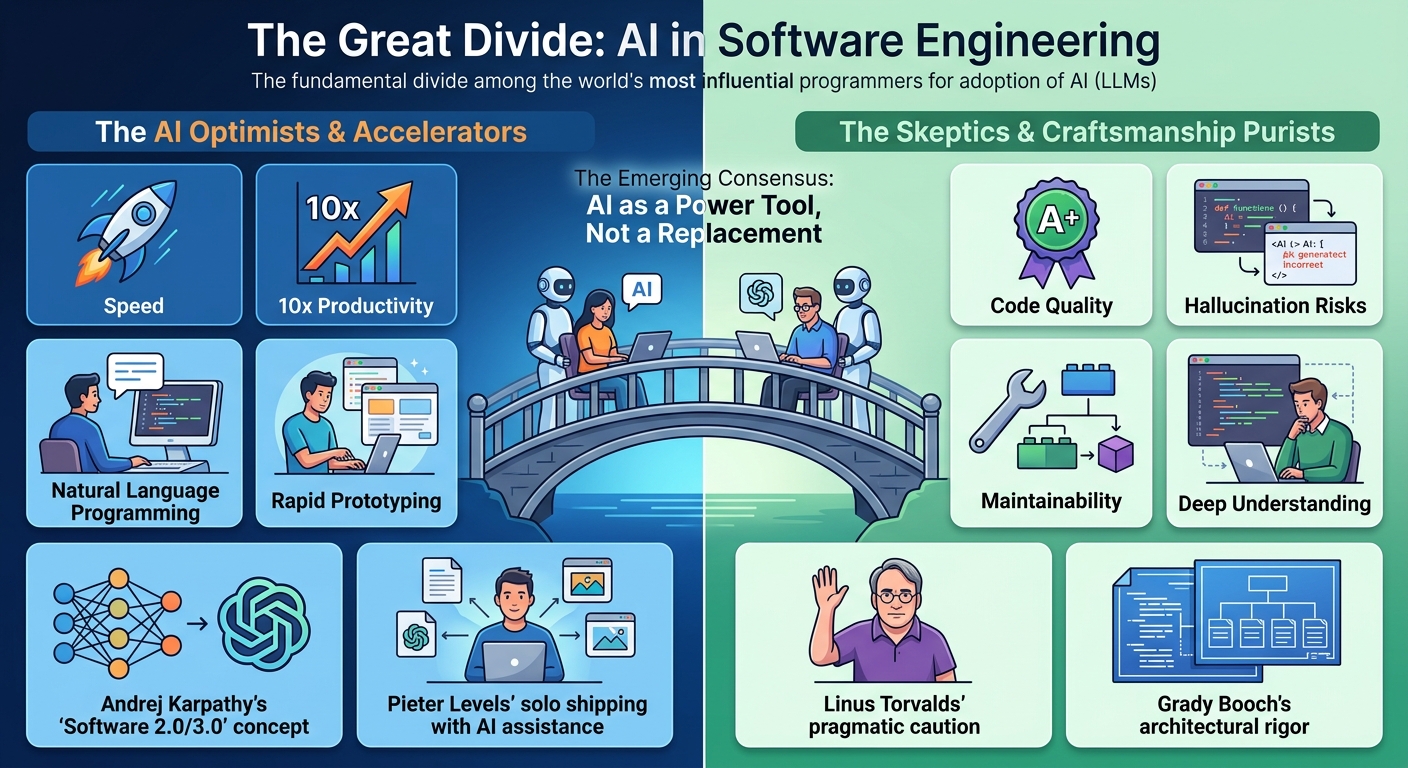
The video explores a fundamental divide among the world’s most influential programmers regarding the adoption of AI (LLMs) in software engineering.
It frames this as a “war” between those who view AI as a catastrophic mistake that erodes software quality and those who see it as an inevitable evolution that drastically multiplies productivity. The discourse is categorized into four philosophical camps: absolute skeptics, full converts, pragmatic maintainers, and constraint-driven architects.
Historic Context, Facts, and Persons
The Skeptics (Against AI)
- George Hotz: A pioneer in jailbreaking. After an initial period of hype in 2023, he published “The Eternal Slop Timber” in May 2026, arguing that AI agents are “stochastic parrots” that mimic code without understanding, leading to costly long-term mistakes.
- Jonathan Blow: Indie game developer (Braid, The Witness) and creator of the
Jailanguage. He maintains a strict ban on LLM-generated code in his company, viewing it as “obviously terrible.” - Bjarne Stroustrup: The creator of C++. He argues that while AI might handle trivial code, it is unfit for the critical 20% of software that requires safety and performance, effectively “unfixing 40 years of software progress.”
- Edsger W. Dijkstra: Mentioned as a historical titan who considered the notion of natural language as a programming language to be “idiotic.”
The Converts (For AI)
- Andrej Karpathy: Co-founder of OpenAI and former Tesla Autopilot lead. He introduced “Vibe Coding” and transitioned away from writing most of his code by hand by 2026.
- Steve Yegge: An industry veteran who claims to have produced a million lines of code in a year via AI, accepting high-risk failures (like wiped production passwords) as a trade-off for 10x speed.
- David Heinemeier Hansen: Creator of Ruby on Rails. Initially skeptical, he eventually conceded that the models had become “good enough” to be useful.
The Pragmatists and Constraint-Driven
- Linus Torvalds: Creator of Linux. Initially ignored the hype but eventually accepted AI tools in the Linux kernel. He acknowledges the operational burden of “AI-assisted” code (bloated PRs) but values the ability of AI to find long-hidden bugs.
- Kent Beck: The creator of Test-Driven Development (TDD). He believes 90% of traditional coding skills have lost their value and uses TDD as a “steering wheel” to guide AI agents.
- Robert C. Martin (Uncle Bob): The author of Clean Code. In a surprising shift, he has stopped reading AI-generated code entirely, instead surrounding agents with a “gauntlet” of extreme automated constraints (mutation testing, Gherkin tests, etc.) to ensure quality.
Technical Discoveries and Consequences
Key Concepts
- Stochastic Parrots: The theory that LLMs only mimic the statistical distribution of training data without any internal functional reasoning.
- Vibe Coding: A shift toward high-level intent and rapid iteration over precise syntax and manual implementation.
- Constraint-Based Engineering: Shifting the role of the programmer from writer to architect of constraints, where the goal is to build “prison walls” (tests) so tight that incorrect code cannot pass.
Consequences
- Productivity vs. Technical Debt: The trade-off between massive increases in output speed and the inheritance of “bloated repos” and subtle, undocumented bugs.
- Devaluation of Syntax: A shift in professional value from the ability to write “clean code” to the ability to design rigorous validation systems.
- Operational Fatigue: The “code review fatigue” caused by the sheer volume of AI-generated contributions in critical projects like the Linux kernel.
