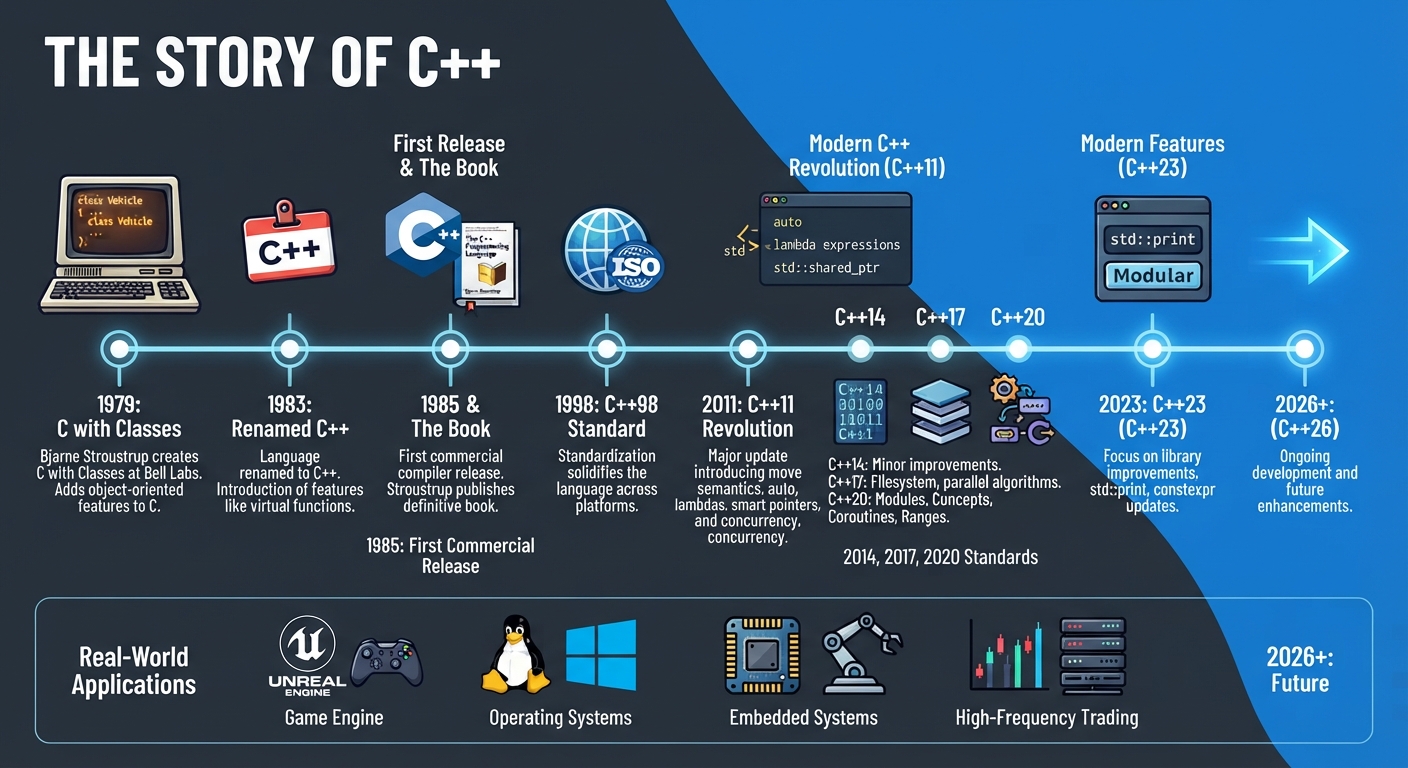
C++ was conceived as a way to bridge the gap between high-level architectural abstraction and low-level hardware efficiency.
Born at Bell Labs, it evolved from “C with Classes” into a powerhouse language that underpins much of modern civilization’s digital and physical infrastructure. Despite periods of decline (C++ winters) and competition from languages like Java and C#, C++ has survived and thrived by continuously evolving to meet the demands of performance-critical computing.
The language emerged in the late 1970s and early 1980s at Bell Labs (AT&T). At the time, programmers faced a choice between the extreme efficiency of Assembly/C (which were low-level and hardware-specific) and the high-level abstraction of Simula (which was far too slow and resource-heavy). Bjarne Stroustrup sought to create a language that could handle the complexity of large-scale systems—such as the distributed systems he was building over UNIX—without sacrificing the performance of the C language.
Key Figures
- Bjarne Stroustrup: The creator of C++, who spent over 40 years refining the language.
- Dennis Ritchie & Brian Kernighan: The creators of C, whose work provided the “efficient bed” upon which C++ was built.
- Alex Stepanov: The visionary behind the STL (Standard Template Library), which revolutionized how algorithms and containers are handled in C++.
- Herb Sutter: A key figure in the modernization of C++, pushing the committee toward time-based releases and the C++11 renaissance.
- Scott Meyers: Noted for defining C++ as a tool for “demanding programming problems.”
Technical and Scientific Discoveries
- C with Classes: The precursor to C++, acting as a preprocessor that translated high-level constructs into C code via Cfront.
- The STL (Standard Template Library): A revolutionary application of mathematical theory to programming, allowing algorithms to work generically across different data structures.
- ANSI/ISO Standardization: The transition from fragmented, vendor-specific implementations (IBM, HP, Microsoft) to a unified global standard, ensuring portability and compatibility.
- Modern C++ (C++11 and onwards): The introduction of move semantics, lambdas, and formal concurrency support, effectively creating a “new language” within the same syntax.
- Memory Safety & C++26: Current efforts to address the “second winter” of C++ by eliminating undefined behavior for uninitialized variables and implementing bound safety.
- Reflection: Identified as one of the most impactful features ever standardized, allowing code to “see” other code.
Consequences and Impact
- Infrastructure Foundation: C++ is “roughly everywhere,” powering electricity grids, wind turbines, automotive systems, and the Large Hadron Collider at CERN.
- Performance Supremacy: It remains the gold standard for domains where latency and performance are non-negotiable, such as High-Frequency Trading (HFT) on Wall Street and AAA Game Development (e.g., Unreal Engine).
- AI and HPC: C++ powers the underlying libraries (like NVIDIA’s CUDA) that enable the current AI revolution, even when the surface layer is written in Python.
- Industry Shift: The success of C++ proved that efficient abstraction at scale is possible and portable, allowing for the creation of much larger and more complex software than was feasible with C.
