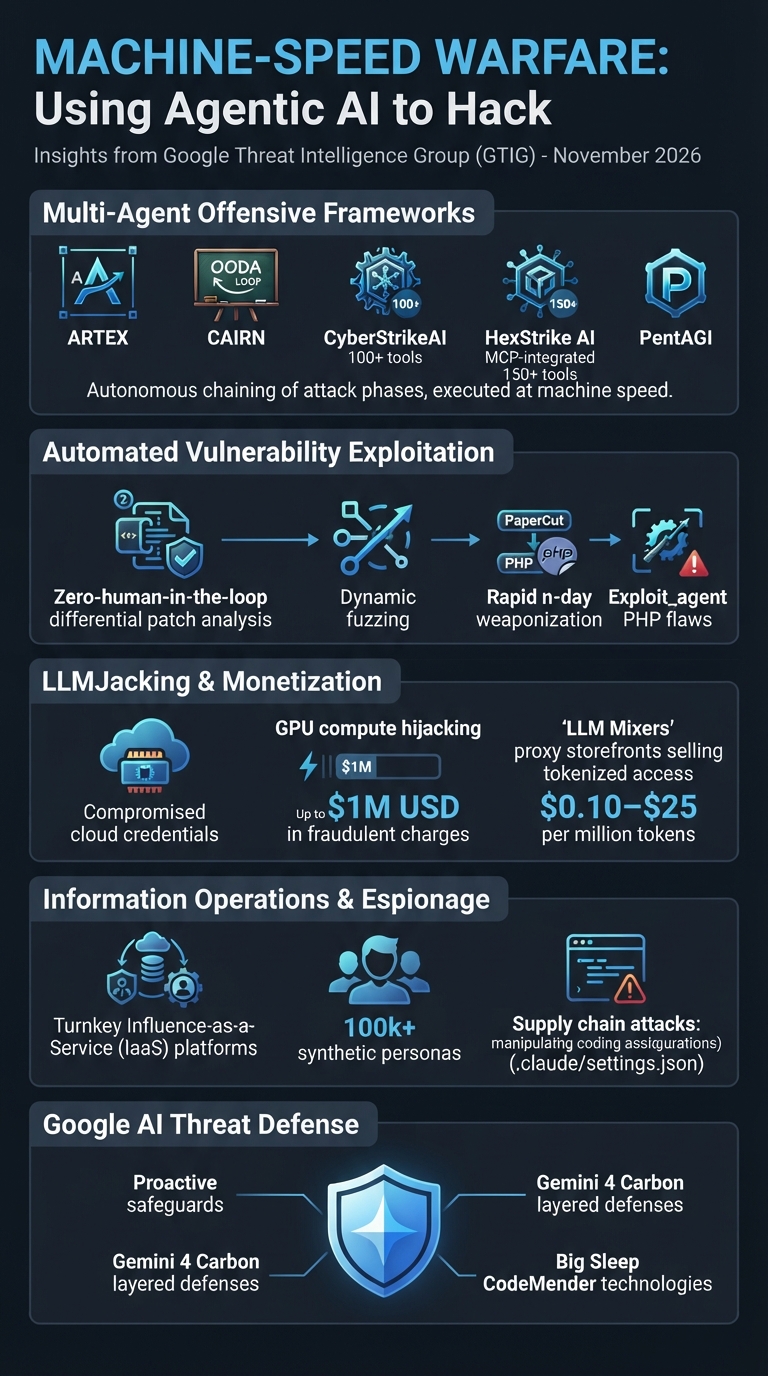
The Google report “Agentic Threat Activity Crosses a Significant Threshold” provides an extended analysis of the Google Threat Intelligence Group (GTIG) briefing regarding the transition of adversarial AI from simple prompting to autonomous, agentic activity.
1. The “Significant Threshold”: From Tool to Agent
The core thesis of the report is that we have passed a critical inflection point in cyber-adversary evolution. The “threshold” mentioned is the shift from Copilot-style usage (where a human asks an LLM to write a script or a phishing email) to Agentic usage (where autonomous frameworks execute multi-stage attack chains with minimal human intervention).
The key differentiator is the loop:
- Prompting (Linear): Human Prompt LLM Output Human (Manual Execution).
- Agentic (Cyclical): Framework Goal Agent Tool Execution Feedback Adjustment Goal Achievement.
GTIG identifies the first instances of fully automated vulnerability discovery and exploitation (e.g., the exploit_agent framework), meaning the “human-in-the-loop” is no longer a requirement for the technical execution of a breach.
2. Technical Ecosystem of Offensive Frameworks
The report highlights a proliferation of open-source and custom frameworks that “weaponize” LLMs by giving them access to security tools (via APIs or the Model Context Protocol – MCP).
| Framework | Core Architecture / Innovation | Observed Use / Target |
|---|---|---|
| CAIRN | OODA Loop + Shared Blackboard: Specialized agents collaborate on a shared state to navigate to an objective. | US Aerospace sector. |
| CyberStrikeAI | C2 Orchestration: Go-based backend connecting LLMs to 100+ security tools and YAML “attack recipes.” | General operational scaling. |
| HexStrike AI | MCP Integration: Uses the Model Context Protocol to wrap 150+ tools into callable functions for 12+ sub-agents. | High-tooling flexibility. |
| PentAGI | Low-Barrier Entry: Designed to allow low-skill operators to run complex campaigns. | Systematic scanning in Asia. |
| Continuous Differential Analysis: Automates the comparison of patched vs. unpatched code to find bugs. | French media and entertainment. |
3. Threat Vector Matrix: Actor-Specific Operationalization
The integration of agentic AI is not uniform; different actors are optimizing for different goals:
A. Cyber Criminals (The Economic Play)
- LLMJacking: A new monetization model. Instead of just stealing data, actors steal LLM API quotas and cloud compute.
- LLM Mixers: The creation of “underground proxy services” that resell stolen frontier model access and compute, mirroring the “money mixer” ecosystem in crypto.
- Phishing-as-a-Service (PhaaS): Tools like Jieyou now include LLM chatbots that allow low-skill affiliates to customize lures using natural language, removing the need for manual template editing.
B. Espionage / State Actors (The Strategic Play)
- Supply Chain Subversion: A highly sophisticated move by groups like MIDNIGHT NEPTUNE, who modify the configuration files of AI agents (e.g.,
.claude/settings.json) to force the agent to download a backdoor during local execution. - Data Synthesis: Using LLMs (e.g., LEAKY CASTLE) not just to steal data, but to automatically translate, analyze, and summarize exfiltrated intelligence into reports for sale.
- Infra Abuse: Using frontier model file-hosting and backend APIs as “Dead Drop” C2 (Command & Control) centers to bypass traditional network monitoring.
C. Information Operations (The Influence Play)
- Turnkey IaaS: The development of platforms managing 100k+ accounts that automate persona creation and “astroturfing.”
- Hyper-Localization: Using prompts to mimic regional dialects, slang, and even intentional typos and “smartphone camera flaws” in synthetic images to evade AI detection and look organic.
4. The Collapse of the “Patch Window”
One of the most concerning findings is the impact on vulnerability management.
- Differential Analysis at Scale: Agentic frameworks can automatically compare the source code of a patched version of a software against the old version.
- The “N-Day” Weaponization: This allows threat actors to weaponize “n-day” vulnerabilities (known flaws with available patches) almost instantly.
- The Result: The window between a patch being released and a widespread exploitation campaign beginning has shrunk from weeks/days to hours or minutes.
5. Defensive Reality: Velocity vs. Stealth
The report notes a critical current weakness in agentic AI: It is loud. Autonomous agents generate high volumes of forensic traffic, use recognizable identifiers, and leave distinct code-level traces. Current frameworks trade stealth for velocity.
Defensive Shift: Because attackers are moving at “machine speed,” defenders can no longer rely on human-led response. Google is pushing toward Agentic Defense:
- Proactive Hunting: Tools like
Big Sleep(DeepMind/Project Zero) to find zero-days before attackers do. - Automated Remediation:
CodeMenderfor autonomous patching. - Behavioral Detection: Shifting from signature-based detection to volumetric and behavioral rules that identify the “noise” generated by autonomous offensive frameworks.
Final Conclusion
We have entered the era of Machine-Speed Warfare. The primary risk is no longer just a “smarter” phishing email, but the existence of autonomous pipelines that can find a bug, write an exploit, and deploy it across thousands of servers before a human security analyst has even finished their morning coffee. The only viable counter-measure is the deployment of equivalent agentic defense systems.
