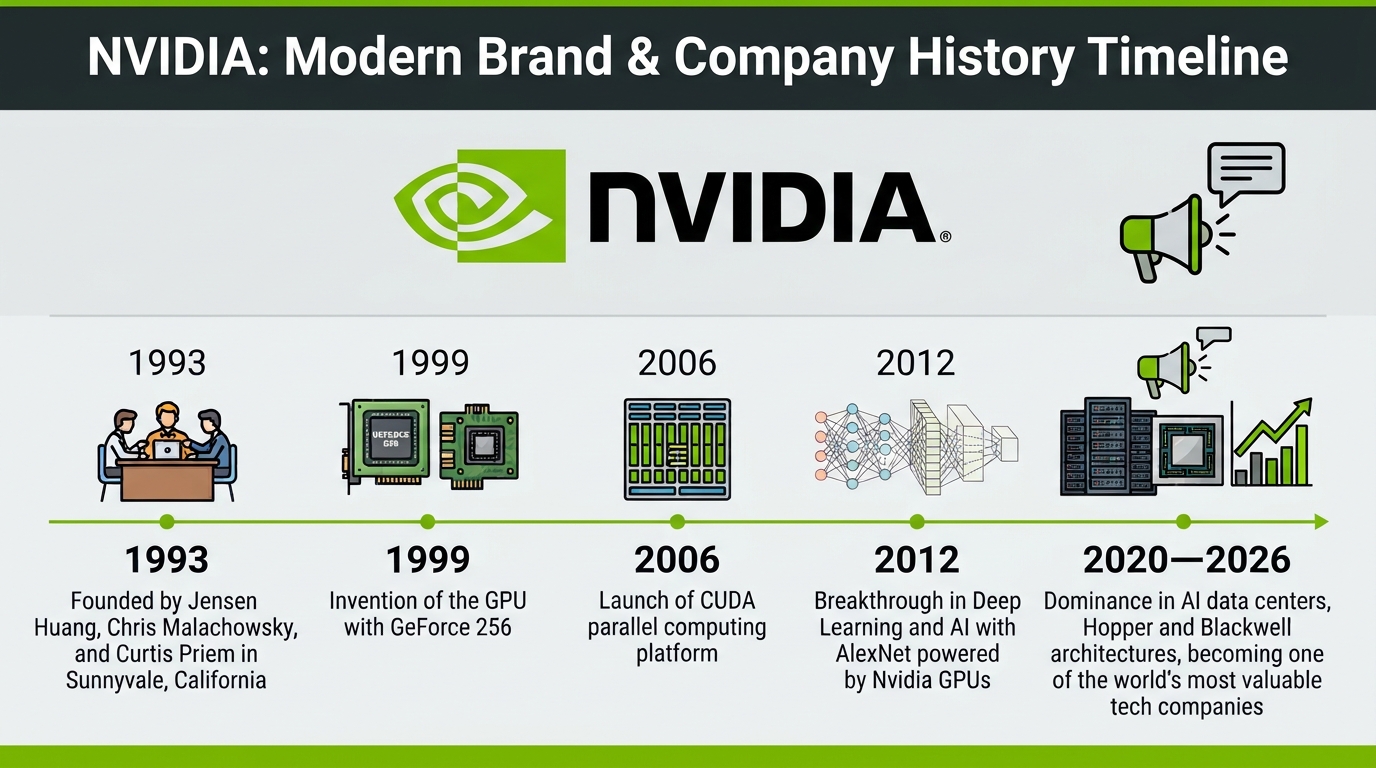
Nvidia represents one of the most extreme trajectories in corporate history: transforming from a near-bankrupt startup in the 1990s to the bedrock of the global AI economy, only to be shaken by a convergence of personal scandals, geopolitical espionage, and financial irregularities in 2026. This analysis explores the synergy between Nvidia’s technical brilliance and the structural vulnerabilities created by its founder-centric leadership.
I. Foundations and the Era of Survival (1993–1999)
Nvidia was founded in 1993 in Fremont, California, by Jensen Huang, Chris Malachowski, and Curtis Priam. Their core vision was based on a fundamental shift in computing: moving from Serial Processing (the CPU’s one-task-at-a-time approach) to Parallel Processing, allowing thousands of mathematical operations to occur simultaneously.
The First Great Failure: The NV1 (1995)
The company’s first major product, the NV1 chip, was an ambitious “octopus” design—an all-in-one solution for 3D graphics, video, and audio processing. However, it was a technical disaster:
- Architectural Error: Nvidia used a quadrangle-based rendering architecture. The rest of the industry had moved toward triangles and the DirectX standard.
- Incompatibility: The NV1 was incompatible with the industry’s direction, making games unplayable or poorly performing.
- Near Bankruptcy: The failure led to massive product returns (specifically from Diamond Multimedia) and forced the layoff of half the staff. Nvidia only survived through an act of generosity from Sega, who paid the company in full to be released from a contract.
The Pivot and the Birth of the GPU (1999)
Learning from the NV1, Nvidia shifted focus toward the burgeoning PC gaming market. In 1999, they launched the G-Force 256, the first programmable Graphics Processing Unit (GPU). This established the GPU as a distinct category of hardware and took the company public with a $600 million valuation.
II. The Technological Leap and AI Revolution (2000–2023)
Nvidia transitioned from a gaming company to a foundational infrastructure provider through two primary strategic pillars: the Fabless Model and CUDA.
1. The Fabless Strategic Model
Nvidia adopted a “fabless” approach, designing the architecture but outsourcing the physical manufacturing to TSMC (Taiwan Semiconductor Manufacturing Company). This minimized capital expenditure and allowed the company to focus exclusively on innovation.
2. CUDA: The General-Purpose GPU (2006)
The release of CUDA (Compute Unified Device Architecture) in 2006 was the most significant pivot in the company’s history. It provided a software layer allowing developers to use standard languages (C, C++, Java) to program GPUs for non-graphical tasks.
3. The AI Big Bang (2012)
The utility of CUDA was proven in 2012 during the ImageNet competition. PhD student Alex Krizhevsky created AlexNet, utilizing Nvidia GPUs to accelerate deep learning neural networks. This breakthrough ended the “AI Winter” and positioned Nvidia as the sole provider of the hardware necessary for the modern AI era.
4. Diversification and Market Cap (2022–2023)
By the early 2020s, Nvidia’s technology extended into:
- RTX & Ray Tracing: Real-time simulation of light for photorealistic rendering.
- DLSS: Using AI to upscale resolution without increasing computational load.
- Genomic Sequencing: Breaking world records for DNA sequencing speed in 2022.
- Market Dominance: By May 2023, Nvidia became the sixth company to reach a $1 trillion market capitalization, fueled by the demand for Large Language Models (LLMs) like ChatGPT.
III. The 2026 Collapse: The Convergence of Scandals
At its peak, Nvidia controlled approximately 90% of the advanced AI chip market, with a valuation exceeding $4 trillion. However, the company’s structure—a “hub-and-spoke” model where Jensen Huang was the sole central authority—created a singular point of failure.
1. The Personal and Governance Crisis
In late 2026, a New York Times investigation revealed that Jensen Huang had engaged in multiple extramarital affairs, including relationships with subordinates. This represented a severe corporate governance violation, mirroring the exits of CEOs at companies like Intel and McDonald’s.
2. The Espionage Narrative: The “Gray Zone”
The personal scandal intersected with national security. US intelligence suspected that Alice Huang, a Chinese businesswoman and head of Megaspeed International, was an asset for China’s Ministry of State Security.
- The Megaspeed Front: Megaspeed (based in Singapore) allegedly acted as a front to bypass US export bans. By placing chips in data centers in Malaysia and Indonesia, they rented computing power back to Chinese giants like Alibaba via the “Neo Cloud Space.” This effectively allowed China to access US AI hardware without the chips ever crossing a physical border.
- Geopolitical Stakes: Because AI chips are viewed as the “nuclear weapons” of the modern age, this was treated as a counterintelligence nightmare, involving Senator Marco Rubio and the US government.
3. The Financial Scandal: Circular Financing
Alongside the personal and geopolitical crises, allegations emerged regarding Circular Financing. NVIDIA was accused of investing billions into AI startups on the condition that those startups use the funds to purchase NVIDIA GPUs. The IMF identified this as a systemic risk totaling $1.4 trillion, suggesting that the AI boom’s revenue was partially artificial.
IV. Consequences and Aftermath
The convergence of these events led to the forced resignation of Jensen Huang and a period of extreme instability.
Financial and Legal Fallout
- Market Crash: Nearly $500 billion in market value vanished within four trading sessions.
- Federal Investigations: Simultaneous probes were launched by the FBI and the US Department of Justice.
- Lawsuits: A wave of shareholder lawsuits followed the revelation of the circular financing and governance failures.
Structural Transformation
The crisis forced a fundamental change in how the company operates:
- End of the Hub: The centralized “hub-and-spoke” management style was abandoned in favor of a committee-based institutional structure.
- Interim Leadership: Colette Cress (former CFO) assumed the role of interim CEO.
- Security Overhaul: A push for “defense-grade” security protocols within the tech sector to prevent further intelligence breaches.
