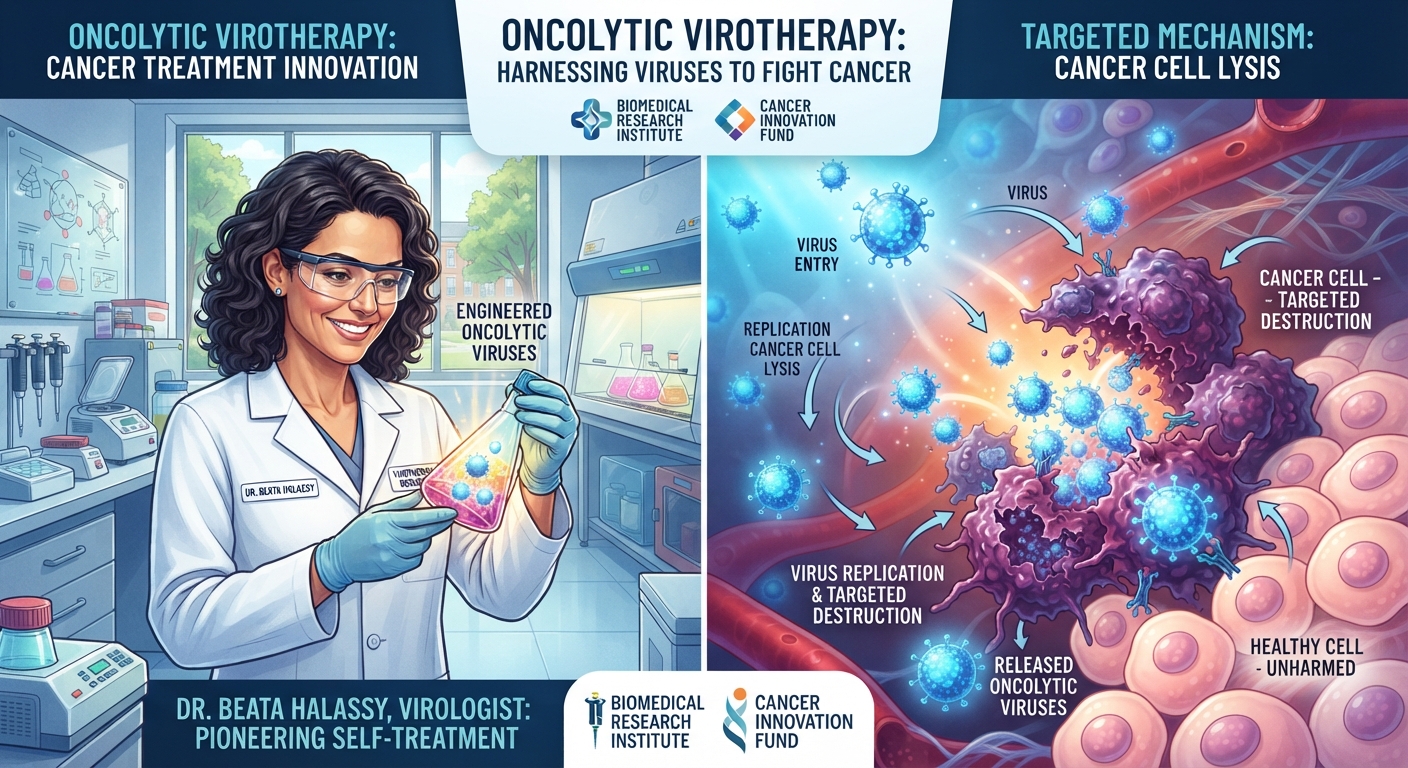
Dr. Beata Hallasey, a Croatian virologist who successfully treated her Stage 3B breast cancer using self-administered virotherapy. After surgery and harsh chemotherapy failed to prevent a recurrence, Dr. Hallasey bypassed conventional medical protocols to engineer and inject a customized virus mix directly into her tumor, triggering a massive immune response that effectively eliminated the cancer.
Historic Context
Virotherapy is rooted in early 20th-century medical observations. Doctors noticed that cancer tumors in some patients would shrink following natural viral infections, such as influenza or measles. This paradoxical effect led to the scientific exploration of using viruses as therapeutic agents to destroy malignant cells.
The Core Research: Oncolytic Virotherapy (OVT)
Dr. Halassy’s work in this area focuses on using viruses as “biological missiles” to destroy cancer cells while simultaneously alerting the immune system to the presence of the tumor.
1. The Case Study
In 2020, after facing a third recurrence of triple-negative breast cancer (a highly aggressive form), Dr. Halassy performed a self-experiment. With the approval of her oncologists, she injected herself with lab-grown viruses to shrink a tumor that was otherwise difficult to remove surgically.
2. Viruses Used
She employed two specific research-grade virus preparations cultivated in her own laboratory:
- Edmonston-Zagreb measles vaccine strain (MeV): A modified measles virus.
- Vesicular stomatitis virus Indiana strain (VSV): A virus typically used in veterinary medicine and research.
3. Results and Outcome
- Tumor Reduction: The intratumoral injections caused the tumor to shrink and lose its invasion into the skin and underlying muscle.
- Surgical Success: Because the tumor became “debulked” and localized, surgeons were able to perform a simple, non-invasive resection.
- Immune Response: Analysis of the excised tumor revealed strong lymphocytic infiltration, specifically an increase in:
- CD8+ T cells (cytotoxic T cells that kill cancer cells).
- CD20+ B cells.
- Macrophages.
- The presence of PD-L1 expression, indicating that the viruses had successfully “turned on” the immune response against the cancer.
- Current Status: As of late 2024, she has reported being in remission for nearly four years.
Academic Publication
The details of this experiment were published in the peer-reviewed journal Vaccines in August 2024:
- Title: “An Unconventional Case Study of Neoadjuvant Oncolytic Virotherapy for Recurrent Breast Cancer”
- DOI:
10.3390/vaccines12090958
Context and Ethics
While her case was a clinical success, it sparked significant debate within the scientific community. Dr. Halassy and her co-authors emphasize that this was an unconventional self-experiment and explicitly warn that others should not attempt to treat cancer with lab-grown viruses outside of controlled clinical trials, as OVT can have unpredictable risks and requires precise laboratory standards.
General Academic Background
Beyond this specific cancer research, Dr. Beata Halassy is a highly cited scientist (over 1,700 citations) with extensive expertise in general virology and venomics (the study of animal venoms).
The official publication of the study
The full text of the article from the Vaccines journal. You can find the official publication here: An Unconventional Case Study of Neoadjuvant Oncolytic Virotherapy for Recurrent Breast Cancer.
Below is a detailed summary of the technical and clinical findings from the paper:
1. Patient Background & Diagnosis
- Profile: A 50-year-old female virologist.
- Cancer History: Originally diagnosed in 2016 with Triple-Negative Breast Cancer (TNBC). After a mastectomy and chemotherapy, she had a recurrence in 2018 (surgically removed).
- The 2020 Recurrence: A new 2 cm solid tumour appeared. At this stage, the tumour was muscle-invasive (invading the pectoral muscle) and had skin infiltration. Interestingly, a biopsy showed the tumour had evolved from TNBC to HER2 3+.
2. The Treatment Protocol (The “Self-Experiment”)
Dr. Halassy used Neoadjuvant Oncolytic Virotherapy (OVT), meaning the treatment was given before surgery to shrink the tumour and make it operable.
- The “Cocktail”: She used two different viruses prepared in her own lab as clarified cell culture supernatants (non-clinical grade):
- MeV (Edmonston-Zagreb measles vaccine strain): 7 applications administered every 3–4 days over three weeks.
- VSV (Vesicular stomatitis virus Indiana strain): 3 applications administered over the following few weeks.
- The Strategy:
- Sequential Administration: She used two different viruses to prevent the body from developing “antiviral immunity” that would stop the second virus from working.
- Intensive Scheduling: Frequent intratumoural injections were used to maintain a high concentration of the virus within the tumour.
3. Clinical Results
- Immediate Effect: The tumour shrank significantly. Within two months, it was no longer invading the skin or muscle.
- Surgery: Because the tumour was now “downstaged” (smaller and localized), it was successfully removed via a simple, non-invasive surgical excision.
- Post-Op: She completed a one-year course of trastuzumab (a targeted therapy for HER2+ cancer) as adjuvant therapy.
- Outcome: She remained recurrence-free 45 months after the surgery.
4. Pathological Findings (Why it worked)
The most significant scientific finding was in the analysis of the removed tumour. The viruses didn’t just kill cells directly; they “primed” the immune system:
- Immune Infiltration: The tumour showed a massive increase in CD8+ T cells (killer T cells), CD20+ B cells, and macrophages.
- Phenotype Shift: The tumour shifted from a PD-L1-negative phenotype (invisible to the immune system) to PD-L1-positive, meaning the viruses essentially “unmasked” the cancer, allowing the immune system to recognize and attack it.
5. Scientific Conclusion
The authors conclude that OVT can be a powerful tool for “debulking” (reducing size) and “downstaging” inoperable tumours, transforming them into cases that can be successfully treated with surgery. However, they reiterate that this was a unique case due to the patient’s professional expertise in virology.
Video Explaining the case
Kurzgesagt has an excelent video about the research of Dr. Beata Hallasey:
