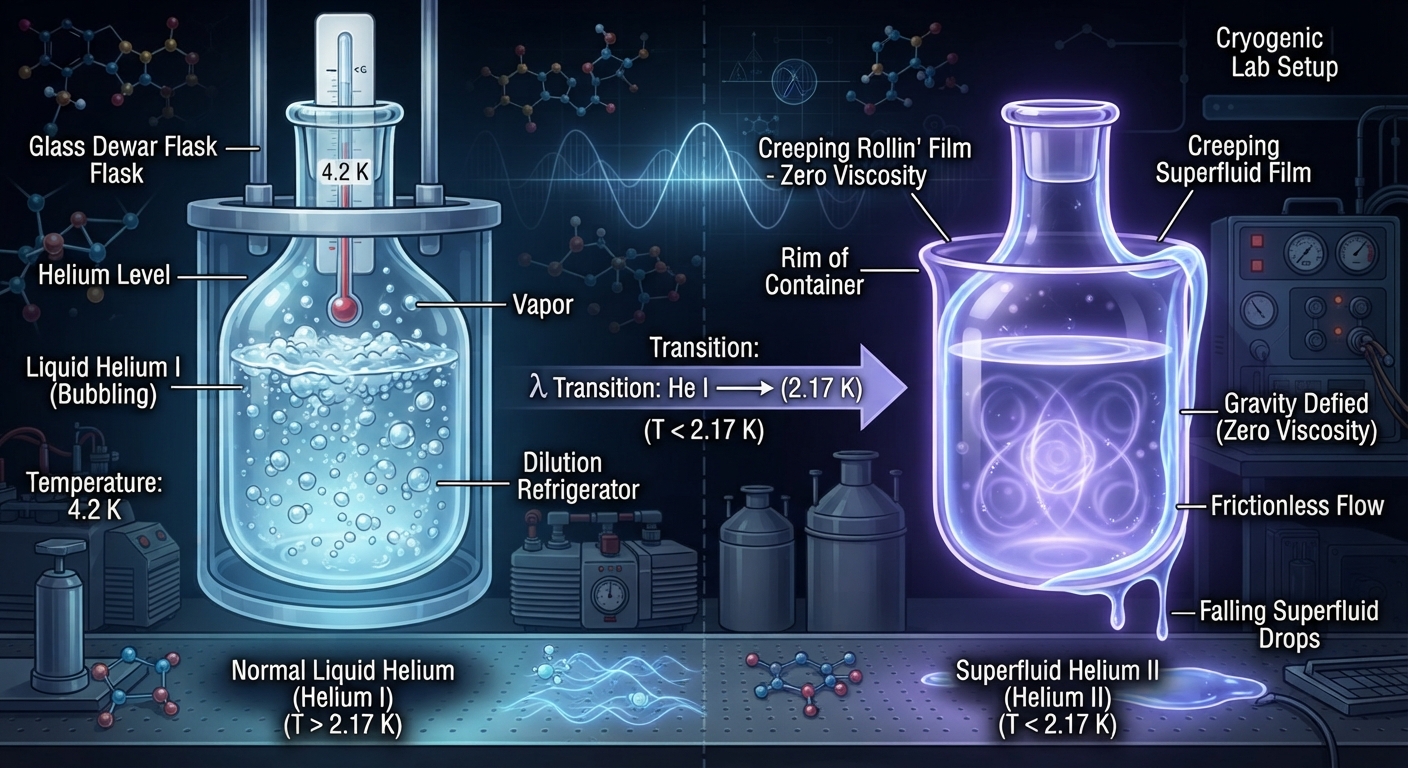
The video explores the properties of liquid helium and its transition into a superfluid at a critical temperature known as the Lambda point (2.17 Kelvin). It provides a comprehensive journey from the 19th-century “race to absolute zero” to the discovery of superconductivity and the theoretical framework of Bose-Einstein Condensates (BEC). The core focus is on how superfluidity allows matter to behave in ways that seem to defy classical physics—such as flowing with zero viscosity and climbing the walls of containers—serving as a macroscopic bridge to the quantum world.
Historic Context, Facts, and Persons
Key Figures
- Lord Kelvin: Established the absolute temperature scale and identified Absolute Zero (~ -273°C).
- Michael Faraday: Pioneer of gas liquefaction (1823), successfully liquefying chlorine and later ethylene using dry ice.
- James Dewar: Liquefied hydrogen and invented the vacuum flask (Dewar flask), essential for maintaining ultra-low temperatures.
- Heike Kamerlingh Onnes: The first scientist to liquefy helium (1908) and the discoverer of superconductivity in mercury (1911).
- Pyotr Kapitsa: Soviet physicist who independently discovered superfluidity and coined the term “superfluid.”
- Don Meissner & Jack Allen: Experimentalists who identified the precipitous drop in helium’s viscosity at the transition point.
- Albert Einstein & Satyendra Nath Bose: Predicted the Bose-Einstein Condensate (BEC), a state where particles merge into a single quantum state.
- Lev Landau: Developed the “Two-Fluid Model” to explain the coexistence of normal and superfluid components and introduced the concepts of phonons and rotons.
Historical Timeline & Facts
- 1823: Michael Faraday begins liquefying gases.
- 1908: Heike Kamerlingh Onnes achieves the first liquefaction of helium.
- 1911: Discovery of superconductivity (zero electrical resistance).
- 1937-1938: Independent discovery of superfluidity by Kapitsa and the team of Allen and Meissner.
- Absolute Zero: Defined as the point where all thermal motion stops, though quantum zero-point energy ensures some motion persists.
Technical & Scientific Discoveries
The Physics of Superfluidity
- The Lambda Point (2.17 K): The temperature at which liquid helium undergoes a phase transition into a superfluid. The name derives from the $\lambda$-shaped curve of its specific heat.
- Zero Viscosity: Superfluids have no internal friction, allowing them to flow through nanometer-scale pores (like aerogel) and form “creep films” that climb walls to empty containers.
- Bose-Einstein Condensate (BEC): Since helium atoms are bosons (aggregate of 6 fermions), they can occupy the same lowest energy state. At the Lambda point, a macroscopic fraction of atoms condense into a single coherent quantum state.
- The Two-Fluid Model: Proposes that helium below 2.17 K consists of:
- Superfluid component: Zero viscosity, zero entropy, carries no heat.
- Normal fluid component: Has viscosity, carries all the heat.
- Second Sound: Unlike regular sound (pressure waves), “second sound” consists of temperature/entropy waves traveling through the two-fluid mixture.
- Zero-Point Energy: Based on Heisenberg’s Uncertainty Principle, helium atoms possess inherent kinetic energy that prevents them from freezing into a solid through cooling alone (requiring pressure instead).
Consequences and Applications
- CERN & LHC: Superfluid helium’s unparalleled heat conductivity and lack of boiling make it the ideal coolant for the superconducting magnets of the Large Hadron Collider.
- Quantum Observation: Provides a rare opportunity to observe quantum mechanical behavior (like wave-particle duality and BEC) on a macroscopic scale.
- Astrophysics: The study of rotating superfluids provides insights into the behavior of neutron stars and the simulation of black hole physics.
