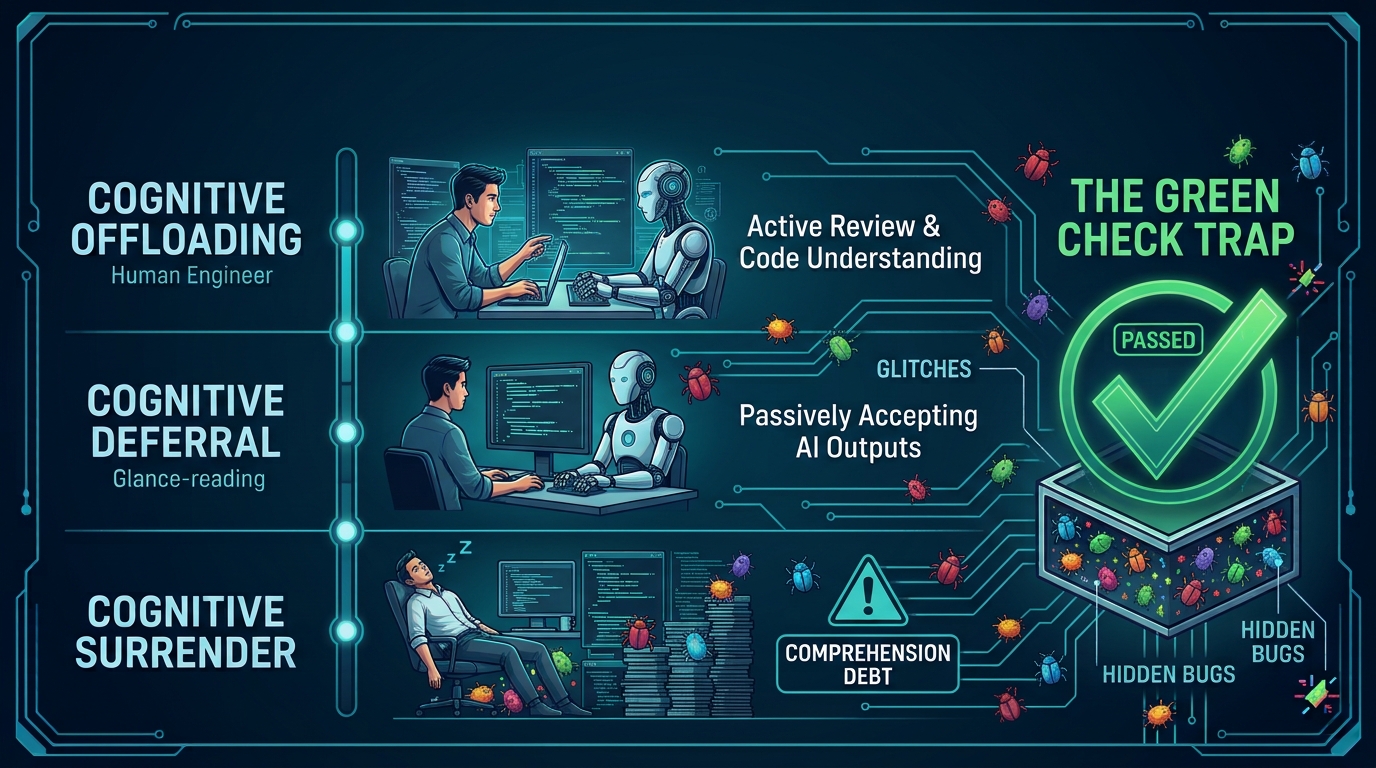
Addy Osmani’s post named “Critical thinking when agents do the work“, is a pragmatic warning about “cognitive surrender” in the age of AI agents. It’s a long article, but it’s worth reading in its entirety.
The Core Thesis
As AI agents improve and produce fewer obvious errors, the risk shifts from “the AI is wrong” to “the human is no longer thinking.” He argues that because agentic outputs are pleasant and “mostly correct,” users naturally drift from delegating tasks to blindly accepting results—leading to cognitive debt (a loss of systemic understanding).
The Spectrum of AI Usage
He defines a three-tier sliding scale of how we interact with agents:
- Cognitive Offloading (Healthy): Delegating the work but retaining ownership and critical oversight of the result.
- Deferral (Warning): Treating the agent’s output as a fact/input rather than a hypothesis to be verified.
- Cognitive Surrender (Danger): The AI’s output becomes your own. You stop checking it and lose the ability to explain the “why” behind the result.
Operational Risks
The primary operational danger is Comprehension Debt. You may end up with a “pristine” codebase or a “perfect” strategy document that passes all tests, but which no human actually understands. The system works, but the team has lost the mental model required to maintain or evolve it.
Pragmatic Countermeasures
Osmani proposes specific habits to prevent surrender:
- Establish a Hypothesis: Decide what you think the answer is before asking the agent.
- Audit the “Green Check”: A passing test proves one specific thing; ask what it didn’t prove.
- Review Decisions, Not Summaries: Instead of reading the “everything is fine” summary, force the agent to list the trade-offs, assumptions, and decisions it made.
- Calibration Exercises: Periodically perform a task manually to ensure your foundational skills haven’t atrophied.
- Verification Loops: Build agents that verify their own work through tangible evidence (logs, screenshots, tests) rather than self-assessment.
Final Take
The post is not an argument against AI, but an argument for intentionality. The trade-off is clear: you can have the speed of AI, but the cost is a higher requirement for manual, disciplined verification to ensure you remain the owner of the outcome, not just the passenger.
