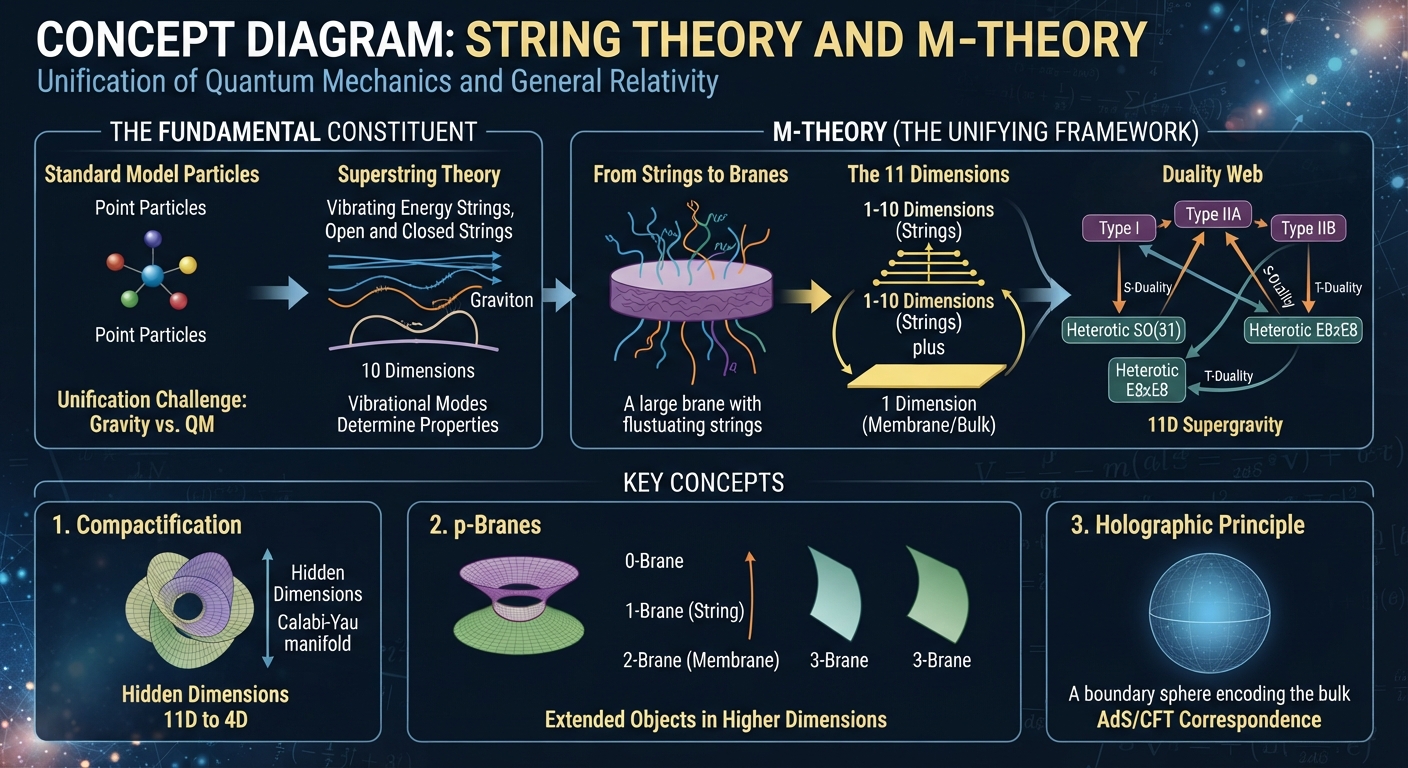
To understand String Theory and M-Theory, you have to start with the problem they are trying to solve: The Great Divide in Physics.
Currently, we have two sets of rules for the universe:
- General Relativity (GR): Describes the “big” things (gravity, stars, galaxies). It treats space-time as a smooth fabric.
- Quantum Mechanics (QM): Describes the “small” things (atoms, subatomic particles). It treats the world as discrete, jittery, and probabilistic.
The problem is that these two theories hate each other. If you try to apply GR to the center of a black hole (where something is both very heavy and very small), the math breaks and gives you “infinity” as an answer. This is physically impossible. String Theory is the most prominent attempt to create a “Theory of Everything” that unifies them.
1. String Theory: The Basic Idea
In standard physics, we imagine electrons or quarks as 0D points (dots with no size). String Theory proposes that if you zoomed in far enough, you would see that every particle is actually a 1D string—a tiny, vibrating loop of energy.
- The Analogy: Think of a guitar string. Depending on how you pluck it, it produces a different note (C, G, Eb). In String Theory, the “note” the string vibrates at determines what particle it is. One vibration is an electron; another is a photon; another is a graviton.
- The Goal: Because the “graviton” (the particle of gravity) is included in this vibration spectrum, gravity is naturally integrated into the quantum framework.
2. The “Five” Theories and the Jump to M-Theory
By the 1990s, physicists realized they hadn’t found one string theory, but five different versions (Type I, Type IIA, Type IIB, and two “Heterotic” versions). They all worked mathematically, but having five “Theories of Everything” is a problem.
In 1995, physicist Edward Witten proposed M-Theory.
He showed that these five theories weren’t actually different; they were just different ways of looking at the same underlying physical reality. He called this “Duality.”
M-Theory changed two major things:
- Dimensions: It increased the required dimensions from 10 to 11.
- Objects: It introduced Branes (short for membranes). While String Theory focuses on 1D strings, M-Theory says there are also 2D membranes, 3D volumes, and so on (p-branes). Our entire 3D universe might technically be a “brane” floating in a higher-dimensional space.
3. The “Prerequisites” (The Hard Parts)
For the math of M-Theory to work, two controversial things must be true:
- Supersymmetry (SUSY): Every known particle has a “super-partner” particle that we haven’t discovered yet.
- Compactification: The extra 7 dimensions aren’t “missing”; they are curled up (compactified) into incredibly complex shapes (Calabi-Yau manifolds) so small we can’t detect them.
4. The Pragmatic Reality (The Criticism)
From an operational standpoint, String/M-Theory is in a strange position:
- Mathematically: It is one of the most beautiful and sophisticated structures ever built. It solves the “infinity” problem of black holes.
- Experimentally: It is currently untestable. To see a string, we would need a particle accelerator the size of a galaxy.
Because it makes so many different predictions (the “Landscape” of possible universes), some critics argue it has moved from “physics” into “mathematical philosophy” because it cannot be proven wrong (falsified) with current technology.
Evolution of String Theory
String Theory was not proposed as a “Theory of Everything” from the start. It actually began as a failed attempt to explain something else entirely: the strong nuclear force (the force that holds the nucleus of an atom together).
Here is the sequence of how it was proposed and how it evolved:
1. The “Accidental” Discovery (1968)
In the late 1960s, physicists were trying to understand why certain particles (hadrons) behaved the way they did. A physicist named Gabriele Veneziano found a mathematical formula (the Euler Beta Function) that perfectly described how these particles scattered off each other.
At the time, Veneziano didn’t know why the math worked; he just knew the formula fit the data.
2. The “String” Insight (Early 1970s)
Shortly after, other physicists (Leon Takuvson, Yoichiro Nambu, and Holger Nielsen) looked at Veneziano’s math and realized something strange: the equations didn’t describe “point particles” (dots). Instead, they described tiny, vibrating strings.
The logic was simple: if a particle is a point, it only has one state. If a particle is a string, it can vibrate in different patterns—and each pattern corresponds to a different mass or energy.
3. The “Failure” and the Pivot (Mid-1970s)
String Theory almost died immediately. A different theory called Quantum Chromodynamics (QCD) came along and explained the strong nuclear force much better and more simply. By 1974, most physicists abandoned String Theory.
However, String Theory had one “problem” that turned out to be a goldmine: it predicted a particle that didn’t fit in the nuclear force model.
The math insisted there must be a massless particle with a “spin” of 2.
In the world of physics, there is only one thing that fits that description: the Graviton (the theoretical particle that carries gravity).
4. The First Superstring Revolution (1984)
Physicists realized that if they stopped trying to explain atoms and instead used the theory to explain gravity, the “problem” of the graviton became the “solution.”
In 1984, Michael Green and John Schwarz showed that by adding Supersymmetry (the idea that every particle has a partner) and Extra Dimensions, they could remove the mathematical contradictions (anomalies) that had plagued the theory.
This changed the proposal from:
“Here is a way to explain how protons work” → “Here is a way to unify all forces, including gravity, into one single equation.”
Summary: The Logic Path
- Formula: Veneziano finds a math trick for scattering particles.
- Interpretation: Nambu/Susskind realize the math implies “strings” instead of “dots.”
- Pivot: The theory fails at nuclear physics but accidentally predicts the graviton.
- Expansion: Green/Schwarz add extra dimensions to make the math stable.
- Result: It becomes a candidate for the “Theory of Everything.”
M-Theory
M-Theory was proposed in 1995 by physicist Edward Witten during a presentation at a conference in Southern California. This event is known as the “Second Superstring Revolution.”
To understand how it was proposed, you have to understand the “crisis” physicists were facing at the time.
1. The Problem: The “Five Theory” Mess
By the early 90s, String Theory had a huge problem. Instead of one “Theory of Everything,” physicists had found five different versions of the theory that were all mathematically consistent:
- Type I
- Type IIA
- Type IIB
- Heterotic-O (SO(32))
- Heterotic-E (E8xE8)
This was an embarrassment. If you are looking for the single fundamental law of the universe, finding five different laws is a failure.
2. The Insight: Dualities (The “Mirror” Effect)
Edward Witten proposed that these five theories weren’t different theories at all. Instead, they were five different ways of looking at the same thing.
He used a concept called Duality. A duality occurs when two descriptions of a system look completely different on the surface, but the math proves they are identical.
- T-Duality: Showed that a string moving in a circle of radius R is mathematically identical to a string moving in a circle of radius $1/R$. (Big and small are the same).
- S-Duality: Showed that a theory where particles interact strongly is mathematically identical to a theory where they interact weakly. (Strong and weak are the same).
Witten realized that if you used these dualities, you could “travel” from one theory to another. If you changed the parameters of Type IIA, it would “become” Type IIB.
3. The Proposal: The 11th Dimension
The most shocking part of Witten’s proposal was that to unify these five theories, he had to add one more dimension.
String Theory required 10 dimensions. Witten proposed that there is a hidden 11th dimension. He argued that when the “coupling constant” (the strength of the interaction) of certain string theories increases, a new spatial dimension actually “opens up.”
He didn’t call it “Multiverse Theory” or “Universe Theory”—he simply called it M-Theory. (The ‘M’ is ambiguous; Witten has said it stands for Membrane, Master, or Mystery).
4. The a Change in Geometry: From Strings to Branes
Once you add the 11th dimension, the fundamental object is no longer just a 1D string.
Witten proposed that strings are actually just “slices” of higher-dimensional objects called Branes (short for membranes).
- A 0-brane is a point.
- A 1-brane is a string.
- A 2-brane is a sheet (membrane).
- And so on…
This meant that our entire 3D universe could be a 3-brane—a three-dimensional membrane floating in an 11-dimensional “bulk.”
Summary: The Logical Leap
- Pre-1995: “We have five different string theories. We are confused.”
- Witten’s Proposal: “These five theories are just different perspectives of one single theory.”
- The Requirement: “To make this work, we must accept an 11th dimension and membranes (branes) instead of just strings.”
- The Result: M-Theory, the overarching framework that connects all versions of string theory.
Holographic Principle
The Holographic Principle is the theoretical proposal that the entire description of a volume of space can be encoded on a lower-dimensional boundary surrounding that region.
In simple terms: the “3D” world we experience may be a projection of information stored on a “2D” surface.
The Core Logic
The principle emerged from the study of black holes:
- The Entropy Problem: In standard physics, the amount of information (entropy) you can fit in a room depends on the volume of the room.
- The Black Hole Exception: Stephen Hawking and Jacob Bekenstein discovered that the entropy of a black hole is proportional to the surface area of its event horizon, not its volume.
- The Conclusion: If the maximum amount of information a region of space can hold is limited by its surface area, then the “interior” is essentially redundant. The surface contains everything needed to describe the interior.
Theoretical Application (AdS/CFT)
While it started with black holes, it became a pillar of modern theoretical physics through the AdS/CFT correspondence (proposed by Juan Maldacena).
It suggests a mathematical equivalence between two different types of theories:
- Bulk (AdS): A theory of gravity in a higher-dimensional space (Anti-de Sitter space).
- Boundary (CFT): A quantum field theory (Conformal Field Theory) without gravity on the boundary of that space.
If this correspondence is correct, gravity—one of the hardest forces to reconcile with quantum mechanics—might actually be an “emergent” phenomenon resulting from quantum interactions on a distant boundary.
Pragmatic Take
It is important to note that this is a mathematical framework used to solve complex problems in quantum gravity and string theory. It is not a claim that we are “living in a simulation” or that the world is “fake”; rather, it is a statement about how information is fundamentally organized in the universe.
