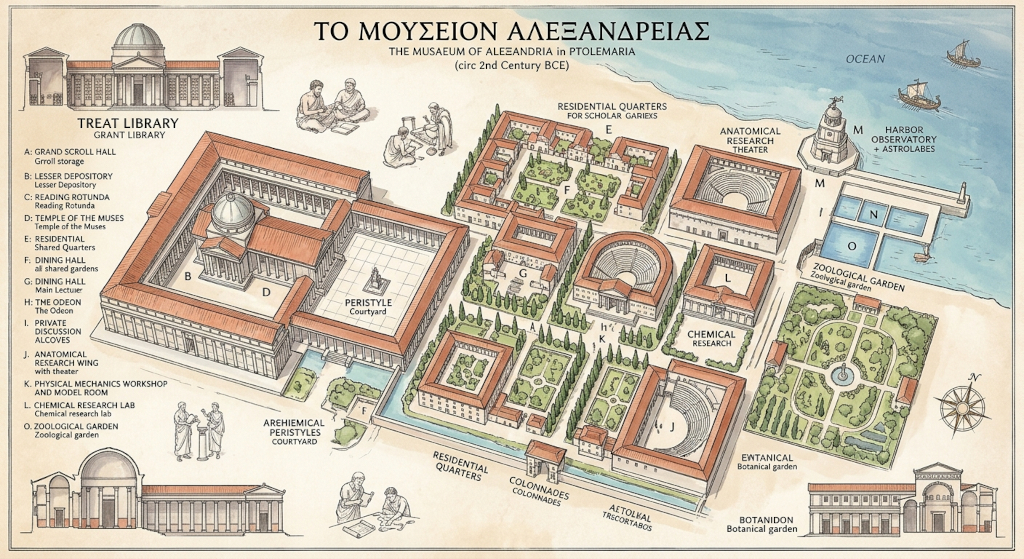
The Musaeum and the Great Library of Alexandria were not two separate entities, but rather a symbiotic pair: the Musaeum was the overarching research institution, and the Library was its crowning intellectual asset.
Together, they represented the first state-funded attempt in history to create a universal repository of all human knowledge.
1. The Musaeum (The “Temple of the Muses”)
Founded in the 3rd century BCE by Ptolemy I Soter and expanded by Ptolemy II Philadelphus, the Musaeum was essentially the ancient world’s first university or think-tank.
- Operational Reality: It was a royal institution. The Ptolemies provided scholars with salaries, free meals, and housing, allowing them to focus entirely on research without the need for outside employment.
- Purpose: It served as a hub for the “natural sciences” and the arts. It included laboratories, observatories, gardens, and lecture halls.
- The “Pension”: By removing the burden of survival, the Ptolemies attracted the greatest minds of the Mediterranean, turning Alexandria into the intellectual capital of the world.
2. The Great Library of Alexandria
If the Musaeum was the “campus,” the Library was the “archive.” Its goal was an ambitious, perhaps impossible, one: to acquire a copy of every book (scroll) ever written.
- Aggressive Acquisition: The library is famous for itsruthless collection methods. According to historical accounts, ships docking in Alexandria were searched; any scrolls found were confiscated, copied, and sometimes the copies were returned while the originals were kept by the library.
- Scale: At its peak, it is estimated to have held between 40,000 and 400,000 papyrus scrolls.
- The Decline: There is no single “fire” that destroyed the library. Instead, it suffered a slow death through a series of events: Caesar’s fire (48 BCE), the attack of Emperor Aurelian (270s CE), and the decree of Theodosius I (391 CE) which targeted pagan temples.
3. The Polymaths and Thinkers
The genius of Alexandria lay in its polymaths—scholars who refused to specialize, blending mathematics, astronomy, geography, and linguistics.
The Scientific Giants
- Eratosthenes: A quintessential polymath and Chief Librarian. He is most famous for calculating the circumference of the Earth with remarkable accuracy using only the angle of the sun at two different locations (Syene and Alexandria). He also pioneered the field of geography.
- Euclid: The “Father of Geometry.” He worked at the Musaeum and authored the Elements, the most influential textbook in the history of mathematics.
- Aristarchus of Samos: He was the first to propose a heliocentric model of the solar system (that the Earth revolves around the Sun), nearly 1,800 years before Copernicus.
- Herophilus: Often called the father of anatomy; he performed some of the first systematic dissections of human bodies to understand the nervous system and the brain.
The Literary & Linguistic Architects
- Callimachus: He solved the “big data” problem of the ancient world. He created the Pinakes (Tables), a massive bibliographic catalogue that organized the library’s contents by genre and author—the ancestor of the modern library index.
- Zenodotus: The first chief librarian, who began the tradition of “textual criticism”—comparing different versions of Homer’s works to determine the most authentic text.
- Aristophanes of Byzantium: A scholar who refined the Greek language and is credited with inventing the system of accent marks and punctuation we still use today to clarify meaning and pronunciation.
The Alexandrian Ecosystem
| Feature | The Musaeum | The Library |
|---|---|---|
| Nature | Research Institute / University | Universal Archive |
| Focus | Observation, Experimentation, Teaching | Preservation, Cataloging, Translation |
| Input | The best minds of the era | Every scroll in existence |
| Output | Theoretical breakthroughs (e.g., Geometry) | The Pinakes and curated texts |
| Key Figure | Euclid / Herophilus | Eratosthenes / Callimachus |
