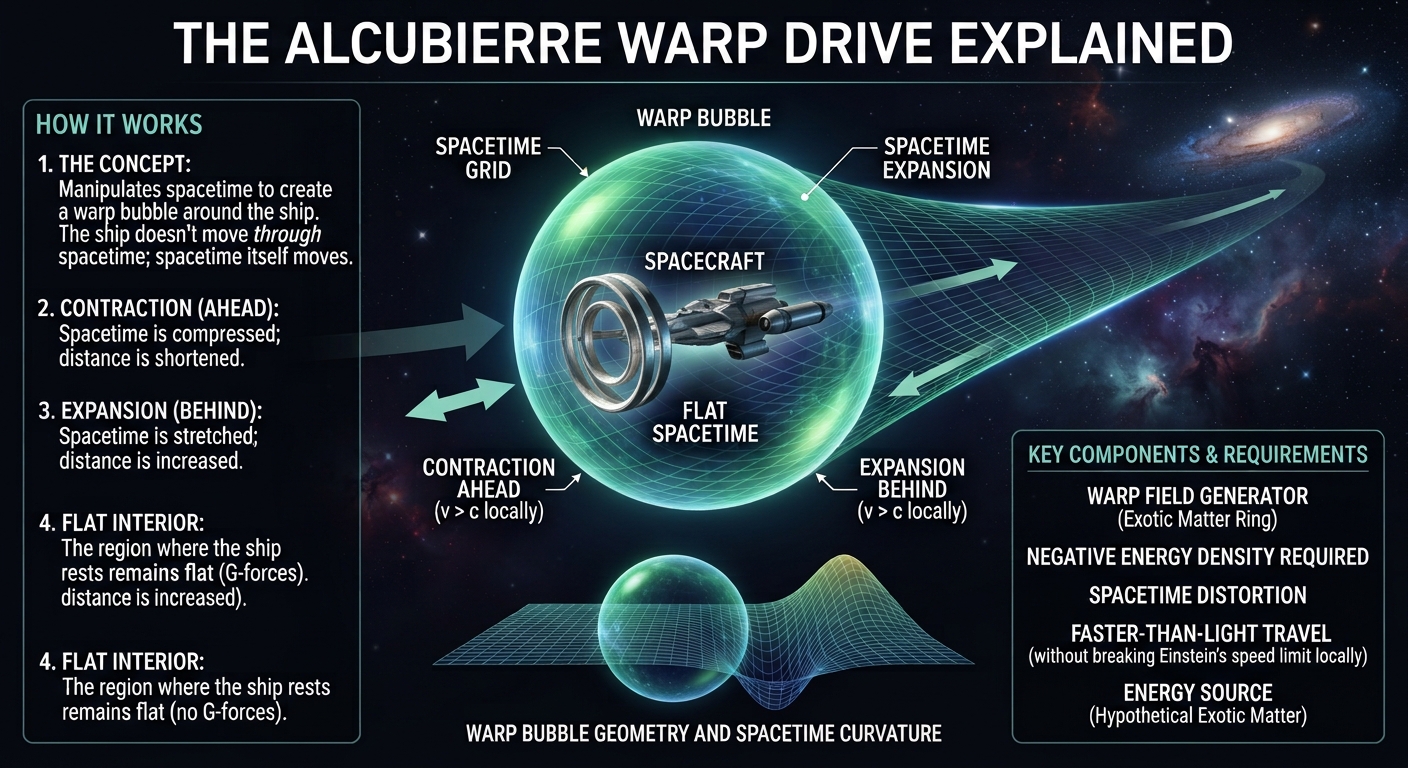
The Alcubierre engine (or Alcubierre Drive) is a theoretical solution to the Einstein Field Equations that allows for superluminal (faster-than-light) travel by distorting spacetime rather than moving a craft through space in the conventional sense. proposal by Miguel Alcubierre Moya (a Mexican theoretical physicist)
1. Fundamental Mechanism
The core idea is to create a “warp bubble.” Instead of the spaceship accelerating to near-light speed (which would require infinite energy and cause time dilation), the engine modifies the geometry of spacetime around the craft:
- Front of the bubble: Spacetime is contracted.
- Back of the bubble: Spacetime is expanded.
The spaceship remains stationary inside a region of flat spacetime (the bubble). The bubble itself is moved by the curvature of the spacetime “surf,” effectively transporting the craft at any arbitrary speed—including superluminal speeds—relative to an outside observer, without violating the local laws of Special Relativity.
2. The Alcubierre Metric
The theoretical foundation is expressed through the Alcubierre metric. In a simplified form (with c=1), the spacetime interval is defined as:
Component Breakdown:
- : The velocity of the warp bubble center.
- : The shape function (or regulating function). It determines the geometry of the bubble.
- inside the bubble (the passenger experiences flat space).
- outside the bubble (spacetime remains asymptotically flat).
- The transition occurs at the bubble walls.
- : The distance from the center of the bubble: .
- Shift Vector (): The term is known as the shift vector. It represents the “velocity” of the coordinate system relative to the Eulerian observers.
3. Operational Physics & Constraints
While mathematically consistent within General Relativity, the Alcubierre drive faces severe operational hurdles:
- Exotic Matter (Negative Energy): To create the necessary expansion and contraction, the stress-energy tensor must violate the Weak Energy Condition (WEC). This requires matter with negative energy density, often referred to as “exotic matter.”
- The Energy Requirement: Early calculations suggested that the energy required to move a small ship would exceed the total mass-energy of the observable universe. Later refinements (by Van Den Broeck and others) have reduced this, but it remains astronomical.
- The Horizon Problem: A ship inside the bubble is causally disconnected from the front wall of the bubble. This means the crew cannot “steer” or “turn off” the drive from the inside; the path would have to be laid out by external infrastructure beforehand.
- Hawking Radiation: Some theories suggest the bubble would accumulate high-energy particles (blue-shifted radiation) at the front wall, potentially incinerating anything at the destination upon arrival.
Summary Table
| Feature | Description |
|---|---|
| Core Logic | Move the space, not the ship. |
| Local Experience | Zero acceleration; no time dilation. |
| Key Equation | |
| Main Blocker | Requirement for negative energy density (exotic matter). |
| Causal Status | Superluminal globally, subluminal locally. |
Exotic matter
In physics, specifically within General Relativity, exotic matter is a theoretical form of matter that possesses negative energy density and/or negative pressure.
It is distinct from “dark matter” (which is an unknown substance that provides extra gravitational pull) and “antimatter” (which has opposite charge but still has positive mass/energy).
Here is the breakdown of what makes matter “exotic”:
1. Violation of Energy Conditions
In standard physics, we assume that energy density is always non-negative. This is formalized as the Weak Energy Condition (WEC).
- Normal Matter: If you measure any volume of space, the energy density is .
- Exotic Matter: . To an observer, this matter would effectively have a “negative mass.”
2. Gravitational Repulsion
Because of the way the Einstein Field Equations work, mass-energy tells spacetime how to curve.
- Positive mass creates attractive gravity (convergence of geodesics).
- Negative mass/energy creates gravitational repulsion (divergence of geodesics).
This is why the Alcubierre drive requires it: to expand the space behind the ship, you need a source of gravity that “pushes” spacetime apart rather than pulling it together.
3. Does it actually exist?
Whether exotic matter can exist in bulk is an open question, but there are two primary pieces of evidence that “negative energy” is mathematically and physically possible:
- The Casimir Effect: In quantum field theory, if you place two uncharged conducting plates extremely close together, they restrict the types of vacuum fluctuations that can exist between them. This creates a region of space between the plates with a lower energy density than the surrounding vacuum—effectively a local negative energy density.
- Dark Energy: The accelerated expansion of the universe is attributed to “Dark Energy” (often modeled as the Cosmological Constant ). Dark energy behaves like a fluid with a strong negative pressure, acting as a repulsive force on a cosmic scale.
Summary Comparison
| Matter Type | Mass/Energy | Gravitational Effect | Example/Status |
|---|---|---|---|
| Normal | Positive | Attractive | Planets, stars, people |
| Antimatter | Positive | Attractive | Positrons, antiprotons |
| Dark Matter | Positive | Attractive | Galactic halos (unseen) |
| Exotic | Negative | Repulsive | Casimir effect, Dark Energy |
Weak Energy Condition (WEC)
The Weak Energy Condition (WEC) is a fundamental restriction in General Relativity that formalizes a very simple intuition: the energy density of any region of space, as measured by any single observer, must be non-negative.
In simpler terms, it is the “no negative energy” rule.
1. The Mathematical Definition
In the language of tensors, the WEC is expressed using the Stress-Energy Tensor (), which describes the density and flux of energy and momentum in spacetime.
The condition states that for any timelike vector (which represents the 4-velocity of a physical observer):
What this actually means:
- is the observer’s path through spacetime.
- The contraction results in the energy density that the observer measures.
- The inequality simply says: “You cannot measure a negative amount of energy.”
2. Why is this a “Condition” and not a “Law”?
The WEC is called a condition because Einstein’s Field Equations describe how spacetime curves based on energy, but they don’t actually tell you what kinds of energy are allowed to exist.
Physicists add “Energy Conditions” (like WEC, SEC, and DEC) to the theory to filter out “unphysical” solutions. If a mathematical solution to Einstein’s equations requires a violation of the WEC, it is generally considered experimentally impossible or unphysical unless a specific quantum mechanism can be found to support it.
3. Relation to the Alcubierre Drive
The Alcubierre drive is a “mathematical curiosity” precisely because it violates the WEC.
To create the warp bubble:
- You need to expand spacetime behind the ship.
- Expansion requires a repulsive gravitational effect.
- Repulsive gravity requires a negative energy density ().
- Therefore, the Alcubierre metric requires .
Because this violates the WEC, most physicists conclude that the Alcubierre drive cannot be built using any known form of matter.
4. The “Loophole”: Quantum Field Theory
While the WEC holds for all classical matter (stars, gas, light), Quantum Field Theory (QFT) allows for local violations.
As mentioned previously, the Casimir Effect creates a region of space where the energy density is lower than the surrounding vacuum (effectively negative). This proves that the WEC is not an absolute law of the universe, but rather a guideline. However, there is a massive gap between a tiny laboratory effect (Casimir) and the astronomical amounts of negative energy needed to warp spacetime for a spaceship.
