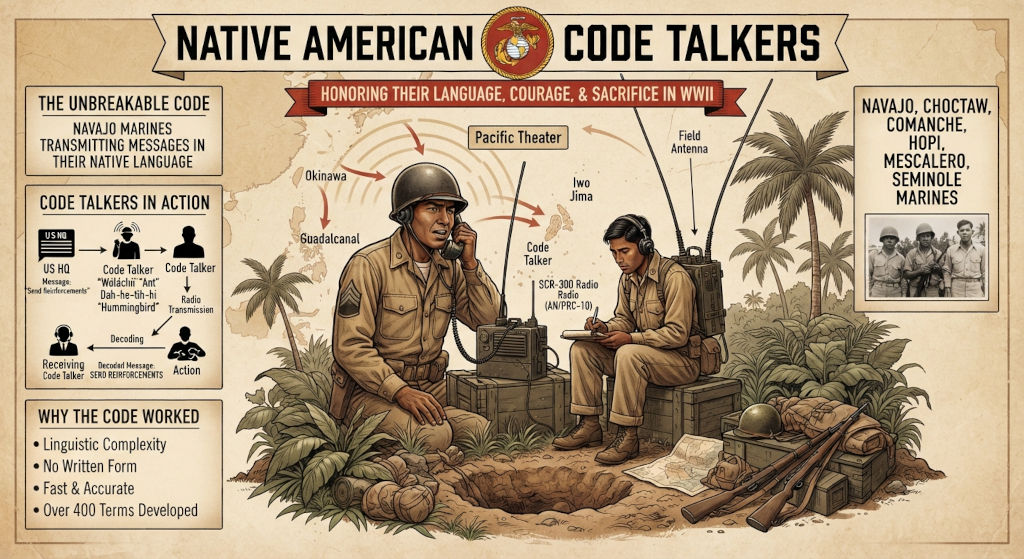
The “Code Talkers” were members of various Native American tribes who used their native languages to create secure, unbreakable communication systems for the U.S. military during World War II (and some in World War I).
To provide a more exhaustive and descriptive account, we must look at the Code Talkers not just as a military tool, but as a convergence of linguistics, strategic desperation, and a complex sociological paradox.
1. The Genesis: Why Native Languages?
By 1942, the U.S. military faced a critical failure in communication. Machine encryption (like the Enigma used by Germany) was slow and prone to being “broken” by enemy cryptanalysts. In the fast-paced environment of the Pacific Theater, the time spent encoding a message into a cipher and the time spent decoding it on the other end created a deadly lag.
The military needed a code that was:
- Rapid: Able to be spoken and understood in real-time.
- Indigenous: Not based on a known Western linguistic structure.
- Rare: Spoken by very few people outside a specific geographic area.
The Navajo language (Diné Bizaad) was ideal because it is an unwritten, tonal language with a complex grammar that is fundamentally different from Indo-European languages. At the time, very few non-Navajos spoke it, and there were no dictionaries or textbooks available to the Japanese intelligence services.
2. The Architecture of the Code
A common misconception is that the Code Talkers simply spoke their native language over the radio. In reality, they developed a two-layered encryption system to ensure that even if a Navajo speaker were captured or if a Japanese linguist somehow learned the language, the messages would still be unintelligible.
- Layer 1: The Alphabet Substitution. To transmit names or specific coordinates, they created a Navajo alphabet. They chose words for animals or objects to represent English letters. For example, the letter “A” might be represented by a specific Navajo word for a type of bird.
- Layer 2: The Thematic Dictionary. For common military terms, they created a standardized dictionary of substitutions. They avoided using the literal Navajo word for a military object and instead used a descriptive one.
- “Iron Fish” Submarine
- “Hummingbird” Fighter Plane
- “Turkey” Bomber
- “Talking-with-the-wind” Radio
This meant a message like “Send fighter planes to the beach” would be translated into a series of Navajo words that sounded like a conversation about birds and nature to anyone listening.
3. Operational Role & The “Pacific Edge”
The Code Talkers were deployed in the most precarious positions—often as the first wave of an invasion. Because they were the primary link between the frontline infantry and the command centers, they were high-priority targets for the enemy.
The Battle of Iwo Jima stands as the definitive example of their utility. During the first 48 hours of the battle, six Navajo Code Talkers worked without sleep, transmitting over 800 messages. General an Army officer later remarked that without the Navajo, the Marines would never have taken Iwo Jima. Their ability to call in precise artillery strikes and air support in seconds—rather than the 30 minutes a machine cipher would require—saved countless American lives.
4. The Multi-Tribal Effort
While the Navajo program was the most formalized (due to the Marine Corps’ structured recruitment), the U.S. military utilized a wide array of other tribal languages:
- The Choctaw: They were actually the first Native American code talkers, used during World War I to confuse German listeners in the trenches of France.
- The Comanche and Cherokee: Served in various capacities, often in smaller, less centralized groups than the Navajo.
- The Hopi: Often worked alongside the Navajo due to shared regional geography in the American Southwest.
5. The Sociological Paradox
The story of the Code Talkers contains a profound irony. The Navajo people were serving a government that had, only decades prior, treated them as enemies of the state.
- The Long Walk (1864): The U.S. government had forcibly removed the Navajo from their lands in a brutal ethnic cleansing campaign.
- Boarding Schools: The U.S. government had spent years running boarding schools where Navajo children were physically punished for speaking their native language.
Despite this, the Code Talkers volunteered. They viewed their service as a way to protect their homeland and prove their loyalty and value to a nation that had historically marginalized them.
6. The Wall of Silence (The Aftermath)
One of the most descriptive parts of their history is the post-war silence. Because the code was considered a vital strategic asset, the program remained top secret until 1968.
For over 20 years, the Code Talkers returned home and lived as ordinary citizens. They could not tell their children, spouses, or community members why they had been chosen for special duties or why their role in battles like Iwo Jima was so critical. They were “invisible heroes.” It wasn’t until the late 1960s and eventually the 2000s (with the awarding of the Congressional Gold Medal) that their contributions were publicly and officially recognized.
Summary of Descriptive Facts
- Personnel: across various tribes; the “First Navajo” was 29 men.
- Speed: Reduced transmission time from minutes (machine) to seconds (human).
- Success Rate: 100% encryption success; the Japanese military never broke the code.
- Key Theaters: Primarily the Pacific (Island Hopping campaign).
Summary of Strategic Value
The Code Talkers solved a critical vulnerability in WWII communications: the trade-off between security (strong encryption) and speed (rapid battlefield communication). By leveraging the unique complexity of Native languages, they provided the U.S. military with a “human cipher” that was faster than any machine of the era and remained completely penetrated-proof throughout the war.
Sources
Museums & Official Institutions
- The National WWII Museum: https://www.nationalww2museum.org/war/articles/american-indian-code-talkers
- National Museum of the American Indian: https://americanindian.si.edu/why-we-serve/topics/code-talkers/
- CIA (Central Intelligence Agency): https://www.cia.gov/stories/story/navajo-code-talkers-and-the-unbreakable-code
Academic & Government Records
- Cambridge University Press: https://www.cambridge.org/core/books/indigenous-peoples-and-the-second-world-war/war-years-19391945/5312319142AEBE89FA7A78D8BCB89DEF
- Arizona State University (ASU): https://news.asu.edu/20171130-discoveries-code-talker-101-asu-professor-storyteller-offers-insight-history
- Utah State History: https://historytogo.utah.gov/post/uhg-history-american-indians-ch-7/
News & Media
- AP News: https://apnews.com/article/navajo-code-talkers-dei-pentagon-native-american-5ae814f99a5c5e00128613b2be9b554e
- National Geographic: https://www.nationalgeographic.com/history/article/navajo-code-talkers-wwii
- Wikipedia (Battle of Iwo Jima): https://en.wikipedia.org/wiki/Battle_of_Iwo_Jima
