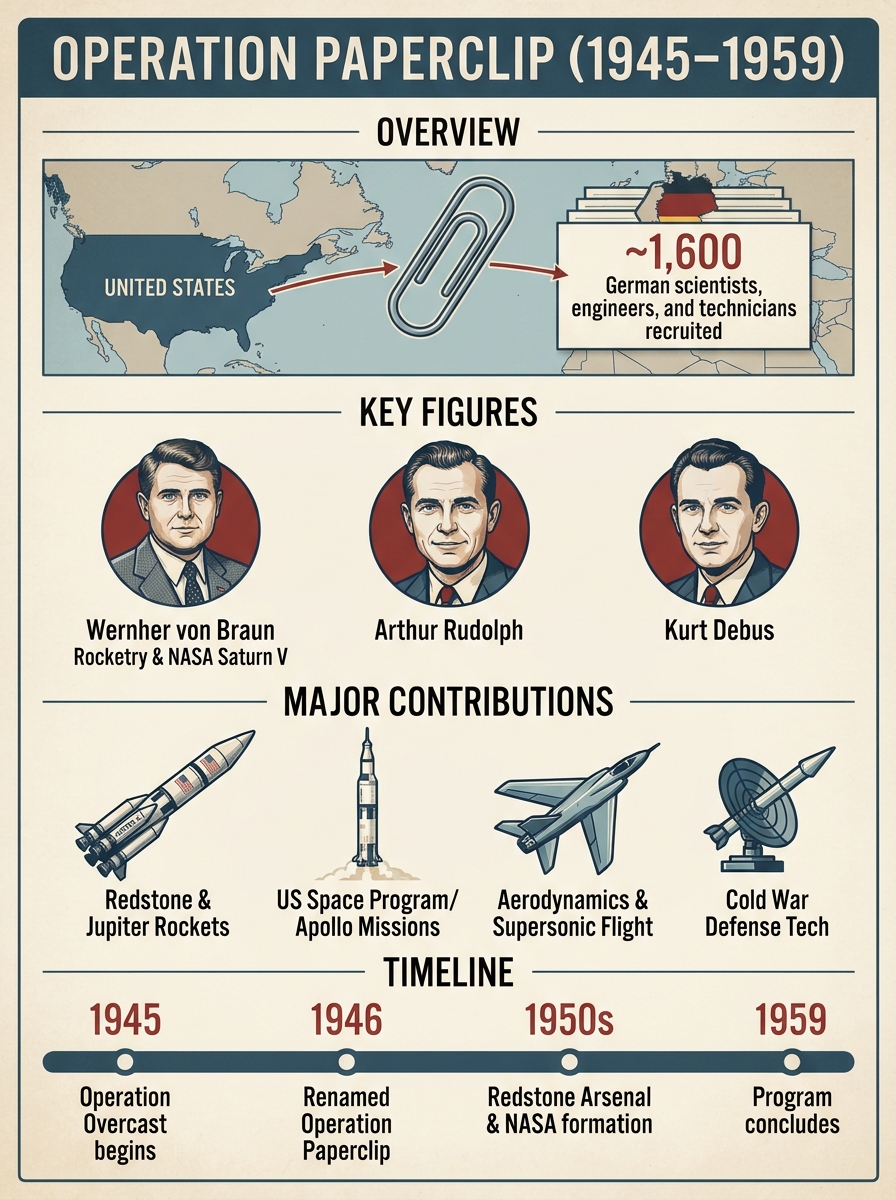
Operation Paperclip was a secret U.S. program that brought about 1,600 German scientists, engineers and technicians to the United States between 1945 and 1959. Many of them had been Nazi Party or SS members. The aim was to use their expertise in rocketry, aviation, medicine and chemical and biological weapons, and to keep it away from the Soviet Union.
Britannica describes it as a program that sponsored the postwar immigration of German and Austrian scientists to exploit their knowledge for military and industrial purposes. It was run by the Joint Intelligence Objectives Agency (JIOA) and largely carried out by agents of the U.S. Army Counter Intelligence Corps (CIC) (Wikipedia). Over the following decades it became one of the most debated moral bargains of the Cold War.
Key facts and timeline
The program began as Operation Overcast in July 1945, was renamed Paperclip in late 1945, and formally ended in 1947, though follow-on programs continued until about 1962.
| Date | Event | Detail |
|---|---|---|
| 1962 | JIOA disbanded | Related follow-on programs end (National Archives) |
| 30 Sep 1947 | Paperclip officially ends | Individual cases still considered afterward (U.S. Army / DVIDS) |
| 3 Sep 1946 | Truman’s secret directive | Formally approves Paperclip, expanded to 1,000 scientists under “temporary, limited military custody” (Wikipedia) |
| Nov 1945 | Renamed Paperclip | Ordnance officers clipped the folders of scientists they wanted; “Camp Overcast” had become locally known. Some sources say March 1946 (TheCollector) |
| Sep 1945 | First arrivals | Seven rocket scientists, including Wernher von Braun, reach Fort Strong (Jewish Virtual Library) |
| 19 Jul 1945 | Operation Overcast created | Joint Chiefs of Staff launch it to help end the war with Japan and aid postwar military research; capped at about 350 people (HistoryNet) |
| Spring 1945 | Rocket team surrenders | Dornberger, von Braun, Rudolph and about 450 others move to Bavaria to surrender to the Americans (HistoryNet) |
| 1943 | Osenberg List | Germany recalls scientists from combat; the list of them later becomes the Allies’ target list (Jewish Virtual Library) |
Truman’s ban and how it was evaded. Truman forbade recruiting Nazi members or active supporters (History.com). That rule would have excluded von Braun, Rudolph and Strughold. The JIOA got around it by writing new employment and political biographies for the scientists.
How many people came. Totals vary by source:
| Source | Figure |
|---|---|
| History.com | About 1,600 scientists, plus families |
| National Geographic | About 1,500 scientists from Germany and Austria, through 1962 |
| National Archives | Dossiers on over 1,500 people |
| Nuremberg.media | 1,800 specialists and 3,700 family members |
People involved
The best-known recruits came from rocketry and aviation medicine, but the program also brought in chemical and biological weapons experts.
| Person | Field | Role in Germany | Role in the U.S. |
|---|---|---|---|
| Wernher von Braun | Rocketry | SS officer; technical director of the V-2 program, which used concentration-camp forced labor | Led design of the Saturn V Moon rocket; made space films with Walt Disney |
| Arthur Rudolph | Rocket production | Nazi Party member from 1931, SS captain from 1940; ran V-2 production at Mittelwerk (1943–45) | A chief engineer of the Saturn V; U.S. citizen 1954–1984 |
| Hubertus Strughold | Aviation medicine | Headed the Luftwaffe Institute of Aviation Medicine | “Father of Space Medicine”; first professor of space medicine (1948); chief scientist of NASA’s Aerospace Medical Division (1962) |
| Kurt Blome | Biological warfare | Deputy Reich Surgeon General; ran the bioweapons program | Tried at Nuremberg and acquitted; later hired by the U.S. Army Chemical Corps |
| Kurt Debus | Launch operations | V-2 test engineer | First director of NASA’s Kennedy Space Center |
| Walter Dornberger | Rocket program | General in charge of the army rocket program | Served prison time for using slave labor before coming to the U.S. |
Others. Annie Jacobsen’s research also names Walter Schreiber, Erich Traub, Georg Rickhey, Otto Ambros, Fritz Hoffmann, Jürgen von Klenck, Theodor Benzinger, Konrad Schäfer, Hermann Becker-Freyseng, Siegfried Ruff, Siegfried Knemeyer, Walther Riedel and Emil Salmon.
On the American side:
- President Harry Truman approved the program.
- The JIOA, the Army Ordnance Corps and the CIC ran it.
- Major Robert Staver of Army Ordnance drew up the first target list. He first meant only to interview the scientists, but what he learned changed the operation’s purpose.
The controversy
The central charge is that the United States knowingly rewarded people tied to forced labor and human experimentation, and hid their records to do it.
Forced labor at Mittelbau-Dora. The V-2 was built in the underground Mittelwerk factory using prisoners from the Mittelbau-Dora concentration camp. An estimated 20,000 prisoners died there from starvation, exhaustion and execution. U.S. government documents show that von Braun and Rudolph oversaw construction of the factory using camp inmates as slave labor (JTA).
Cleaned-up records. Historian Brian Crim told National Geographic that the vetting process was “deliberately shoddy”. He says most recruits were Nazi Party or SS members, and the paperclip effectively signalled officials not to look too closely. Journalists only uncovered the details in the 1970s and 1980s.
The Rudolph case (1984). The Justice Department’s Office of Special Investigations (OSI), created in 1979 to find Nazi war criminals, investigated Rudolph. In 1984 he agreed to return to Germany and gave up his U.S. citizenship rather than face charges (J Weekly). OSI director Neal Sher called it “an awful irony” that Rudolph’s expertise was used in America over the bones of innocent victims (CIA reading room). A Hamburg prosecutor opened a preliminary inquiry on 30 October 1984, but Rudolph was never prosecuted (Passport-Collector). He tried for years to regain U.S. citizenship and died in 1996, aged 89 (Aish).
The Strughold case. In October 1942 Strughold attended a Nuremberg medical conference where SS doctor Sigmund Rascher presented freezing experiments carried out on Dachau prisoners (Wikipedia). The Dachau experiments included immersion in ice water, pressure-chamber tests and forced drinking of seawater (J Weekly). How much he knew is still disputed, but his honors were withdrawn over time:
- An Air Force aeromedical library named for him was renamed in 1995 (David Darling).
- He was removed from the International Space Hall of Fame in 2006 (NBC News).
- The Space Medicine Association retired the Strughold Award in 2013 (History of Medicine).
Biological and chemical weapons experts. Blome reportedly tested plague vaccines on prisoners, and Schreiber tested bacterial weapons (Nuremberg.media). Blome’s U.S. Army Chemical Corps file did not mention his human experimentation (Listverse).
The core moral argument. Defenders said the recruitment was needed for national security and to win the Cold War against the Soviet Union (Business Today). Critics answered that it let people responsible for atrocities escape justice. On ABC’s Nightline in 1984, Ted Koppel asked whether Rudolph’s later work could ever outweigh his share in thousands of deaths (CIA reading room).
The Soviet counterpart: Operation Osoaviakhim
The Soviet Union ran a parallel, forced version. Britain also competed for German scientists but was largely pushed out (Medium / The Analyst Centre).
On the night of 22 October 1946, Soviet MVD and army units removed German specialists from the Soviet zone at gunpoint (Wikipedia). In total, 2,552 specialists and 4,008 family members were sent to the USSR (Wikipedia). This race for German expertise is a large part of why Washington accepted Paperclip’s moral cost.
Impact on history
Paperclip shaped the U.S. space program and Cold War military power, and it remains a standard case study in trading justice for national security.
- The space race and the Moon landing. Von Braun’s team laid the foundation of the U.S. space program and built the Saturn V that carried Apollo to the Moon.
- Military power in the Cold War. German expertise strengthened U.S. ballistic missiles, jet aviation and chemical and biological weapons research, which affected the Cold War balance of power (We Are The Mighty).
- Aerospace medicine. Strughold and his colleagues laid foundations for keeping people alive in high-altitude flight and in space.
- Late accountability. From 1979 the OSI reopened files that had been closed for nearly 40 years (Christian Science Monitor).
- A lasting ethical case. National Geographic calls it a controversial chapter in which U.S. officials brought former Nazis into American life and institutions.
Key books and archives
| Title | Author / holder | Why it matters |
|---|---|---|
| Operation Paperclip: The Secret Intelligence Program to Bring Nazi Scientists to America | Annie Jacobsen (Little, Brown, 2014) | The most detailed public account, drawing on newly declassified documents and interviews |
| Our Germans: Project Paperclip and the National Security State | Brian E. Crim (Johns Hopkins University Press) | An academic history of the program |
| Secret Agenda (1991) | Linda Hunt | Investigative work whose 1980s research helped expose the program |
| Foreign Scientist Case Files 1945–1958, RG 330 | U.S. National Archives | JIOA dossiers on more than 1,500 recruits |
| Declassified CIA and FBI files | The Black Vault | 267 pages from the CIA and 32 from the FBI |
Movies and TV
Operation Paperclip has been the basis of one major TV series, a plot device in several films, and the subject of a few documentaries.
Drama and fiction
| Title | Year | Type | How it uses Paperclip |
|---|---|---|---|
| Hunters | 2020–2023 | Amazon Prime series | Historical fiction about 1970s Nazi hunters in New York. Wernher von Braun (played by Victor Slezak) is the only real Paperclip figure in season 1; the “Fourth Reich” plot is invented (Screen Rant) |
| Indiana Jones and the Dial of Destiny | 2023 | Film | The villain, Jürgen Voller, is a fictional character modelled on the Paperclip recruits |
| Captain America: The Winter Soldier | 2014 | Film | Hydra infiltrates SHIELD through Paperclip |
| The X-Files, “Paper Clip” | 1995 | TV episode | Season 3 conspiracy episode built around the program (cited from memory, not checked against a source) |
| The Rocky Horror Picture Show | 1975 | Film | The character Dr. Scott is strongly implied to be a Paperclip recruit |
| Dr. Strangelove | 1964 | Film | The title character is said to have come to the U.S. through Paperclip |
Documentaries
| Title | Year | Notes |
|---|---|---|
| My Grandfather Was a Nazi Scientist: Opa, von Braun and Operation Paperclip | 2022 | A filmmaker uncovers her grandfather’s wartime science work and his recruitment |
| Camp Confidential: America’s Secret Nazis | 2021 | 35-minute Netflix film about P.O. Box 1142, the secret interrogation camp near Washington, with interviews of surviving soldiers |
| Operation Paperclip: The Secret Recruitment | 2019 | 51 minutes, directed by Kim Harrington; focuses on the recruits who went to NASA. Weakly reviewed on IMDb |
| Atomic Rocketeer and related films | 2020s | Larry L. Sheffield’s series on New Mexico’s Manhattan Project, Trinity and Paperclip history |
In development
- Paperclip, a screenplay by Ioana Uricaru based on the program. No sign it has been produced yet.
Sources
Some details differ between sources, especially head counts (1,500 to 1,800) and the date of the name change (November 1945 or March 1946). The figure of about 20,000 deaths at Mittelbau-Dora is widely cited but is an estimate.
- Operation Paperclip – Wikipedia
- Project Paperclip – Encyclopaedia Britannica
- How Operation Paperclip brought Nazi scientists to the U.S. – National Geographic
- What Was Operation Paperclip? – History.com
- Operation OVERCAST Created to Recruit German Scientists – U.S. Army Intelligence Center (DVIDS)
- IWG Declassified Records, RG 330 (JIOA) – U.S. National Archives
- World War II: Operation Paperclip – Jewish Virtual Library
- How the U.S. Got Nazi Germany’s Best Scientists – HistoryNet
- Operation Paperclip – Annie Jacobsen
- Arthur Rudolph – Wikipedia
- The Nation, 17 Nov 1984, on Rudolph – CIA FOIA Reading Room
- ABC Nightline transcript, 18 Oct 1984 – CIA FOIA Reading Room
- Arthur Rudolph: Saturn V Engineer’s Fall From Grace – Passport-Collector
- TV documents recruitment of Nazi scientists – JTA archive
- Secret OSI report on Nazi cases – J Weekly
- Critics doubt latest US version of rocket scientist’s wartime role – Christian Science Monitor (1985)
- Hubertus Strughold – Wikipedia
- Name of scientist nixed from library due to Nazi past – J Weekly (1995)
- Former Nazi removed from Space Hall of Fame – NBC News
- Strughold award retired 2013 – History of Medicine
- 10 Nazi Scientists Who Survived the War – Listverse
- That time America worked with Nazi scientists – We Are The Mighty
- Operation Paperclip – TheCollector
- How Nazi scientists laid the foundation for NASA – Business Today
- Harry Truman Approves Operation Paperclip – Nuremberg.media
- Operation Osoaviakhim – Wikipedia
- German influence on Soviet rocketry – Wikipedia
- Of Paperclips and Rockets – Medium / The Analyst Centre
- Operation Paperclip: The Truth – Aish
- Declassified documents – The Black Vault
