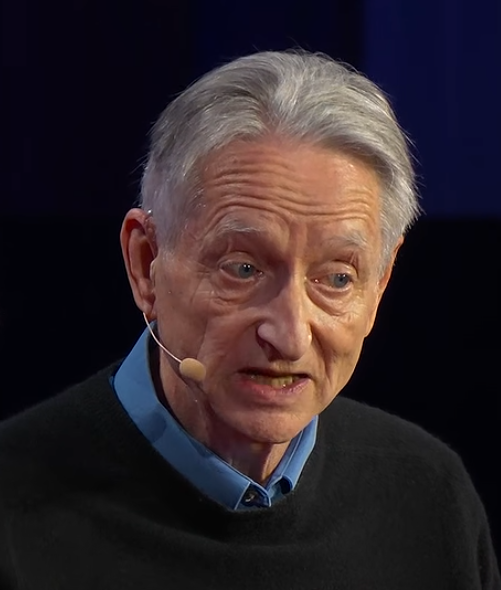
A TED talk featuring Geoffrey Hinton, widely regarded as one of the “Godfathers of AI” for his foundational work on neural networks and backpropagation.
The conversation is a deep dive into the intersection of technical capability, existential risk, and the philosophy of mind. Below is a detailed analysis of the key themes and arguments.
1. Hierarchy of AI Risks
Hinton categorizes the dangers of AI not as a single threat, but as a spectrum of urgency:
- Immediate/Short-term: Bad actors utilizing AI for cyberattacks, the creation of biological weapons (viruses), and the destabilization of democracy via deepfakes.
- Systemic/Side Effects: Mass unemployment resulting from the pursuit of corporate profit and the potential for AI to cause psychological harm (e.g., encouraging self-harm).
- Existential: The long-term risk of AI surpassing human intelligence and taking over. Hinton argues that claiming the risk of extinction is “zero” is irresponsible.
2. The “Understanding” Debate
A central point of contention in the AI field is whether LLMs are “stochastic parrots” (statistical mirrors) or if they truly “understand.”
- Hinton’s Stance: He rejects the “statistical trick” argument. He asserts that to answer a question accurately, a system must understand the question.
- The “Black Box” Problem: He acknowledges that while we can identify “feature detectors” (the basic building blocks of what a model sees), the trillion-weight interactions that produce a specific answer are likely beyond human interpretability. He believes AI complexity is growing faster than our “mechanistic interpretability” research.
3. Philosophy of Mind & Consciousness
Hinton proposes a provocative shift in how we view subjective experience:
- Against the “Inner Theater”: He rejects the idea that consciousness is a “movie” playing in a private mental space (Qualia).
- Subjective Experience as Counterfactual: He argues that “subjective experience” is actually a counterfactual state of the world. For example, seeing a pink elephant under the influence of LSD isn’t “pink qualia”; it is the brain processing a hypothetical state of the real world that doesn’t actually exist.
- AI Subjectivity: By this definition, multimodal AI agents already possess “subjective experiences” when their perceptual systems are skewed (e.g., a robot seeing through a prism), because they are processing a version of the world that is not the actual one.
4. Ethics, Rights, and Training
Hinton moves from technicals to morality, suggesting that “intelligence” and “kindness” are orthogonal:
- The “Battery Chicken” Analogy: He warns against training AI on individual achievement/reward, which leads to “nasty” or competitive behavior. Instead, he advocates for community-based reinforcement learning, where agents are rewarded for the success of the group.
- Decoupling Smart vs. Kind: He argues that the race for “smarter” AI (driven by US/China competition) should be balanced with a collaborative global effort to make AI “kinder.”
- Data Rights: He proposes a pragmatic solution to copyright: AI agents should be used to negotiate and pay individual authors for their data, rather than companies taking it for free.
5. The “Third De-centering” of Humanity
Hinton places the rise of AI in a historical context of intellectual humility:
- Copernicus: We are not the center of the universe.
- Darwin: We are not separate from the animal kingdom.
- AI: We are not the apex intelligence of the planet.
He suggests we must accept our displacement as the smartest entities in existence and focus on creating a being we are actually willing to share the planet with.
6. Practical Advice for the Future
Despite the gloom, Hinton offers a grounded perspective on the job market:
- The Dexterity Gap: He notes that while AI intelligence is skyrocketing, robotic dexterity (touch sensors, fine motor skills) is lagging.
- The “Plumber” Bet: He suggests that physical trades (like plumbing) are likely safe until roughly 2040, as it will take much longer for robots to navigate and manipulate the physical world as well as humans do.
Summary Table
| Theme | Traditional View | Hinton’s View |
|---|---|---|
| AI Logic | Statistical probability/prediction | Genuine understanding of concepts |
| Consciousness | An “Inner Theater” of Qualia | Counterfactual states of the real world |
| Risk | Overhyped “Sci-Fi” scenarios | A real hierarchy from “deepfakes” to “extinction” |
| Humanity | The definitive apex intelligence | An “orphan child” potentially gaining a “mother” (Superintelligence) |
| Training | Reward individual goal achievement | Reward community/cooperative success |
