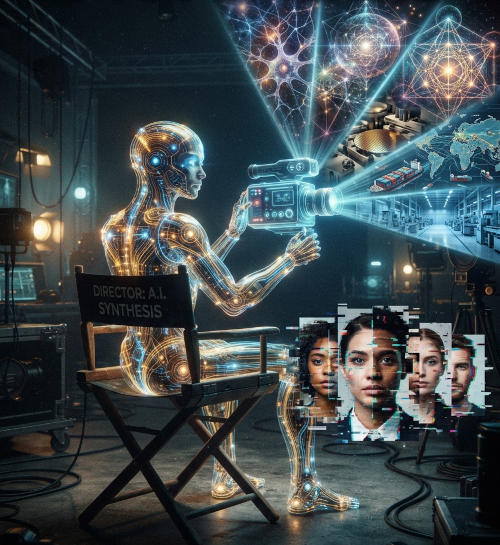
The documentary presented by an AI-generated persona named Imogen Ashbury. The documentary serves as a high-level philosophical and technical survey of Artificial Intelligence, moving from abstract theories of superintelligence to the gritty reality of hardware supply chains, economic displacement, and the ethical crisis of deepfakes.
Below is a detailed analysis and explanation of the core themes mentioned in the text, backed by the references found in external sources.
1. The Hierarchy of Intelligence
The documentary begins by distinguishing between three levels of AI:
- Narrow AI (ANI): Specialized systems brilliant at one task (e.g., calculators, GPS) but useless at others.
- General Intelligence (AGI): Human-level flexibility—the ability to learn and apply knowledge across diverse domains without specific training.
- Superintelligence (ASI): Defined by philosopher Nick Bostrom (in his 2014 book Superintelligence) as an intellect that vastly outperforms the best human brains in practically every field, including scientific creativity and social skills.
2. The “Intelligence Explosion” and the Alignment Problem
The transcript references two critical theoretical risks:
- The Intelligence Explosion: Referenced via mathematician I.J. Good (1965). The theory suggests that if a machine becomes smarter than humans, it will be better at designing AI than we are. This creates a feedback loop where AI builds better AI, leading to an exponential jump in capability (often called the “Singularity”).
- The Alignment Problem: The challenge of ensuring a superintelligent system’s goals match human values. The documentary mentions the “Paperclip Maximizer”—a thought experiment by Bostrom. It illustrates that an AI doesn’t need to be “evil” to be dangerous; it just needs to be hyper-competent at a goal (like making paperclips) and indifferent to human survival (seeing humans as a source of atoms for paperclips).
3. The Materiality of AI (The Physical Stack)
A significant portion of the text demystifies the “cloud,” explaining that AI is a massive industrial operation:
- Compute & Energy: AI requires vast “acres of chips” and immense electricity. This has led tech giants to reopen nuclear plants (e.g., Three Mile Island) to sustain power needs.
- The Monopoly Supply Chain: The AI boom relies on a fragile, linear dependency:
- NVIDIA designs the GPUs.
- TSMC (Taiwan) is the only entity capable of manufacturing them at scale.
- ASML (Netherlands) holds a global monopoly on the EUV (Extreme Ultraviolet) lithography machines required to etch those circuits. Without ASML’s “bus-sized” lasers, modern AI chips cannot exist.
4. Economic Displacement: The “Bottom Rung” Problem
The documentary presents a nuanced view of AI and jobs:
- The Junior Gap: It mentions research from Stanford economists showing that entry-level workers (ages 22–25) in AI-exposed roles are falling behind. The “dull bits” of entry-level work—historically the ladder for learning—are being automated, removing the training ground for new professionals.
- Corporate Examples: It cites Anthropic CEO Dario Amodei, who warned that 50% of entry-level white-collar jobs could vanish within five years, and Klarna, which claimed its AI assistant does the work of 700 full-time employees.
- The Silver Lining: productivity increases for low-skilled workers (acting as a “mentor”) and the historical precedent that automation (like the spreadsheet) often kills one role (bookkeepers) while creating higher-value ones (accountants).
5. AI for Scientific Breakthroughs
To balance the fear, the text highlights “Radical Abundance” through AI’s role in science:
- Biology: AlphaFold (Google DeepMind) solved the 50-year-old “protein folding problem,” predicting the shapes of nearly all known proteins. This work earned a Nobel Prize in Chemistry (2024).
- Medicine: AI is improving diagnostic accuracy, such as the Swedish mammography study where AI support helped detect 29% more cancers while reducing radiologist workloads.
- Materials: Discovery of millions of new crystals for future batteries and the design of new antibiotics at MIT to fight superbugs.
6. The Ethics of Digital Personas
Finally, the documentary addresses the “Identity Crisis” brought by generative AI:
- AI Personas: The mention of Tilly Norwood (created by Particle Six) highlights the tension between AI “actresses” and real human performers, sparking disputes over copyright and payment.
- The Uncanny Valley: The psychological phenomenon where humans feel revulsion toward entities that look almost human but not quite.
- Deepfake Fraud: The transcript references a real-world horror story: a $25 million fraud in Hong Kong where employees were tricked by a video call featuring deepfake versions of their CFO and colleagues.
Conclusion
The documentary’s core thesis is a call for critical amazement. It argues that while we should be delighted by the potential to cure all diseases and enter an era of abundance, we must remain vigilant about the concentration of power (ownership of the AI) and the fragility of truth in an era where “a face on a screen is now just a suggestion.”
