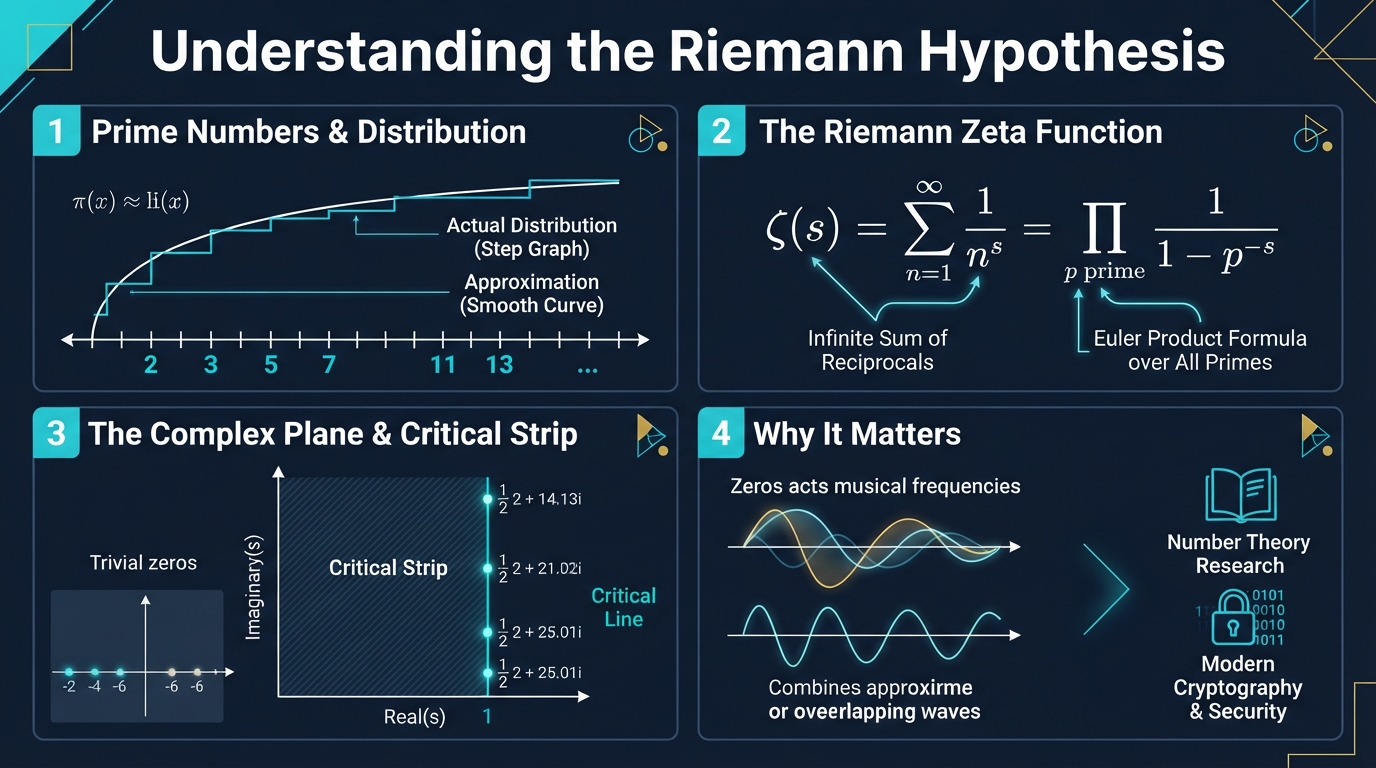
The Riemann Hypothesis is a conjecture about the distribution of prime numbers. It centers on the Riemann zeta function, denoted as .
The Technical Core
The zeta function is defined for a complex number (where the real part is greater than 1) as the sum:
Through a process called analytic continuation, this function can be extended to the rest of the complex plane (except for a pole at ).
The function has “zeros”—values of s where .
- Trivial zeros: These occur at every negative even integer (). These are well-understood and a mathematical formality.
- Non-trivial zeros: These are the zeros that lie in the “critical strip,” where the real part of s is between 0 and 1.
The Hypothesis: Riemann conjectured that every non-trivial zero has a real part exactly equal to . In other words, they all lie on a single vertical line called the “critical line.”
Why It Matters (The Practical Reality)
The hypothesis isn’t just a puzzle about a function; it is the key to the prime number theorem.
If the hypothesis is true, it means the prime numbers are distributed as regularly as possible. If it’s false, there are “fluctuations” or irregularities in the distribution of primes that we current cannot account for.
Essentially, proving the Riemann Hypothesis would provide a precise formula for the number of primes less than any given magnitude, removing the guesswork from the “randomness” of prime distribution.
Current Status
It remains unsolved. It is one of the seven Millennium Prize Problems, with a 1 million reward for a correct proof. While billions of zeros have been calculated and all of them lie on the critical line, a general proof for all zeros remains elusive. But an Anthropic employee and mathematician claims to prove it.
The Prime Number Theorem
The Prime Number Theorem (PNT) is the mathematical rule that describes the average distribution of prime numbers.
While primes appear to crop up randomly on a number line, the PNT shows that they follow a very predictable smooth curve as you zoom out.
The Core Idea
The PNT defines the prime-counting function, denoted as , which simply counts how many primes there are less than or equal to a given number .
The theorem states that as becomes very large, is approximately:
(Where ln is the natural logarithm).
In plain English: The number of primes up to is roughly divided by the natural log of .
The “Probability” Interpretation
A more intuitive way to think about the PNT is in terms of density. If you pick a random integer near , the probability that it is prime is approximately:
This means that as numbers get larger, primes become “thinner” (less frequent), but they do so at a rate governed by the logarithm. For example:
- Near (100), roughly 1 in numbers are prime.
- Near (1 million), roughly 1 in numbers are prime.
The Refinement:
While is the simple version of the theorem, it isn’t a very precise approximation. A much tighter fit is the offset logarithmic integral, denoted as :
This integral essentially sums up the probabilities mentioned above and provides a significantly more accurate count of primes.
Connection to the Riemann Hypothesis
The PNT tells us the “average” behavior—the general shape of the curve. However, the actual number of primes fluctuates slightly above and below that curve.
The Riemann Hypothesis is essentially a claim about the size of those fluctuations. If the Riemann Hypothesis is true, it means the “error” between the actual count of primes and the smooth curve of is as small as mathematically possible.
The PNT tells us where the primes are on average; the Riemann Hypothesis tells us how strictly they stick to that average.
An Anthropic employee and mathematician claims to prove the Riemann hypothesis.
Levent Alpöge claims in this document, that over the course of about six weeks, he used the Claude chatbot to create a detailed proof of the maths problem.
This document is not a traditional academic paper, but rather a personal announcement and technical summary written by an individual claiming to have discovered a proof of the Riemann Hypothesis (RH), the Generalized Riemann Hypothesis (GRH), and potentially the Extended Riemann Hypothesis (ERH).
The author explicitly states that this work was achieved in collaboration with Claude (an AI). Because the resulting argument is currently “incredibly long” and “unreadable” (mentioning a “slop” document of over 250,000 pages), the author provides a Lean formalization (links to .tar.gz files) as the primary evidence of the proof’s correctness rather than a narrative paper.
Below is a detailed explanation of the claims and the technical path described in the text.
1. The Core Claim
The author claims to have resolved the Riemann Hypothesis—one of the most famous unsolved problems in mathematics—by finding a way to translate techniques that work for “function fields” (where RH is already proven) to the “integers.”
2. The Technical “Breakthrough”
The main obstacle in proving RH over integers is the lack of “multiplicity” (something akin to differentiation for whole numbers), which is a key component of Stepanov’s proof for function fields.
The author describes the solution as follows:
- Theta Lifts: Instead of traditional multiplicity, the author uses iterated theta lifts between totally definite unitary groups.
- The “Trick”: For a von Mangoldt sum of length , the author suggests a chain of theta lifts of length . He claims that each lift in the chain mimics “.”
- Automorphic Forms: The approach is “natively automorphic,” meaning it works within the framework of automorphic forms on higher-rank groups rather than relying on simpler analytic approximations.
3. The Discovery Path (Technical Timeline)
The document provides a rough timeline of the logic used to construct the proof. Key mathematical milestones mentioned include:
- Stepanov’s Method: Starting with the Stepanov determinant and adapting it to the integers.
- Unitary Groups & Lifts: Implementing iterated theta lifts to “win” multiplicity .
- Advanced Number Theory Tools:
- Chowla-Selberg, Weyl, and Siegel mass are used to handle the norms of these lifts and cancellation of terms.
- Iwasawa Towers and the Bost slope inequality are employed for structural depth.
- Relative Trace Formula and Cauchy-Schwarz bounds are used to finalize the norms of projected Poincaré series.
- Verification: The author emphasizes that the entire logic has been formalized in Lean, a language used for formal mathematical verification, which removes the need for traditional “human” peer review of a written manuscript at this stage.
4. Context and Status
- Collaboration with AI: The author notes that while he provided the guiding intuition and the “toy setting,” Claude “flew and danced” near the finish line, providing the technical mastery to execute the complex automorphic forms and the Lean formalization.
- Current State: The author admits the proof is currently a “massive unreadable travesty” in terms of length. He intends to spend time simplifying the argument and writing it into a proper, readable mathematical paper.
- Social/Professional Aspect: He mentions consulting with “Dario” (likely Dario Amodei of Anthropic) and several trusted mathematicians before making the announcement.
Summary Table
| Feature | Description |
|---|---|
| Goal | Prove Riemann Hypothesis (RH) and Generalized RH (GRH) |
| Primary Tool | Iterated Theta Lifts in totally definite unitary groups |
| Analogy | Adaptation of Stepanov’s function field proof to integers |
| Verification | Formalized in Lean (provided as binary archives) |
| Key AI Role | Technical execution and formalization (via Claude) |
| Current format | Announcement/Remark (not a peer-reviewed paper) |
