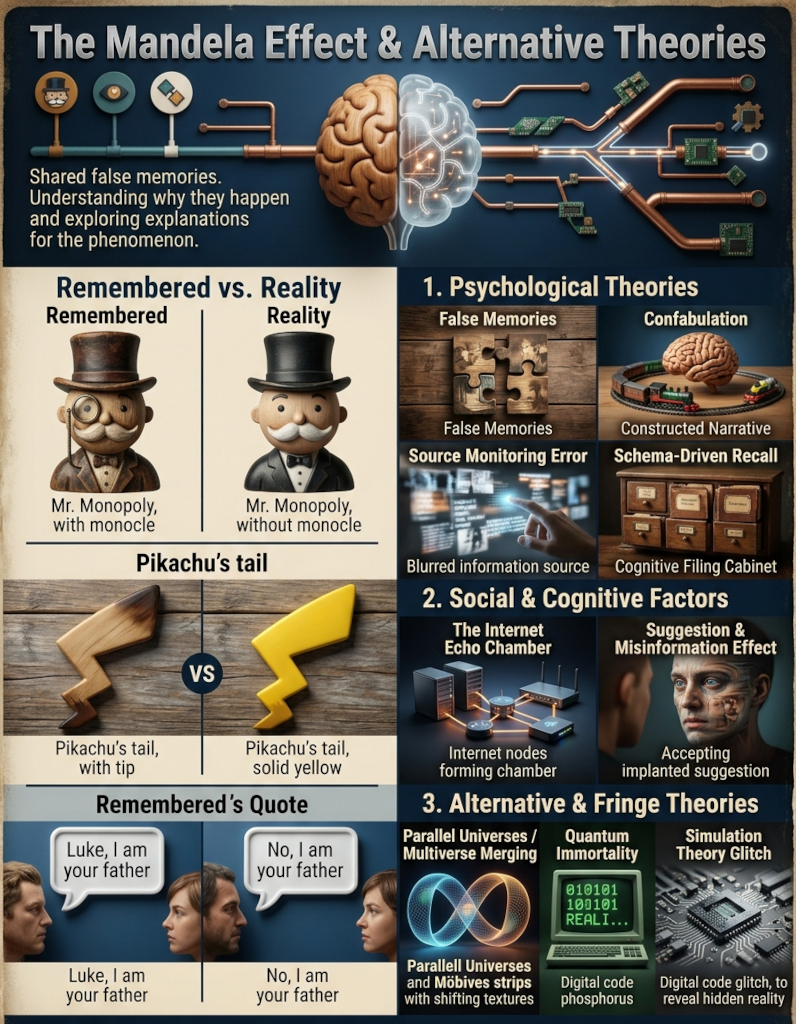
The Mandela Effect is a psychological phenomenon where a large group of people collectively remembers an event or a detail differently from how it actually occurred. It is a form of collective false memory.
1. Origin of the Term
The effect is named after Nelson Mandela, the former president of South Africa. The term was coined in 2009 by Fiona Broome, a paranormal researcher, who discovered that she and many others shared a vivid but incorrect memory of Mandela dying in prison during the 1980s. In reality, Mandela was released in 1990, served as president from 1994 to 1999, and passed away in 2013.
2. Common Examples
Many of the most famous examples involve pop culture, branding, and famous quotes:
| Subject | Collective False Memory | Actual Reality |
|---|---|---|
| The Monopoly Man | Remembers him wearing a monocle. | He does not wear a monocle. |
| Fruit of the Loom | Remembers a cornucopia in the logo. | There has never been a cornucopia. |
| Star Wars | “Luke, I am your father.” | “No, I am your father.” |
| Snow White | “Mirror, mirror on the wall…” | “Magic mirror on the wall…” |
| Berenstain Bears | Remembers the spelling as “Berenstein.” | The correct spelling is “Berenstain.” |
| Looney Tunes | Remembers it as “Looney Toons.” | The correct spelling is “Tunes.” |
| The “Sinbad” Movie | Memory of a genie movie starring Sinbad. | No such movie exists (often confused with Kazaam). |
3. Scientific & Psychological Explanations
Psychologists argue that the Mandela Effect is not a mystery, but a reflection of how human memory is constructed rather than recorded:
- Confabulation: The brain’s tendency to fill in gaps in memory with fabricated or misinterpreted information that seems plausible.
- Schema Theory & Priming: We often remember things based on our expectations. For example, the “wealthy tycoon” archetype (the Monopoly Man) often includes a monocle in other media, so our brains “auto-fill” this detail.
- Social Contagion & Reinforcement: Once a false memory is shared online or in groups, it is reinforced. People may adopt the false memory after hearing others describe it with confidence.
- Conflation: The merging of two similar memories. The “Sinbad movie” is likely a conflation of the actor Sinbad, the movie Kazaam, and the Shazam comics.
- Malleability of Memory: Memories are not static; they are reconstructed every time they are recalled and can be easily altered by leading questions or new information.
4. Alternative Theories
Beyond science, the Mandela Effect has sparked several pseudoscientific or metaphysical theories:
- Parallel Universes: The idea that people have “shifted” from one reality to another where slight details are different.
- Simulation Theory: The belief that these discrepancies are “glitches in the Matrix” or updates made to a simulated reality.
- Timeline Shifting: The theory that human consciousness has moved across diverging timelines.
Scientific Consensus: These theories are generally dismissed by the scientific community because they are unfalsifiable (cannot be proven or disproven) and the effect is fully explainable by established cognitive psychology.
The theories mentioned in point 4 move away from cognitive psychology and into the realm of theoretical physics, philosophy, and pseudoscience. While scientists generally reject these as explanations for the Mandela Effect, they are a cornerstone of the online community surrounding the phenomenon.
Here is a detailed breakdown of each theory:
1. Parallel Universes & The Many-Worlds Interpretation (MWI)
This is the most “academic” of the theories, as it borrows from actual quantum mechanics, though it applies those concepts in a way physicists do not.
- The Scientific Basis: The Many-Worlds Interpretation (MWI), proposed by Hugh Everett III in 1957, suggests that every time a quantum event occurs (a “choice” at the subatomic level), the universe splits. Instead of one outcome happening, all possible outcomes happen, each in its own separate branch of a multiverse.
- The “Mandela Effect” Twist: Proponents argue that we aren’t just observing these branches, but that our consciousness can “slide” or “drift” between them.
- The Logic: In “Universe A,” the Monopoly Man wore a monocle. In “Universe B,” he didn’t. The theory suggests that through some unknown mechanism (perhaps a cosmic event or a shift in vibration), a group of people shifted from Universe A to Universe B. They now live in a world where he has no monocle, but they carry the “memory data” from their original home.
2. Simulation Theory (“Glitches in the Matrix”)
This theory treats our entire reality as a piece of software, similar to the premise of The Matrix.
- The Concept: Popularized by philosophers like Nick Bostrom, Simulation Theory suggests that a sufficiently advanced civilization would likely create simulations of their ancestors. If this is true, there is a high statistical probability that we are living in one of those simulations.
- The “Mandela Effect” Twist: The Mandela Effect is viewed as a software bug or a system update.
- The Logic:
- The Patch: The “simulators” decided to change a detail (e.g., changing a movie quote or a brand name) and pushed a “patch” to the reality server.
- The Cache Error: Most people’s memories were updated instantly, but some “users” (people) experienced a “cache error,” meaning they retained the old data from the previous version of the simulation.
- The Glitch: These discrepancies are simply “glitches in the code” where the simulation failed to overwrite the memory of all inhabitants perfectly.
3. Timeline Shifting & Quantum Jumping
While similar to parallel universes, this theory is more focused on the “movement” and “merging” of realities.
- The Concept: This theory posits that there are multiple timelines running in parallel, and these timelines are not always separate—they can converge or merge.
- The “Mandela Effect” Twist: The Mandela Effect is seen as evidence of a Timeline Convergence.
- The Logic:
- The Merge: Two nearly identical timelines crashed into one another and merged into a single reality. The people who “survived” the merge into the current timeline are essentially refugees from a slightly different version of history.
- Quantum Jumping: In more “spiritual” or “New Age” circles, this is linked to Reality Shifting or Quantum Jumping. This is the belief that humans can consciously change their “frequency” to move themselves into a different timeline (e.g., shifting to a reality where they are wealthier or healthier). In this context, the Mandela Effect is the “proof” that such shifts are possible because people are noticing the changes in the world around them.
Comparison
| Theory | Core Analogy | Why the “Wrong” Memory Exists | Status |
|---|---|---|---|
| Parallel Universes | A branching tree | You drifted from one branch to another. | Theoretical Physics Speculation |
| Simulation Theory | A computer program | A software update failed or glitched. | Philosophy Pseudoscience |
| Timeline Shifting | Merging highways | Your timeline collided with another. | Metaphysics Pseudoscience |
CERN and Quantum Jumping
When discussing CERN and Quantum Jumping, it is critical to distinguish between actual particle physics and the internet conspiracy theories that have linked the two.
1. The Scientific Reality (What CERN actually is)
CERN (the European Organization for Nuclear Research) is the world’s largest particle physics laboratory. Its most famous tool is the Large Hadron Collider (LHC), a 27-kilometer ring of superconducting magnets.
- What they actually do: They accelerate protons to nearly the speed of light and smash them together. This allows scientists to study the fundamental building blocks of the universe (like the Higgs Boson) and the conditions immediately following the Big Bang.
- The “Quantum Jump” in Physics: In actual science, a “quantum jump” (or quantum leap) is a very specific and small-scale event. It occurs when an electron in an atom jumps from one energy level to another instantaneously. It has nothing to do with jumping between parallel universes or timelines.
- Parallel Universes in Theory: Some theoretical physicists at CERN explore the possibility of extra dimensions or a multiverse to explain why gravity is so weak compared to other forces. However, these are mathematical models; they are not “portals” that people can enter.
2. The Conspiracy Theory (CERN and the Mandela Effect)
In the world of the Mandela Effect, CERN is often cast as the “villain” or the cause of the phenomenon. These theories claim that CERN’s experiments have had catastrophic effects on reality.
The Core Claims:
- “Cracking Reality”: Conspiracy theorists argue that the high energy generated by the LHC was so intense that it “cracked” the fabric of our space-time.
- The Macro-Quantum Jump: Unlike the scientific quantum jump (electrons), this theory suggests a Macro-Quantum Jump, where the entire human race was shifted from one parallel timeline to another.
- The Portal Theory: Some believe CERN accidentally created a portal to another dimension, and as we “merged” with that dimension, small details of our world (like the spelling of Berenstain Bears) changed.
Why these theories are popular:
- Complexity: Particle physics is so complex that it sounds like “magic” to the average person, making it easy to attach supernatural or sci-fi ideas to it.
- The “God Particle”: The discovery of the Higgs Boson was dubbed the discovery of the “God Particle,” a term that shifted the conversation from physics to theology and metaphysics in the public eye.
- Visuals: The scale of the LHC and the secrecy surrounding some high-level physics often feed “secret society” or “mad scientist” narratives.
Comparison
| Feature | Scientific Perspective | Conspiracy Perspective |
|---|---|---|
| Quantum Jump | An electron changing energy levels. | Humanity shifting to a new timeline. |
| LHC Purpose | To understand fundamental particles. | To open portals or manipulate reality. |
| Parallel Worlds | Theoretical mathematical models. | Actual places we have drifted into. |
| Mandela Effect | A result of cognitive memory errors. | Proof that CERN changed our universe. |
| Evidence | Peer-reviewed data and particles. | Shared “wrong” memories and YouTube videos. |
