The video from Veritasium, provides a detailed analysis of the transcript regarding the nature, implementation, and vulnerabilities of random number generation.
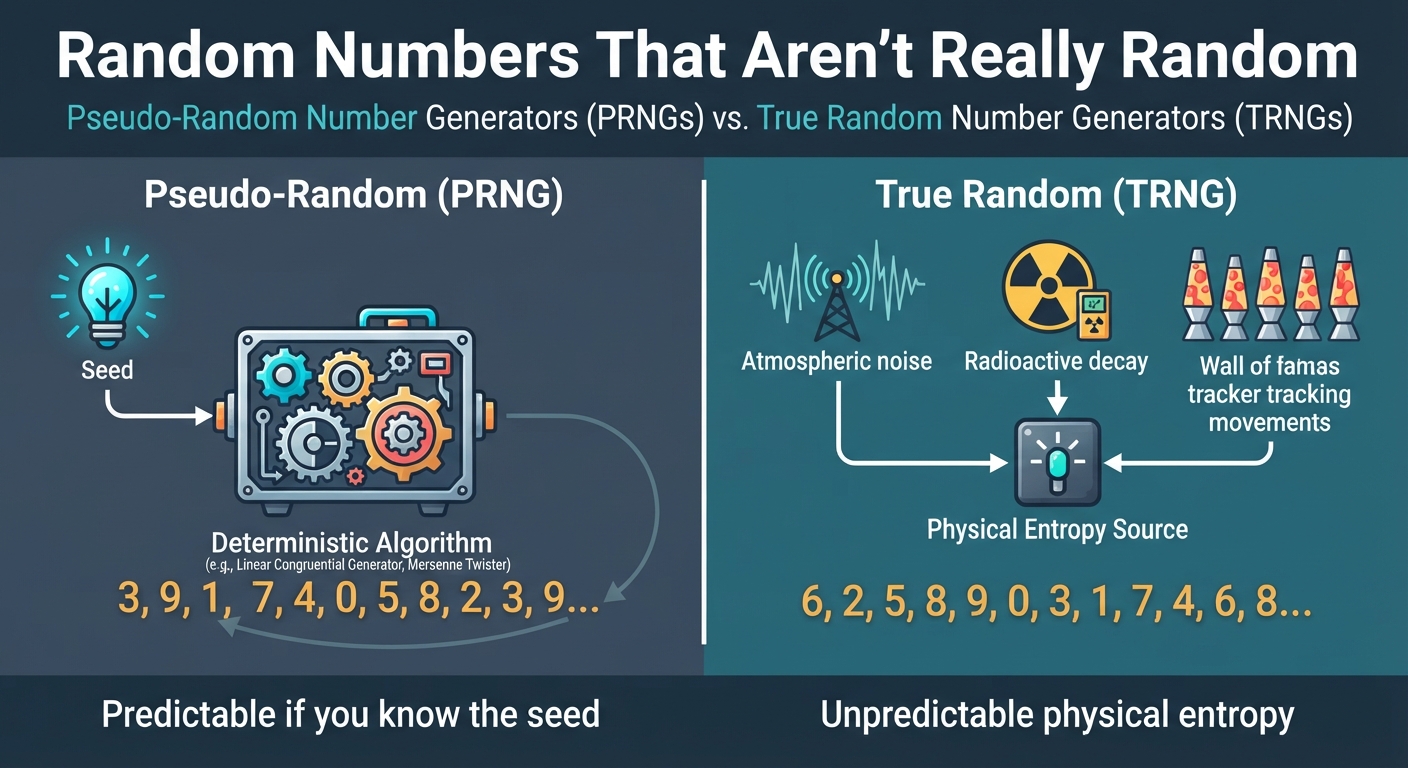
The core thesis is the distinction between Pseudo-Random Number Generators (PRNGs)—which are deterministic algorithms—and True Random Number Generators (TRNGs)—which rely on physical phenomena. The transcript traces the evolution of these systems from early nuclear simulations to modern quantum-certified randomness, highlighting how any predictability in a “random” system creates exploitable vulnerabilities in gaming, gambling, and digital security.
1. The Spectrum of Randomness
A. Pseudo-Random Number Generators (PRNGs)
PRNGs use a mathematical formula and an initial value (the seed) to produce a sequence of numbers. While they appear random, they are entirely deterministic: the same seed always produces the same sequence.
The Evolution of PRNG Algorithms:
- Middle-Square Method (von Neumann): An early approach that squared a seed and took the middle digits. This was highly flawed as it frequently fell into “traps” (short loops) or converged to zero.
- Linear Congruential Generators (LCGs): Defined by the relation . While more robust, LCGs suffer from “spectral patterns”—when plotted in higher dimensions, the numbers fall onto parallel planes rather than filling the space uniformly.
- Mersenne Twister: A more complex algorithm that fills a large table (624 elements) and “twists” it. This provides a massive period before repeating, but it is still predictable if an observer can collect enough output samples to reconstruct the internal state.
- Cryptographically Secure PRNGs (CSPRNGs): These use encryption algorithms to scramble the output, making it computationally infeasible to determine the seed or predict future outputs even if past outputs are known.
B. True Random Number Generators (TRNGs)
TRNGs derive randomness from physical entropy, which is inherently unpredictable.
- Classical Entropy: Examples include measuring electrical noise in processors or observing the fluid dynamics of lava lamps (as used by Cloudflare).
- Quantum Entropy: The gold standard. By measuring quantum states (e.g., the polarization of entangled photons), TRNGs produce results that are fundamentally unpredictable according to the laws of physics.
2. Case Studies in Predictability (The “Exploit” Gap)
The transcript illustrates that the “pseudo” nature of most randomness allows for real-world exploits:
| Context | Algorithm/Flaw | Nature of Exploit |
|---|---|---|
| Slot Machines | Mersenne Twister | Hackers recorded spins, transmitted them to a server in Russia, and predicted the exact moment to press “spin” to win. |
| Minecraft | LCG (Java) | Because diamond and clay seeds were related by a small constant, knowing the location of clay allowed players to pinpoint diamonds. |
| Digital Security | General PRNGs | If a seed is guessed or the internal state is leaked, encrypted communications and bank accounts can be compromised. |
3. Theoretical and Physical Frontiers
The Monte Carlo Method
Originating from Stanislav Ulam’s curiosity about solitaire during a hospital stay, the Monte Carlo method uses random sampling to solve problems that are too complex for analytical calculation (e.g., simulating neutron paths in a nuclear chain reaction).
Certifying Randomness via Quantum Mechanics
The most advanced form of randomness is not just “hard to predict” but certified.
- Bell’s Inequality: By using entangled photons and measuring them at different angles, researchers can prove that the outcomes were not predetermined. A violation of Bell’s inequality proves that the results are genuinely random.
- Freedom of Choice Loophole: To prevent any hidden coordination between the measurement device and the particle, researchers have used light from distant quasars (billions of light-years apart) to pick the measurement angles.
Randomness Extraction
Because raw physical data (like quantum detections) can be biased (e.g., more 0s than 1s), randomness extraction is used. This process (inspired by von Neumann’s coin-flip method) converts a biased but independent stream of bits into a shorter, perfectly fair sequence of random bits.
4. Historic Context, Facts, and Persons
Key Persons
- Stanislav Ulam: A mathematician whose experience with solitaire while recovering from encephalitis led to the conception of the Monte Carlo method.
- John von Neumann: A pioneer of computing who implemented Ulam’s ideas on the ENIAC, helping to simulate nuclear chain reactions.
- Pierre Simon Laplace: Represented the classical “deterministic” view of the universe, imagining an intelligence that could predict all future events.
- Albert Einstein: A proponent of determinism who famously stated, “God does not play dice with the universe.”
- Matthew Bolland: A mathematics PhD student and Minecraft expert who demonstrated how to exploit Java’s LCG to find diamonds.
- David Kaiser: A researcher who improved Bell tests by using light from distant quasars to ensure measurement choices were independent.
- Alex: A Russian hacker who reverse-engineered slot machine software to build a system for predicting winning spins.
Historic Context and Facts
- The Manhattan Project (Los Alamos): The need to understand the behavior of trillions of neutrons in a nuclear bomb led to the development of the Monte Carlo method in 1946.
- ENIAC (1947): One of the world’s first electronic computers, used to run early random simulations.
- RANDU (1960s): An IBM-developed random number generator that became a cautionary tale due to its obvious linear patterns in 3D space.
- The 2014 Slot Machine Scandal: A group of gamblers used a Russian-developed app to time their spins on US slot machines, exploiting the predictable nature of the machines’ PRNGs to steal over $250,000.
5. Conclusion
The transition from the “state of sin” (relying on simple arithmetic for randomness) to quantum certification highlights a critical dependency of the modern world. As computing power increases, the window for “acceptable” pseudo-randomness closes, making true, certified entropy essential for the integrity of global security and fairness in gaming.
