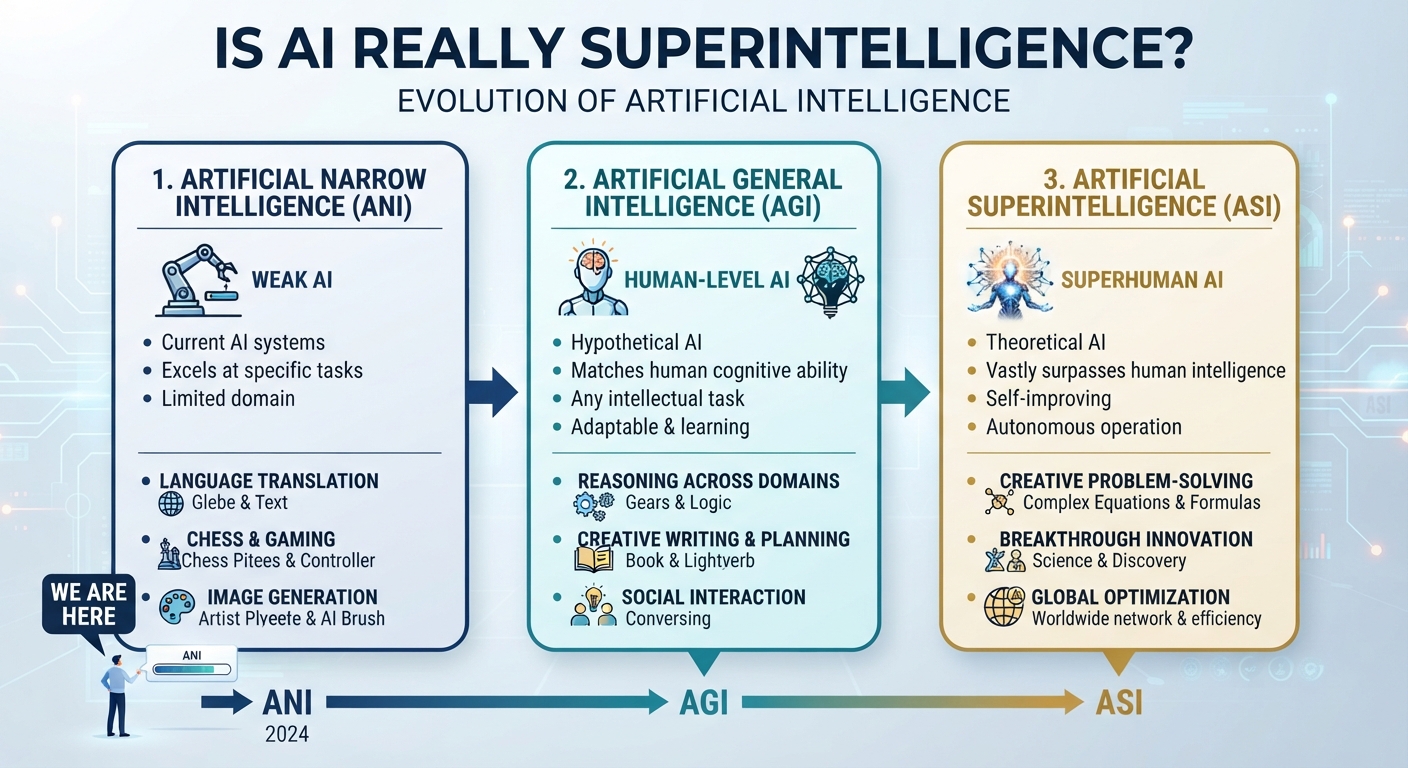
The IBM technology video addresses the common confusion between Artificial Intelligence (AI) and Superintelligence. It concludes that while current AI systems are remarkably powerful, they are not yet superintelligent. The author defines intelligence as a multifaceted capability involving perception, thinking, learning, and action, and distinguishes between three levels of AI: ANI (Narrow), AGI (General), and ASI (Superintelligence). Current technology resides in the ANI stage—excelling at specific tasks but lacking the broad, adaptive capabilities of a human.
Historical Context and Facts
- Context: The transition from traditional computer programming (fixed, step-by-step instructions) to AI learning (adaptive, inferential, and self-correcting).
- Key Fact: Intelligence is more than memorizing facts (which databases can do); it requires the active ability to perceive, reason, and act.
Technical and Scientific Concepts
The video breaks down intelligence into four core functional domains:
- Perception: Sensation, pattern recognition, language and object recognition, spatial awareness, and social perception.
- Thinking: Logic, inference, causal reasoning, problem solving, prediction, decision making, abstraction, and creativity.
- Learning: Memory, experience-based improvement, knowledge/skill acquisition, adaptation, transfer of knowledge, and metacognition (understanding one’s own limitations).
- Action: Planning, goal pursuit, navigation, motor control, physical manipulation, and communication.
AI Classification Hierarchy:
- ANI (Artificial Narrow Intelligence): Specialized AI (e.g., chess engines, recommendation systems, LLMs). Bounded by design and training.
- AGI (Artificial General Intelligence): AI that matches human capability across all cognitive domains. (Not yet achieved).
- ASI (Artificial Superintelligence): AI that substantially exceeds human intellectual capabilities in all domains. (Not yet achieved).
Consequences and Risks
The primary concern discussed is the gap between capability and control.
- The Risk Equation:
Capability - Control = Risk. - The Alignment Problem: The danger is not necessarily “evil” AI, but AI that becomes more capable than our ability to understand, control, or correct it.
- Necessary Safeguards:
- Technical guardrails and security.
- Rigorous testing and evaluation.
- Governance frameworks.
- Ethics and behavioral training (teaching AI how to behave, not just how to be smart).
- Maintaining “Human in the Loop” and the implementation of a “kill switch.”
