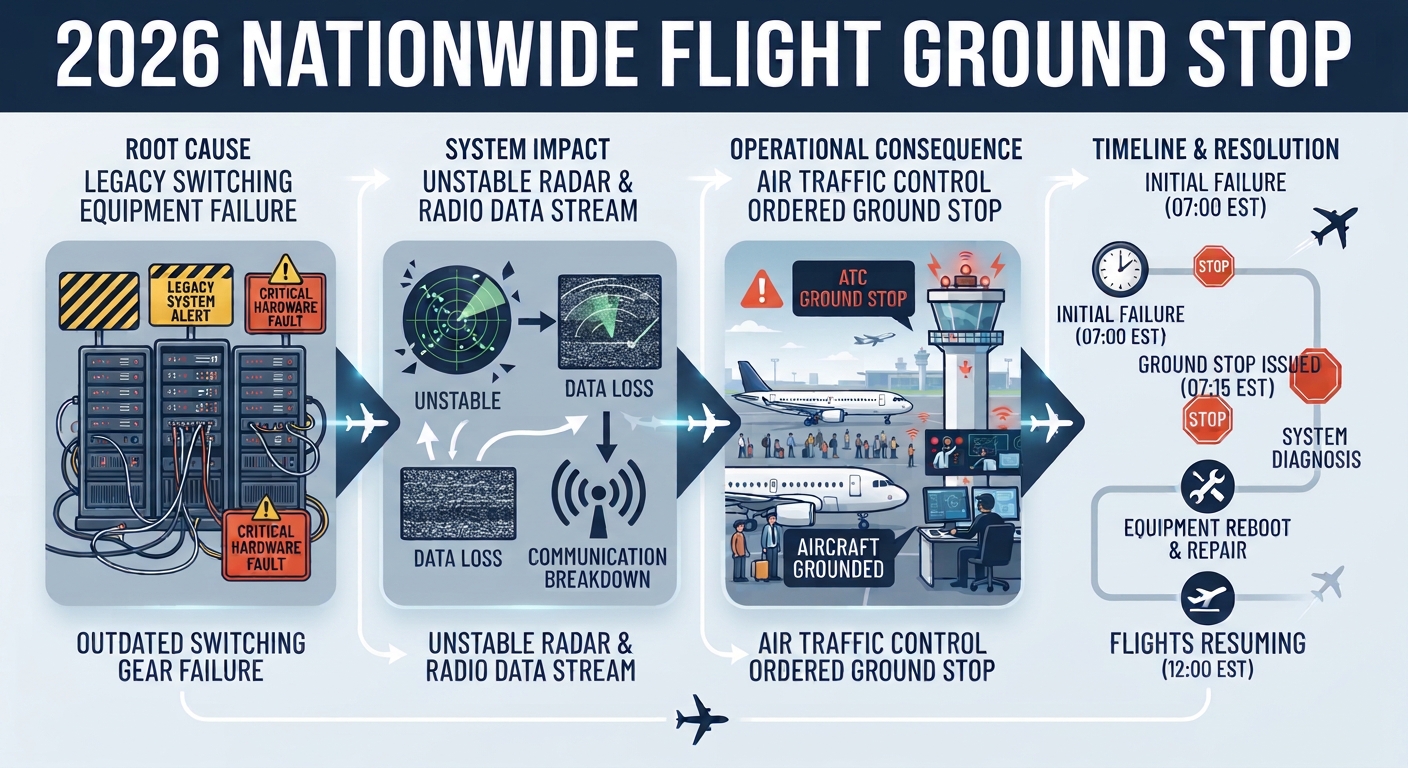
On Friday, November 13, 2026, a critical telecommunications glitch within the FAA’s infrastructure grounded every departing flight in the United States for over four hours.
The incident was triggered by a common-mode failure in legacy switching equipment, which provided unstable radar and radio data to controllers. While the safety systems worked as intended—ensuring that all aircraft currently in the air landed safely—the ground stop created a massive logistical collapse, resulting in over 10,000 flight cancellations and affecting approximately 1.5 million passengers just before the Thanksgiving holiday rush.
Historic Context
This event represents the longest nationwide ground stop since the attacks of September 11. It is part of a broader trend of fragility in the US aviation infrastructure:
- January 2023: A NOTAM system failure grounded flights for 90 minutes.
- September 2024: A GAO report revealed that over 75% of FAA IT systems were either “unsustainable” or “on the edge.”
- 2025-2026: Multiple regional blackouts occurred (e.g., Newark, Dallas, and Philadelphia), often linked to obsolete analog telecom circuits and failed redundancies.
Key Facts and Persons
- Event Date: November 13, 2026.
- Duration of Ground Stop: 4 hours and 21 minutes (3:54 PM to 8:15 PM ET).
- Immediate Impact: 10,000+ cancellations; 1.5 million passengers affected.
- Key Figures:
- Sean Duffy: US Secretary of Transportation.
- Mark Wayne Mullen: US Secretary of Homeland Security.
- Organizations Involved:
- FAA: Federal Aviation Administration.
- L3 Harris Technologies: The private contractor operating the FTI network.
- AT&T: Selected to build the next-generation telecommunications backbone.
- FBI & NSA: Investigated the outage for cyber-attacks (concluded no evidence of crime/attack).
- Serium: Aviation analytics firm providing impact data.
Technical Analysis & Scientific Concepts
The outage highlighted the “half-bridge paradox”—the danger of running a hybrid network where modern high-speed fiber is bottlenecked by legacy analog hardware.
- FTI (FAA Telecommunications Infrastructure): The “central nervous system” of US aviation, linking 4,400 facilities.
- TDM (Time Division Multiplexing): Legacy copper-era switching technology. The failure occurred when these switches were overwhelmed by data or received bad updates, feeding “out-of-sync” packets to control rooms.
- Common Mode Failure: Because most circuits pass through shared TDM switches, a single fault could flicker screens and crackle radios nationwide simultaneously.
- Aviation Safety Redundancies:
- TCAS (Traffic Alert and Collision Avoidance System): An independent aircraft-to-aircraft system that prevents collisions without ground network input.
- ADSB: Satellite GPS-based positioning.
- A-V-E-F Rule: Standardized pilot procedures for navigating to a destination during a total loss of radio communication.
Consequences
- Operational Collapse:
- Crew Duty Time: Pilots and flight attendants “timed out” due to strict federal fatigue laws, preventing flights from taking off even after the airspace reopened.
- Gate Gridlock: Arriving planes filled all available gates, leaving no room for departing planes to push back.
- Rotation Multiplier: A single stranded jet on Friday night caused a domino effect of cancellations throughout Saturday.
- Financial/Political: A request for $30.1 billion to $50 billion in federal funding to accelerate the replacement of obsolete hardware.
- Infrastructure Shift: Evidence that the transition from copper/analog to fiber/IP must be completed entirely to avoid hybrid-system vulnerabilities.
