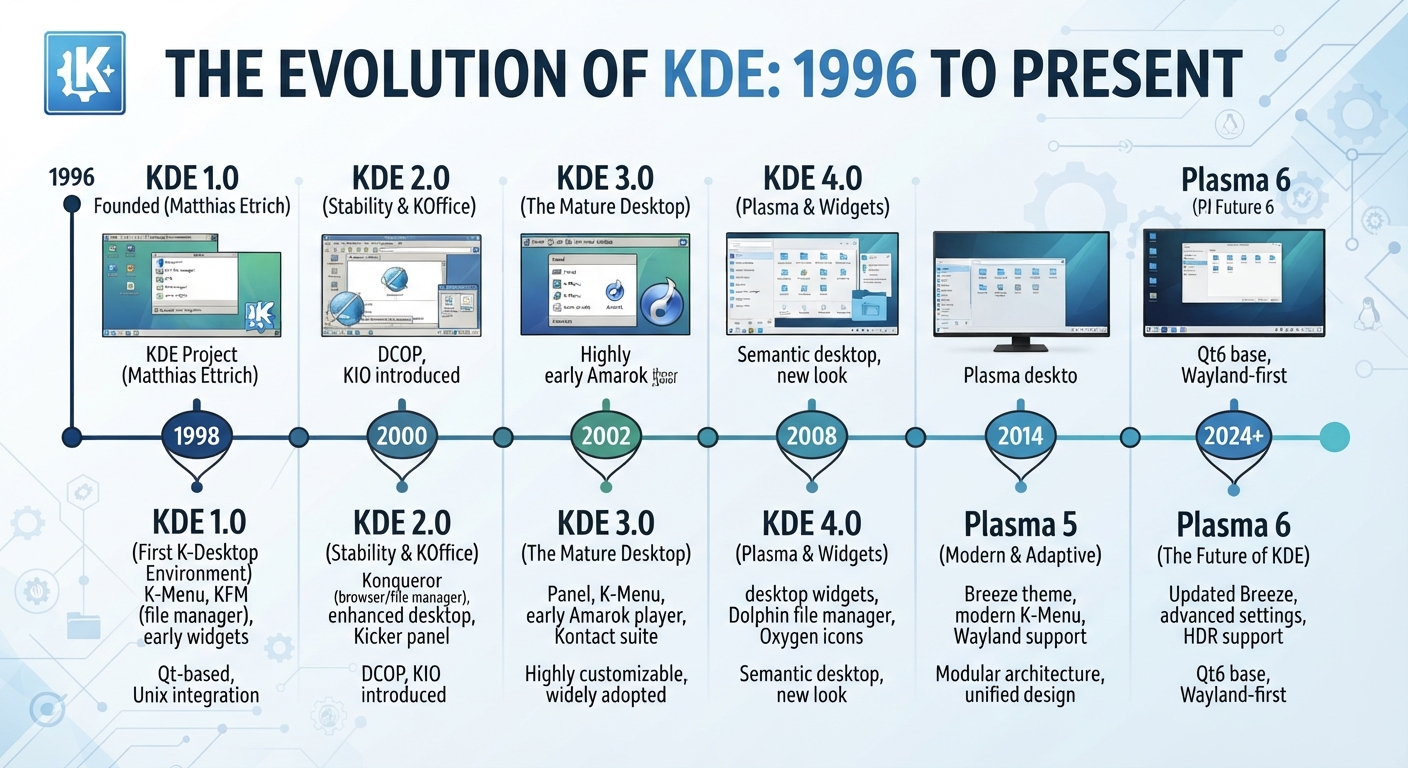
KDE is more than just a software suite; it is a community-driven effort to create a free, open-source desktop environment that makes Linux and Unix accessible to a mainstream audience.
Born out of a desire to move away from the “nerdy” and fragmented nature of early Linux, KDE embodies a mindset of freedom, friendship, and total user control over hardware and software.
2. Historical Context, Facts, and Key Persons
Historical Context
In the mid-1990s, computing was largely confined to universities and research institutions. Linux was growing but remained extremely difficult to use for the average person due to a lack of standardized graphical user interfaces (GUIs) and user-friendly applications. The “barrier to entry” was high, and users were often forced to rely on proprietary software like Microsoft Word to complete basic tasks.
Key Persons
- Matthias Etrich: The catalyst and founder of KDE. He initiated the project via a famous email, envisioning a “cool desktop environment” for the masses.
- Richard Stallman: Founder of the Free Software Foundation. His strict adherence to GPL licensing created a central conflict regarding KDE’s dependency on the then-proprietary Qt library.
- Harry Porten: A contributor who developed a JavaScript engine for the Conqueror browser “for fun,” significantly enhancing the project’s capabilities.
- Torben Weiss: Noted as a key figure within the development and community history.
3. Technical and Scientific Developments
The development of KDE introduced several critical components to the open-source ecosystem:
- Qt Framework: The underlying toolkit that provided the graphical foundation. Its transition from proprietary to open licensing was a pivotal moment for the project.
- Kconfig: A core class designed to ensure that almost every aspect of the system remained configurable by the user, adhering to the philosophy of user autonomy.
- Conqueror: A pioneering web browser for Linux that integrated HTML rendering and JavaScript execution, allowing Linux to compete with commercial browsers.
- K-Mail: One of the first fully functional free software email clients that helped make Linux a viable primary workstation.
- KDE 1 (Ansberg): The first official release, marking the transition from a collection of hacks to a cohesive product.
- The Harmony Project: An attempt to clone the Qt library under a fully free license to resolve the ideological and legal conflicts surrounding the original toolkit.
4. Consequences and Legacy
- Democratization of Linux: By providing a Windows-like experience, KDE lowered the barrier for non-technical users to adopt open-source operating systems.
- Institutional Stability: The creation of a formal foundation (Eingetragende Verein) ensured that the project could survive individual departures and manage sponsorships and legalities professionally.
- Ideological Clash: The tension between the “pragmatism” of using Qt and the “purism” of the Free Software movement highlighted the internal struggles of the open-source world regarding licensing.
- Industry Influence: KDE’s success pushed other distributions (such as SUSE) and developers to prioritize the User Experience (UX), eventually leading to the modern, polished desktop environments available today.
