The story of Silicon Valley is not just about software, but about the evolution of venture capital and the courage of a few engineers to break away from a tyrannical genius.
The video traces the path from William Shockley’s lab to the creation of Fairchild Semiconductor and Intel, explaining how a shift in funding models—from corporate R&D to equity-based venture capital—triggered an unprecedented explosion of technological innovation that created the modern digital world.
Historic Context
- Era: Mid-1950s to 1970s.
- Cultural Setting: The 1950s “Organization Man” ethos, where loyalty to the employer was paramount and risk-taking was discouraged.
- Location: Mountain View, California, then known as the “Valley of Hearts Delight” for its apricot orchards, before becoming “Silicon Valley.”
- Geopolitical Influence: Massive US Government investment during the Cold War (e.g., NASA) provided the initial financial runway for semiconductor advancements.
Key Persons
- William Shockley: Co-inventor of the transistor and Nobel laureate; his abusive management style and paranoid personality drove his top talent to leave.
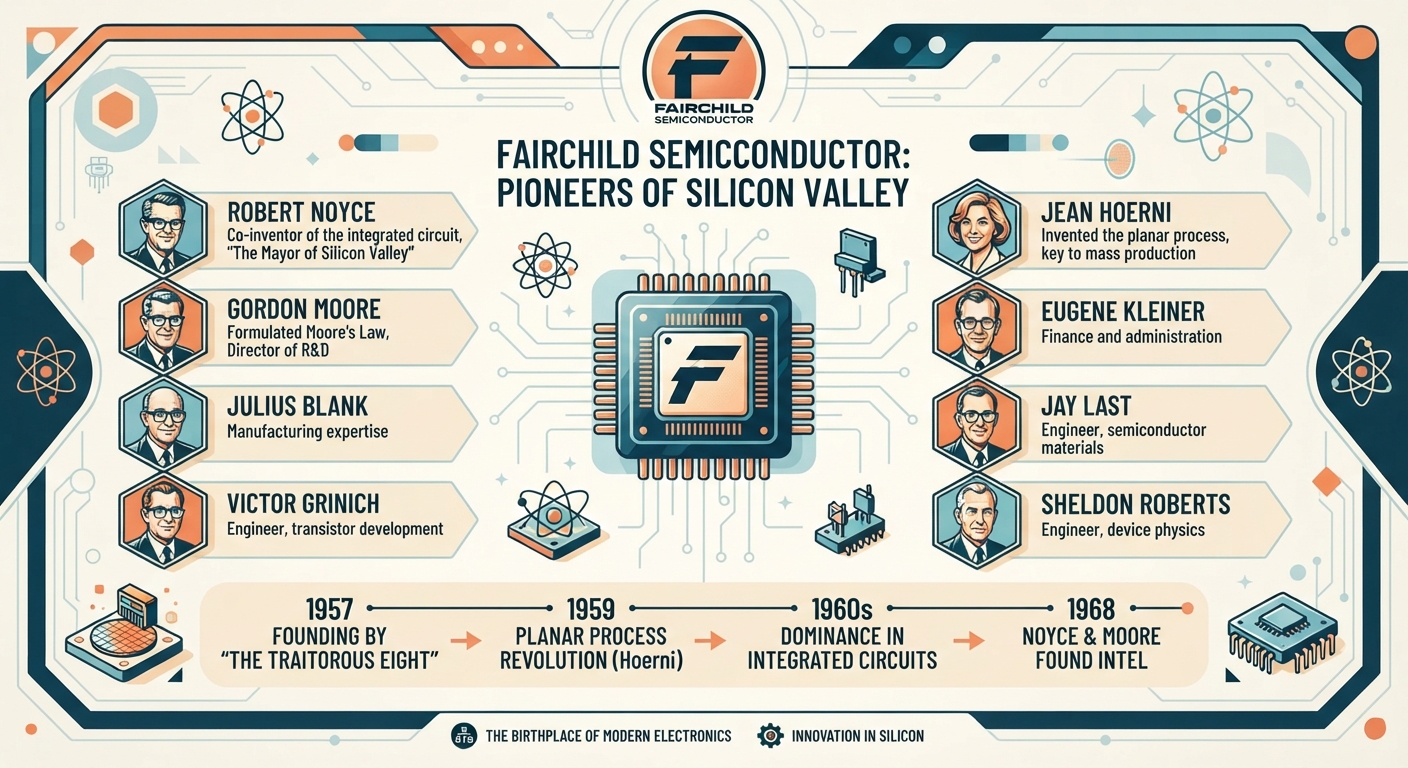
- The Traitorous Eight: The group of engineers who rebelled against Shockley, including Robert Noyce, Gordon Moore, and Eugene Kleiner.
- Arthur Rock: The visionary financier who designed the first modern venture capital deal (the “Magna Carta” of VC), aligning incentives between investors and founders.
- Sherman Fairchild: The wealthy inventor and investor who provided the initial $1.5 million in seed funding for Fairchild Semiconductor.
- Robert Noyce & Gordon Moore: Pioneers of the integrated circuit and Moore’s Law, respectively; co-founders of both Fairchild Semiconductor and Intel.
- Eugene Kleiner & Don Valentine: “Fairchildren” who later founded the legendary VC firms Kleiner Perkins and Sequoia Capital.
- Steve Jobs & Steve Wozniak: Early Apple founders who benefited from the ecosystem and professionalization provided by Fairchild/Intel veterans like Mike Markkula.
Technical and Science Discoveries
- The Transistor: The fundamental building block of all modern electronics.
- The Planar Process (Jean Hoerni): A method of creating flat silicon wafers, making semiconductors faster, more reliable, and mass-producible.
- The Integrated Circuit (Robert Noyce): The invention of the microchip by placing the entire circuit onto a single semiconductor.
- Moore’s Law (Gordon Moore): The observation that the number of transistors on a chip doubles approximately every two years.
- DRAM (Dynamic Random Access Memory): Intel’s 1103 chip which replaced bulky magnetic cores with high-density silicon memory.
- EPROM (Erasable Programmable Read Only Memory): Intel’s 1702 chip, allowing software to be rewritten on a microchip.
- The Microprocessor (CPU): The Intel 4004, the world’s first commercial microprocessor, acting as the “brain” of the computer on a single chip.
Consequences
- Technological Shift: Enabled the miniaturization of computers, moving them from room-sized lab equipment into people’s homes.
- Financial Revolution: established the modern Venture Capital (VC) model, where high-risk bets on talent and ideas are rewarded with equity, creating a “power law” of returns.
- Economic Domination: Led to the creation of the “Big Tech” giants and the strategy of “blitzscaling”—prioritizing rapid market domination over profitability.
- Systemic Impact: The shift toward VC-driven innovation led to the “financialization” of startups and, eventually, the “enshittification” of platforms once monopolies are achieved.
- Societal Risk: The expansion of VC funding to include pension funds shifted the financial risk from wealthy individuals to the general public’s retirement savings.
