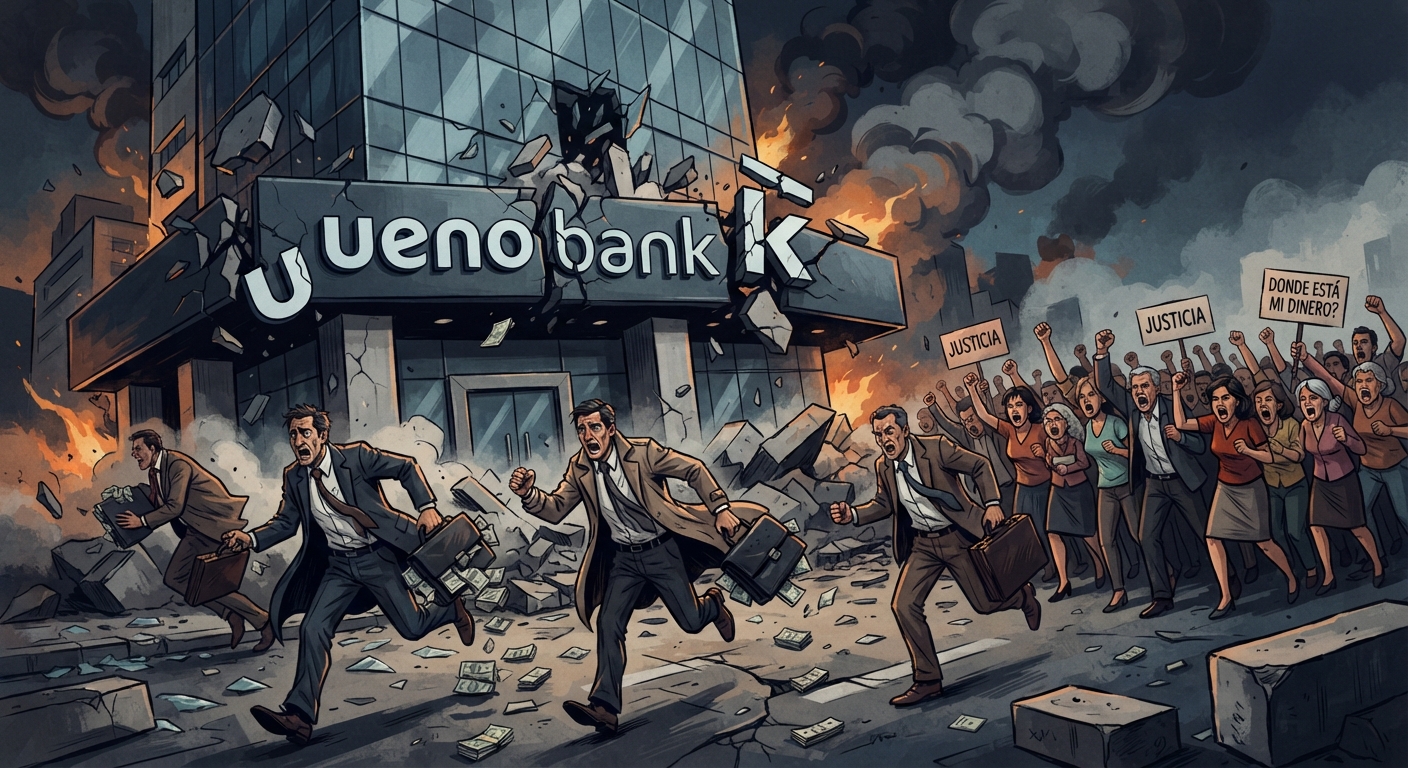
The situation surrounding Ueno Bank in Paraguay is a massive financial and political scandal that has had a systemic impact on the country. Below is the detailed information regarding the bank’s collapse, the political corruption involved, and the damage to its users.
1. The Cause of the Problem: Financial Irregularities
The crisis began when the Banco Central del Paraguay (BCP) intervened in Ueno Bank after discovering severe solvency issues and “undue operations” (operaciones indebidas).
- The Scheme: The bank is accused of attempting to hide its true financial health through fraudulent maneuvers. In June 2026, Ueno transferred a loan portfolio worth USD 74.4 million to a linked company called Vinanzas SA.
- The Goal: This transfer was a response to the Superintendency of Banks’ demand that Ueno divest from bad loans linked to the Grupo Vázquez (the bank’s owners) and other firms (e.g., Grupo Hendy, MOWI).
- The Fraud: Investigations revealed that Vinanzas SA did not have the actual resources to acquire these loans and was instead indirectly funded by Ueno Bank itself. Essentially, the bank “sold” the debt to a shell company using its own money to make its balance sheet look healthier than it was.
- The Result: The bank’s solvency index dropped below half of the legal minimum, leading the BCP to freeze all operations and order the bank’s dissolution.
2. Political Corruption and Conflict of Interest
The collapse of the bank triggered a severe political crisis, culminating in the resignation of President Santiago Peña. The scandal is centered on deep conflicts of interest:
- Presidential Links: Santiago Peña was a shareholder of Ueno Bank until March 2025, linking the head of state directly to the institution’s capital.
- Regulatory Capture: The head of the BCP (the regulator), Carlos Carvallo, had served as the President of Ueno Bank until July 2023. He effectively moved from leading the bank to leading the entity responsible for supervising it, creating a massive gap in oversight.
- Political Fallout: These connections led to accusations that the government ignored warning signs and participated in a system of institutional capture, resulting in public unrest and the eventual resignation of the President.
3. Damage to Users and the Public
The impact was catastrophic due to the bank’s aggressive growth and its role as a “fintech” leader.
- Massive Reach: Ueno Bank had 2.9 million clients, which is roughly 60% of the adult population of Paraguay. Because it was primarily a mobile-app-based bank, the sudden suspension of the app left millions of people completely cut off from their funds.
- The “Corralito”: The situation is described as a corralito (a freeze on withdrawals). Users, including retirees and low-income citizens, found their accounts frozen and cards deactivated overnight.
- Institutional Loss: The damage extended to the state. Ueno managed approximately USD 850 million in public funds, including resources from the Instituto de Previsión Social (IPS) (responsible for health and pensions), the Ministry of Economy, and the South American Football Confederation.
- Recovery Measures: To mitigate the social unrest, the government passed an emergency law to activate the Fondo de Garantía de Depósitos (FGD).
- Immediate Advance: Users can receive an initial payment of up to 40 monthly minimum wages (approx. USD 19,787).
- Total Coverage: The maximum guarantee is capped at 75 monthly minimum wages. Anyone with deposits above this threshold faces a significant risk of total loss.
The history of Ueno Bank
Is a story of extremely rapid growth and digital transformation that transitioned from a family-led financial group to a systemic national crisis in just a few years.
1. The Roots (Pre-2021)
Ueno did not start from scratch; it was built upon the existing financial infrastructure of the Grupo Vázquez, a powerful Paraguayan conglomerate with over 70 years of business experience. Before the “Ueno” brand existed, the group operated Credicentro, a company specializing in credit and consumer loans.
2. The Transformation and Launch (2021–2023)
The shift toward becoming a full-service bank began in 2021 with a strategic acquisition:
- The Acquisition: Grupo Vázquez purchased Financiera El Comercio.
- The Fintech Strategy: Instead of following a traditional banking model, they launched the Ueno brand with a “fintech-first” approach. They focused on a high-quality mobile application, seamless digital payments, and low-cost accounts to attract a younger, tech-savvy demographic.
- Banking License: After a period of operating as a financial entity, they obtained a full banking license and officially began operations as Ueno Bank in December 2023.
3. Aggressive Expansion and the “Mega-Fusion” (2024–2025)
Ueno grew at a pace rarely seen in the Paraguayan banking sector, moving from a niche digital app to a dominant market player:
- Visión Banco Absorption (June 2024): In a pivotal move, Ueno absorbed Visión Banco. This “mega-fusion” allowed Ueno to instantly acquire a massive amount of assets, liabilities, and a pre-existing client base, transforming it from a simple payment app into a full-service bank offering complex loans, investments, and corporate services.
- Market Dominance: By 2025, Ueno had captured 60% of the adult population of Paraguay (approximately 2.9 million clients), becoming the largest bank in the country by number of customers.
- State Integration: The bank successfully positioned itself as a trusted manager for the government, eventually handling USD 850 million in public funds, including those of the Social Security Institute (IPS).
4. The Peak and the Warning Signs (2026)
By early 2026, Ueno was at the height of its visibility and prestige:
- International Markets (March 2026): Ueno became the first Paraguayan bank to issue bonds on international markets, raising USD 350 million with a maturity date of 2031.
- Cultural Saturation: The bank spent aggressively on marketing, becoming the lead sponsor of the Paraguayan Football Association and the Olympic Committee, and attaching its name to the stadiums of the country’s two biggest football clubs, Olimpia and Cerro Porteño.
5. The Collapse (November 2026)
The rapid ascent ended abruptly in November 2026. The Banco Central del Paraguay (BCP) discovered that the bank’s growth had been mirrored by reckless internal lending.
- The Trigger: An audit revealed that the bank had been granting undue credits to companies linked to its own owners (Grupo Vázquez).
- The Fraud: To hide this, the bank attempted to “sell” bad debt to a shell company (Vinanzas SA) using its own money to fund the purchase.
- The End: Once the BCP found that the solvency index had plummeted below 50% of the legal minimum, they intervened, froze all accounts, and ordered the bank’s dissolution, triggering a national financial and political crisis.
Sources
Primary detailed reports (Extracted)
- Infobae: El caso Ueno Bank: por qué cayó y cuál es su impacto sobre la economía de Paraguay (Provided the most detailed technical breakdown of the fraud, the political links to Santiago Peña, and the impact on public funds).
- El Soberbio al Día: El caso Ueno Bank: por qué cayó y cuál es su impacto en todo el país (Provided context on the 60% population reach and the impact on retirees).
- Gente de Salta: La migración masiva de clientes colapsa las aplicaciones de otros bancos: El efecto dominó del corralito en Paraguay (Detailed the “corralito” effect and the mass migration of customers to other banks).
- Municipios Puebla: Crisis bancaria en Paraguay deja a casi 3 millones de clientes sin acceso a sus ahorros (Confirmed the number of affected clients and the BCP intervention).
Supporting information (Search snippets)
- Wikipedia: Ueno bank
- Emol: Medio siglo de historia, megafusión y patrocinios deportivos: El recorrido de Ueno Bank
- Grupo Vázquez: Memoria Anual 2025 (Corporate documents)
