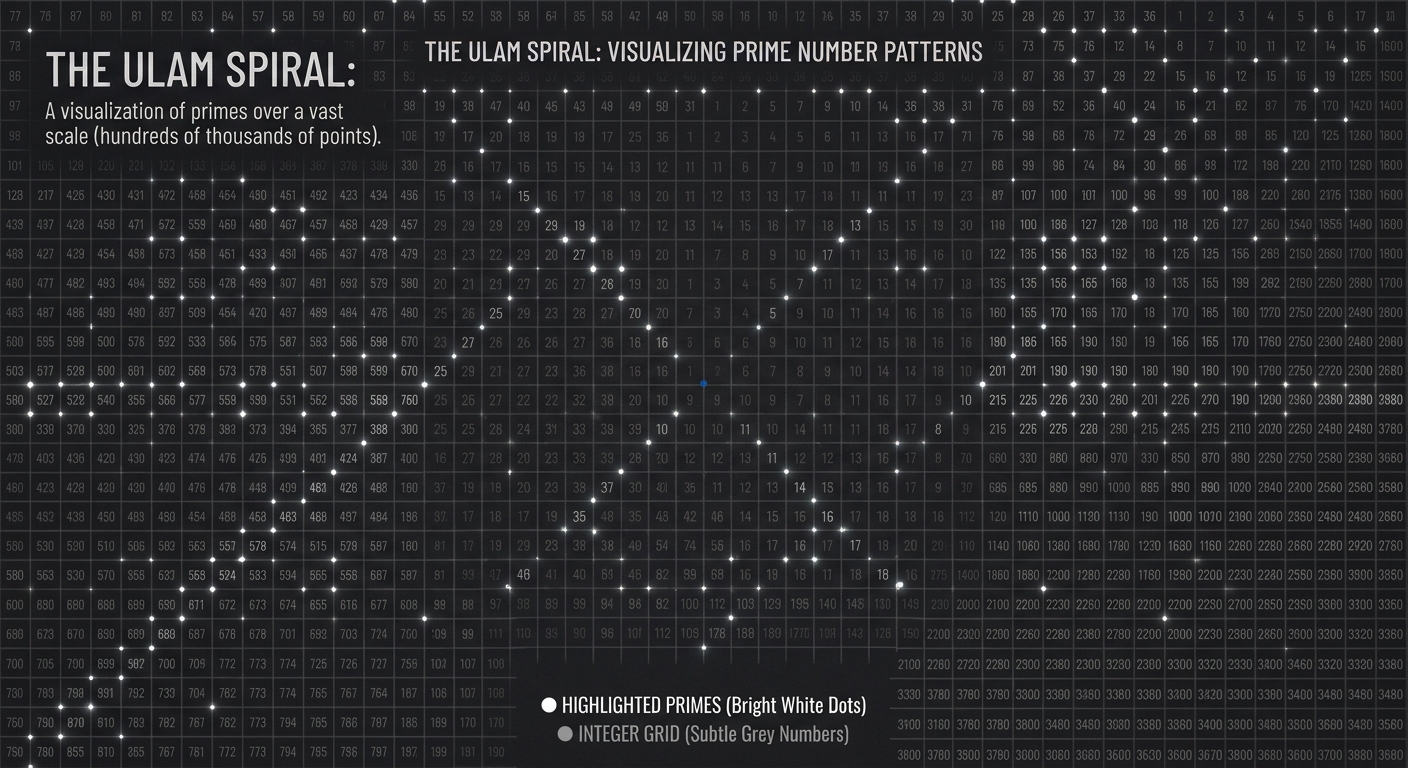
The Ulam Spiral is a visual representation of prime numbers that reveals an unexpected pattern in their distribution. It was discovered by mathematician Stanislaw Ulam in 1963 during a boring meeting.
Construction
To create an Ulam Spiral:
- Start with an integer grid.
- Write the positive integers in a counter-clockwise spiral, starting with 1 at the center.
- Highlight or mark only the prime numbers.
The Observation
In a random distribution, you would expect the primes to be scattered evenly across the grid. Instead, the Ulam Spiral shows that primes tend to cluster along diagonal lines.
Why it Happens (The Pragmatic Explanation)
The diagonals in the spiral correspond to quadratic polynomials of the form:
When you see a dense diagonal of primes, it means those specific quadratic equations are producing primes at a much higher rate than average.
The most famous example is Euler’s prime-generating polynomial:
For = 0 to 39, this formula produces a prime number every single time. On an Ulam Spiral, this appears as a strikingly clear diagonal line.
Significance
The spiral doesn’t “solve” the distribution of primes, but it provides visual evidence that primes are not distributed randomly. It suggests that there are deep, structural relationships between prime numbers and quadratic polynomials—a topic that remains a central part of number theory today.
Euler’s prime-generating polynomial
Euler’s prime-generating polynomial is the formula:
It is famous because it produces an unusually long sequence of prime numbers for consecutive integer inputs.
The “Magic” Range
If you plug in integers starting from = 0 up to = 39, every single result is a prime number.
- For (Prime)
- For (Prime)
- For (Prime)
- For (Prime)
- …
- For (Prime)
That is 40 consecutive prime numbers, which is a statistical anomaly for such a simple formula.
Where it Fails
The formula does not produce primes forever. It is mathematically impossible for any polynomial to produce only primes for all n.
The sequence breaks immediately at :
is not prime; it is .
It also fails at n = 41:
Which is obviously , and therefore not prime.
Why does it work so well?
The high density of primes in this formula is linked to a deep concept in number theory called Heegner numbers.
The constant is related to the fact that the “class number” of the imaginary quadratic field is . In plain English: the number (which is ) has a unique algebraic property that prevents these specific quadratic values from being easily divisible by smaller primes for a long time.
Summary
- What it is: A quadratic formula that hits a “lucky” streak of primes.
- The Streak: to .
- The Reality: It’s a curiosity of number theory, not a way to generate infinite primes.
Heegner numbers
To understand Heegner numbers, you first have to understand a concept called Unique Factorization
The Baseline: Unique Factorization
In standard arithmetic (the integers), every number has a unique “DNA.” For example, can only be factored into . You cannot find another set of primes that multiply to . This is the Fundamental Theorem of Arithmetic.
However, when mathematicians expand numbers into “complex quadratic fields” (adding square roots of negative numbers, like ), unique factorization often breaks. In some of these systems, a number can be factored in two completely different ways.
What are Heegner Numbers?
Heegner numbers are the rare positive integers d where unique factorization still works in the field .
There are only nine such numbers:
If you pick any other number (like ), the system becomes “messy” (it has a class number greater than ), and unique factorization fails.
The Link to Euler’s Polynomial
You previously asked about . There is a direct mathematical bridge between that formula and the largest Heegner number, .
The “discriminant” of Euler’s polynomial (the part of the quadratic formula ) is:
Because is a Heegner number, the field associated with it has that “perfect” unique factorization property. This algebraic “smoothness” is exactly what prevents the polynomial from hitting a composite number for so long. The “gap” before it hits a non-prime is maximized because 163 is the largest of the Heegner numbers.
The “Almost Integer” (A strange side effect)
Because is a Heegner number, it creates one of the most eerie coincidences in mathematics. If you calculate:
The result is: 262,537,412,640,768,743.99999999999925…
It is so close to being a whole integer that it often fools people into thinking it is one. This is not a coincidence; it is a direct consequence of the properties of Heegner numbers and the theory of modular forms.
Summary
- Heegner Numbers: The few numbers (3) that preserve “unique factorization” in complex quadratic fields.
- The Connection: Euler’s is so efficient at making primes because its discriminant is .
- The Result: They represent “islands of order” in the complex landscape of number theory.
