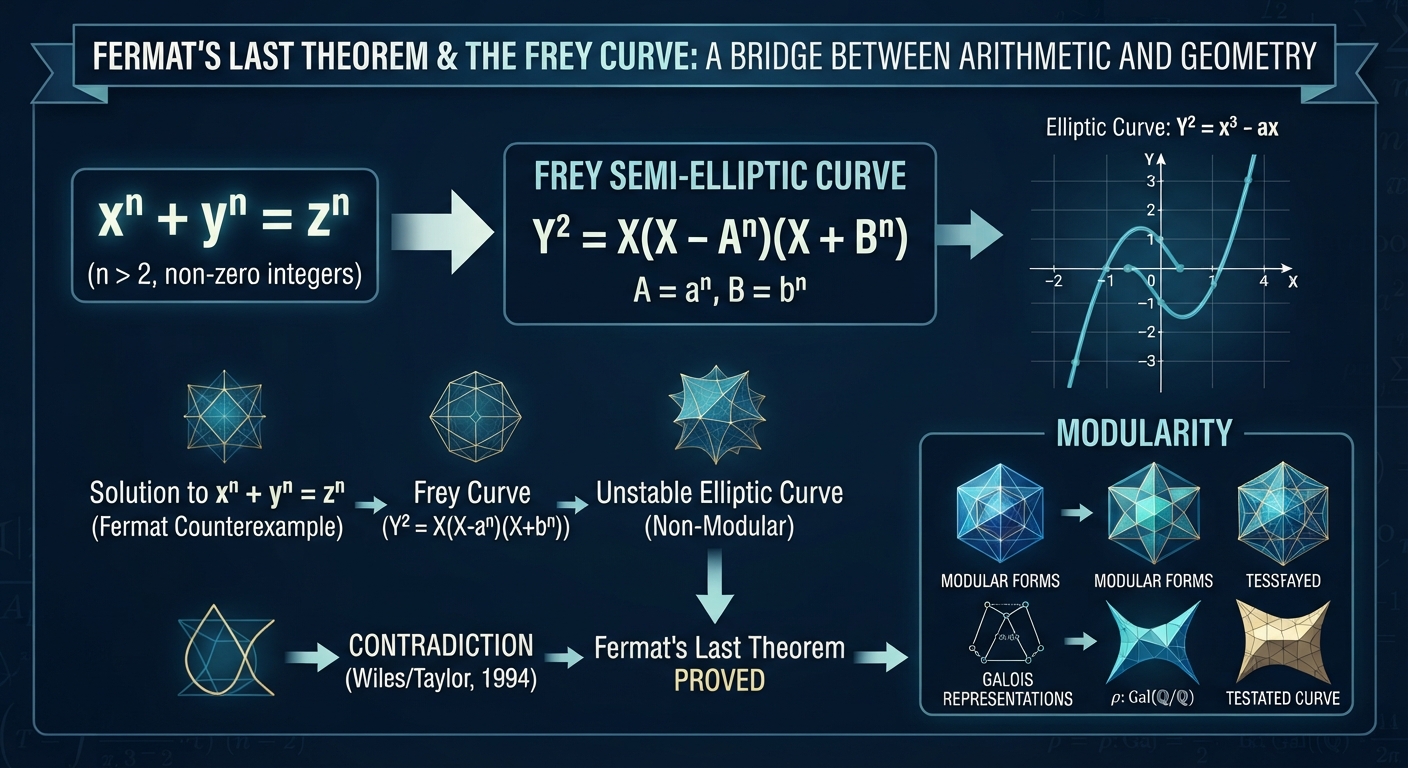
Fermat’s Last Theorem states that no three positive integers and satisfy the equation:
for any integer value of greater than 2.
While the concept is simple, the proof is notoriously complex. Pierre de Fermat claimed to have a “marvelous proof” in 1637 that the margin of his book was too narrow to contain, but it remained unsolved for over 350 years until Andrew Wiles published the formal proof in 1995 using elliptic curves and modular forms.
History
The history of the proof is a 350-year transition from amateur curiosity to the pinnacle of professional mathematics. It is less a linear progression and more a series of “dead ends” that eventually forced the creation of entirely new branches of math.
1. The Marginal Note (1637)
Pierre de Fermat, a lawyer and judge who did math as a hobby, was reading Diophantus’ Arithmetica. He noted that while the Pythagorean theorem () has infinite solutions, he believed it was impossible for . He wrote the famous claim that he had a “truly marvelous proof” but the margin was too small to fit it.
Pragmatic reality: Most modern mathematicians believe Fermat was mistaken and did not actually have a valid proof for all n. He likely had a proof for (which he did actually record) and incorrectly extrapolated that method to all powers.
2. The Era of Specific Cases (1700s – Mid-1800s)
For two centuries, mathematicians tried to prove the theorem one number at a time.
- Leonhard Euler proved it for .
- Sophie Germain developed a strategy to handle a whole class of primes (Sophie Germain primes), moving the needle from individual numbers to groups of numbers.
- Adrien-Marie Legendre and Peter Gustav Lejeune Dirichlet extended the proof for .
3. The “Almost” Proof and the Great Flaw (1847)
Gabriel Lamé and Augustin-Louis Cauchy both claimed to have solved it. They relied on the assumption that numbers in “cyclotomic fields” (complex number extensions) factored uniquely, just like regular integers do.
Ernst Kummer stepped in and proved that unique factorization fails in these higher fields. This was a critical turning point; it proved that the “obvious” ways of attacking the equation were fundamentally broken. To fix this, Kummer invented “ideal numbers,” creating the field of Algebraic Number Theory.
4. The Modern Bridge (1950s – 1980s)
The problem shifted from “solve an equation” to “understand the nature of mathematical objects.”
- Taniyama and Shimura (1950s): Proposed a wild conjecture that all elliptic curves are modular. At the time, this seemed irrelevant to Fermat.
- Gerhard Frey (1984): Realized that a hypothetical Fermat solution could be used to create a very weird elliptic curve.
- Ken Ribet (1986): Proved that Frey’s weird curve could not be modular. This turned the Taniyama-Shimura conjecture into a target: if you prove the conjecture, you disprove the existence of the Fermat solution.
5. The Wiles Saga (1986 – 1995)
Andrew Wiles, who had been obsessed with the theorem since childhood, spent seven years working in total secrecy in his attic.
- The Announcement (1993): Wiles presented his proof at a series of lectures in Cambridge. The world celebrated.
- The Gap (1993-1994): During the peer-review process, a serious flaw was found in the “Kolyvagin-Flach” method he used. For a few months, it looked like the proof had collapsed.
- The Recovery (1994): Working with his former student Richard Taylor, Wiles had a sudden insight. He returned to an older technique (Iwasawa theory) and combined it with his new work to close the gap.
The final proof was published in 1995. It didn’t just solve a riddle; it unified two massive, disparate fields of mathematics, proving that the universe of numbers is more interconnected than anyone had imagined.
Explanation
To understand the actual proof of Fermat’s Last Theorem, you have to move away from simple number theory and into the relationship between two seemingly unrelated worlds: Elliptic Curves and Modular Forms.
The proof is a massive “proof by contradiction.” The logic follows this chain:
1. The Frey Curve (The Bridge)
In the 1980s, Gerhard Frey suggested that if Fermat was wrong—meaning if there did exist a solution where for —then we could use those numbers to build a very specific kind of elliptic curve (a cubic equation of the form ).
This hypothetical curve, now called the Frey Curve, would have extremely strange properties. Specifically, it would be “too stable” or “too semi-stable” in a way that seemed mathematically impossible.
2. Ribet’s Theorem (The Conflict)
Ken Ribet later proved that the Frey Curve was so strange that it could not possibly be modular.
To be “modular” means that the curve can be associated with a Modular Form—a highly symmetrical function existing in the upper half of the complex plane. Modular forms are some of the most symmetric objects in mathematics; they possess a level of internal consistency that is incredibly restrictive.
Ribet essentially said: “If the Frey curve exists, it is not modular.”
3. The Modularity Theorem (The Resolution)
This is where Andrew Wiles spent seven years in isolation. He set out to prove the Taniyama-Shimura-Weil Conjecture, which claimed that every elliptic curve over the rational numbers must be modular.
Wiles didn’t need to prove the whole conjecture for all curves; he only needed to prove it for “semi-stable” elliptic curves (the category the Frey Curve falls into).
The Final Logical Lock
Once Wiles proved that all semi-stable elliptic curves are modular, the trap closed:
- Assume there is a solution to .
- This solution creates the Frey Curve.
- Ribet proved the Frey Curve cannot be modular.
- Wiles proved all such curves must be modular.
- This is a contradiction. Therefore, the initial assumption (that a solution exists) must be false.
The Result: No solutions exist for .
Summary for the Pragmatist
Fermat’s Last Theorem wasn’t solved by staring at the equation . It was solved by proving a fundamental property of a completely different class of mathematical objects (elliptic curves) and showing that the existence of a Fermat solution would violate that property.
