Atlantis is one of the most enduring myths of Western civilization. While often discussed as a “lost city” or “lost continent,” the consensus among historians, archaeologists, and geologists is that it is a fictional allegory.
1. Origin and History
“But afterwards there occurred violent earthquakes and floods; and in a single day and night of misfortune all your warlike men in a body sank into the earth, and the island of Atlantis in like manner disappeared in the depths of the sea.” – Plato, Timaeus (Section 25c–25d).
The story of Atlantis originates solely from the works of the Greek philosopher Plato, specifically in his dialogues Timaeus and Critias (written around 360 BCE).
- The Narrative: Plato describes Atlantis as a powerful naval empire located “beyond the Pillars of Hercules” (the modern-day Strait of Gibraltar). It was a utopia of immense wealth and advanced technology, but its people became corrupt and greedy. After a failed attempt to conquer Athens, the gods punished Atlantis with a series of catastrophic earthquakes and floods, causing the entire island to sink into the ocean in a “single day and night of misfortune.”
- The Purpose: Most scholars agree that Plato invented Atlantis as a philosophical allegory. It served as a cautionary tale about hubris (excessive pride) and as a foil to showcase his vision of an “ideal state” (represented by the fictionalized ancient Athens).
2. Prominent Authors and Influence
While it remained a literary curiosity for centuries, Atlantis became a global obsession in the 19th century.
- Ignatius L. Donnelly: In his 1882 book Atlantis: The Antediluvian World, Donnelly argued that Atlantis was a real historical place and the “cradle of civilization” from which all other ancient cultures (like Egypt and the Maya) descended. This transitioned the story from a philosophical myth to a “pseudoscientific” historical pursuit.
- Charles Berlitz: In the 1970s, Berlitz popularized the association between Atlantis and the Bermuda Triangle, suggesting a link between the “lost” civilization and the mysterious disappearances of ships and planes in the Atlantic.
- Charles Hapgood: Proposed a “crustal displacement” theory, suggesting that the Earth’s crust shifted, moving Atlantis (which he identified as Antarctica) from a temperate zone to the South Pole.
3. Major Speculations and Theories
Because Plato’s description was vague, many have tried to map Atlantis to real-world locations:
- The Minoan Hypothesis (Santorini): The most scientifically grounded theory. It suggests that the catastrophic volcanic eruption of Thera (Santorini) around 1600 BCE, which devastated the advanced Minoan civilization on Crete, provided the historical seed for Plato’s story.
- The Atlantic Ocean: The literal interpretation—that a large continent once existed in the middle of the Atlantic.
- The Black Sea Flood: Some theorists suggest the story is a distorted memory of the Mediterranean Sea breaching the Bosporus and flooding the Black Sea basin around 5600 BCE.
- Bimini Road: Proponents of the Bahamas theory point to the “Bimini Road,” a series of submerged limestone blocks. However, geologists have determined these are natural beach-rock formations.
- Heinrich Himmler: The architect of the Holocaust, who funded archaeological searches for Atlantis to prove the existence of a superior “Aryan race.”
4. Facts vs. Fiction
| Point | Myth/Speculation | Scientific/Historical Fact |
|---|---|---|
| Existence | A real advanced civilization existed and sank. | No archaeological or geological evidence of a sunken continent exists. |
| Geology | A continent can “sink” into the ocean rapidly. | Plate tectonics show that continental crust is too buoyant to simply “sink” into the mantle. |
| Sources | Ancient records from Egypt (via Solon). | No mention of Atlantis exists in any ancient text except those of Plato. |
| Purpose | A historical account of a lost world. | A literary device used by Plato to discuss political and moral philosophy. |
Arquitecture
Based on Plato’s dialogues (Timaeus and Critias), the architecture of Atlantis is described as a masterpiece of urban planning, symmetry, and lavish materiality. Plato focuses specifically on the capital city, which served as a physical manifestation of the empire’s power and order.
1. The Concentric City Layout
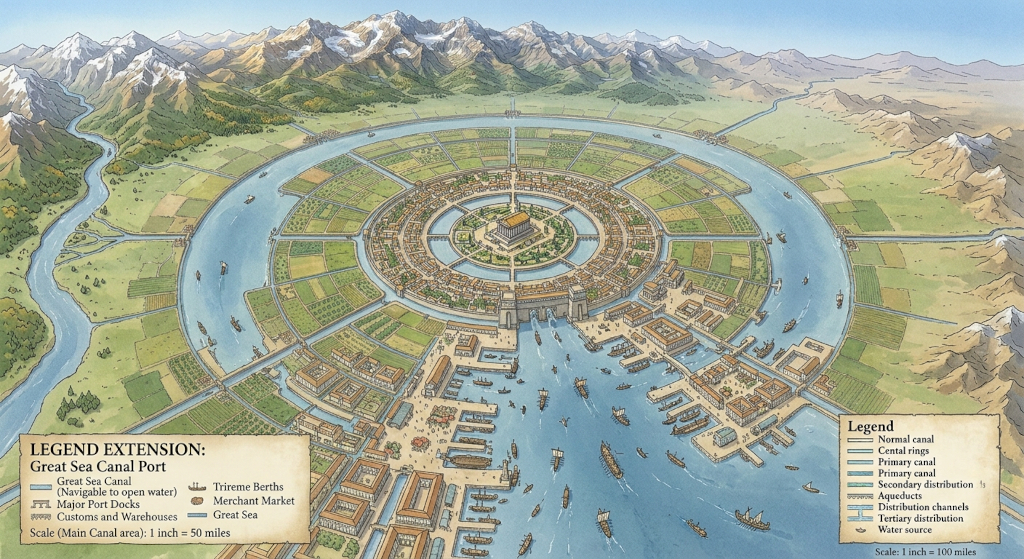
The most iconic feature of Atlantis was its circular, concentric design. The capital was structured as a series of alternating rings of land and water:
- The Core: A central island that functioned as the citadel and the seat of the royal government.
- The Rings: Surrounding the central island were two concentric rings of land and two concentric rings of water.
- Connectivity:
- Bridges: Massive bridges spanned the water rings, connecting the land zones.
- The Great Canal: A deep, wide canal cut through the land rings, allowing ships to sail from the open ocean directly into the innermost ring of water, effectively bringing the harbor to the city’s doorstep.
2. Materials and Color Palette
Plato provides a very specific description of the materials used in the city’s construction, emphasizing a bold, contrasting aesthetic:
- The Three Stones: The walls and buildings were constructed using three types of stone quarried from the island: black, white, and red. These were used in alternating layers to create a striking visual pattern.
- Orichalcum: The outermost wall was coated in orichalcum, a legendary metal described as “flashing like fire.” It is generally interpreted as a gold-copper alloy and was the second most valuable metal after gold.
- Infrastructure: The canals were lined with stone, and the bridges were built to support heavy traffic.
3. The Temple of Poseidon
The architectural crown jewel was the Temple of Poseidon, located at the very center of the city. Plato describes it as an overwhelmingly opulent structure:
- Exterior: The temple was surrounded by a gold wall.
- Interior Finishes:
- The ceiling was made of ivory.
- The walls were plated in silver.
- The floors were adorned with precious stones.
- The Central Statue: Inside stood a colossal gold statue of Poseidon. He is depicted standing in a chariot drawn by six winged horses, with sea-deities and sirens surrounding him, reaching the height of the temple’s ceiling.
4. Investigation about the Atlantis arquitecture and location
Dami Lee has an investigation about the Atlantis arquitecture:
Johnny Harris search maps and possible location of Atlantis:
5. Summary of the Urban Blueprint
| Feature | Description | Purpose/Effect |
|---|---|---|
| Geometry | Concentric circles (Land → Water → Land → Water) | Symmetry, defense, and naval efficiency. |
| Colors | Red, White, and Black stone | Visual grandeur and organizational order. |
| Metalwork | Orichalcum and Gold plating | Demonstration of extreme wealth and divine status. |
| Transport | Deep-water canals and bridges | Integration of maritime trade with urban living. |
| Citadel | Central island with Temple and Palace | Centralization of religious and political power. |
Books about Atlantis
Books based on the myth of Atlantis generally fall into three distinct categories: the primary philosophical source, pseudoscientific theories, and literary fiction.
1. The Source Material (Essential Reading)
To understand Atlantis, one must start with the only texts that actually describe it.
- Plato — Timaeus and Critias: These are the two dialogues where the myth was born. They aren’t “books” in the modern sense but short philosophical treatises. If you want the “original blueprint” of the city and its society, these are mandatory.
2. Theoretical & “Alternative History” (Non-Fiction/Pseudo-Science)
These books attempt to prove that Atlantis was a real place and often propose specific locations.
- Ignatius L. Donnelly — Atlantis: The Antediluvian World (1882): The catalyst for the modern Atlantis obsession. Donnelly argued that all ancient civilizations (Egypt, Maya) were colonists from a primary “mother culture” in Atlantis.
- Graham Hancock — Fingerprints of the Gods (1995): A modern bestseller that proposes a “lost civilization” was wiped out by a global cataclysm around 12,000 years ago, leaving behind monuments like the pyramids as evidence.
- Charles Hapgood — Earth’s Shifting Crust (1958): The foundational text for the theory that Atlantis was located in Antarctica before a pole shift moved the continent to the south.
- William Scott Elliott: A Scottish banker and amateur cartographer who produced a book and maps claiming Atlantis existed a million years ago, based on “spiritual clairvoyance.”
- Raymond Bernard: A French Rosicrucian writer who translated Plato’s measurements into detailed blueprints in his book The Invisible Empire.
3. Literary Fiction (Novels & Storytelling)
These use Atlantis as a setting for adventure, mystery, or social commentary.
- Pierre Benoît — L&’Atlantide (1919): A gothic and haunting novel about an expedition that finds a mysterious, decaying civilization in the Sahara Desert. It treats Atlantis as a place of memory and obsession rather than a high-tech city.
- Cutcliffe Hyne — The Lost Continent (1899): An early adventure novel that blends mythology with a quest to find the vanished empire.
- Francis Bacon — New Atlantis (1627): Rather than a story about a sunken city, Bacon uses the name to describe a utopian society. It is a vision of a perfect world governed by science and reason, rather than a mystery about a lost one.
- Modern Genre Fiction:
- Fantasy/Sci-Fi: You will find Atlantis in countless “Lost World” style novels and modern fantasy series (e.g., works inspired by the Aquaman or Stargate mythology).
- The “Hidden Kingdom” Trope: Many modern thrillers (like those by James Rollins or Steve Berry) often use Atlantis as a MacGuffin for ancient secrets and hidden technology.
Summary Guide: Which one to read?
| If you want… | Read this… |
|---|---|
| The original myth | Plato’s Timaeus & Critias |
| A utopian vision of science | Francis Bacon’s New Atlantis |
| The “conspiracy” side of history | Graham Hancock’s Fingerprints of the Gods |
| The “Mother Culture” theory | Ignatius Donnelly’s Antediluvian World |
| A mysterious, atmospheric novel | Pierre Benoît’s L’Atlantide |
| Clairvoyance and psychic powers in historical research | W. Scott-Elliot’s The Story of Atlantis and the Lost Lemuria |
Movies and TV Series about Atlantis
The legend of Atlantis has been reimagined countless times, evolving from a philosophical parable into a staple of the sci-fi and fantasy genres. Here are the most notable movies and series, categorized by how they interpret the legend:
1. High-Adventure & Sci-Fi (Modern Re-imaginings)
These versions typically portray Atlantis as a technologically advanced civilization that possesses “super-science.”
- Atlantis: The Lost Empire (Disney, 2001): Perhaps the most famous animated version. It blends archaeology and steampunk, presenting Atlantis as a city of glowing crystals and ancient machinery.
- Stargate: Atlantis (TV Series, 2004–2009): A spin-off of Stargate SG-1. In this version, Atlantis is not just a city but a massive spaceship built by an ancient race that settled Earth, now located in a different galaxy.
- 20,000 Leagues Under the Sea (Various versions): While not always the main focus, many adaptations of Jules Verne’s novel include the discovery of the ruins of Atlantis.
2. Superhero & Comic Book Versions
These versions integrate Atlantis into broader fictional universes, often as an underwater kingdom of immortal or amphibious beings.
- Aquaman (2018) & Aquaman and the Lost Kingdom (2023): In the DC Cinematic Universe, Atlantis is a hidden, high-tech empire that rules the seven seas, with a deep focus on royal politics and biological adaptation to the ocean.
- Namor the Sub-Mariner (Marvel Comics/Films): Black Panther: Wakanda Forever (2022) introduces Talokan, which is essentially Marvel’s version of the Atlantis myth—an isolated, advanced civilization hidden underwater.
3. Mythological & Literal Adaptations
These lean closer to the “lost civilization” trope or try to recreate the atmosphere of ancient antiquity.
- Atlantis: End of a World, Birth of a Legend (2011): A more traditional approach that focuses on the tragedy and the actual sinking of the civilization.
- L’Atlantide (Various films, 1921, 1932, 2001): Based on the novel by Pierre Benoît. These films often treat Atlantis as a mysterious, haunting place of ruins and ghosts rather than a high-tech city.
Summary Table for Quick Selection
| Type | Title | Vibe | Key Theme |
|---|---|---|---|
| Animation | Atlantis: The Lost Empire | Adventure/Steampunk | Discovery & Exploration |
| TV Series | Stargate: Atlantis | Military Sci-Fi | Galactic Colonization |
| Blockbuster | Aquaman | Epic/Fantasy | Royal Conflict & Power |
| Art House | L’Atlantide | Gothic/Mysterious | Loss & Obsession |
| Superhero | Black Panther: Wakanda Forever | Political/Action | Isolationism vs. Globalism |
