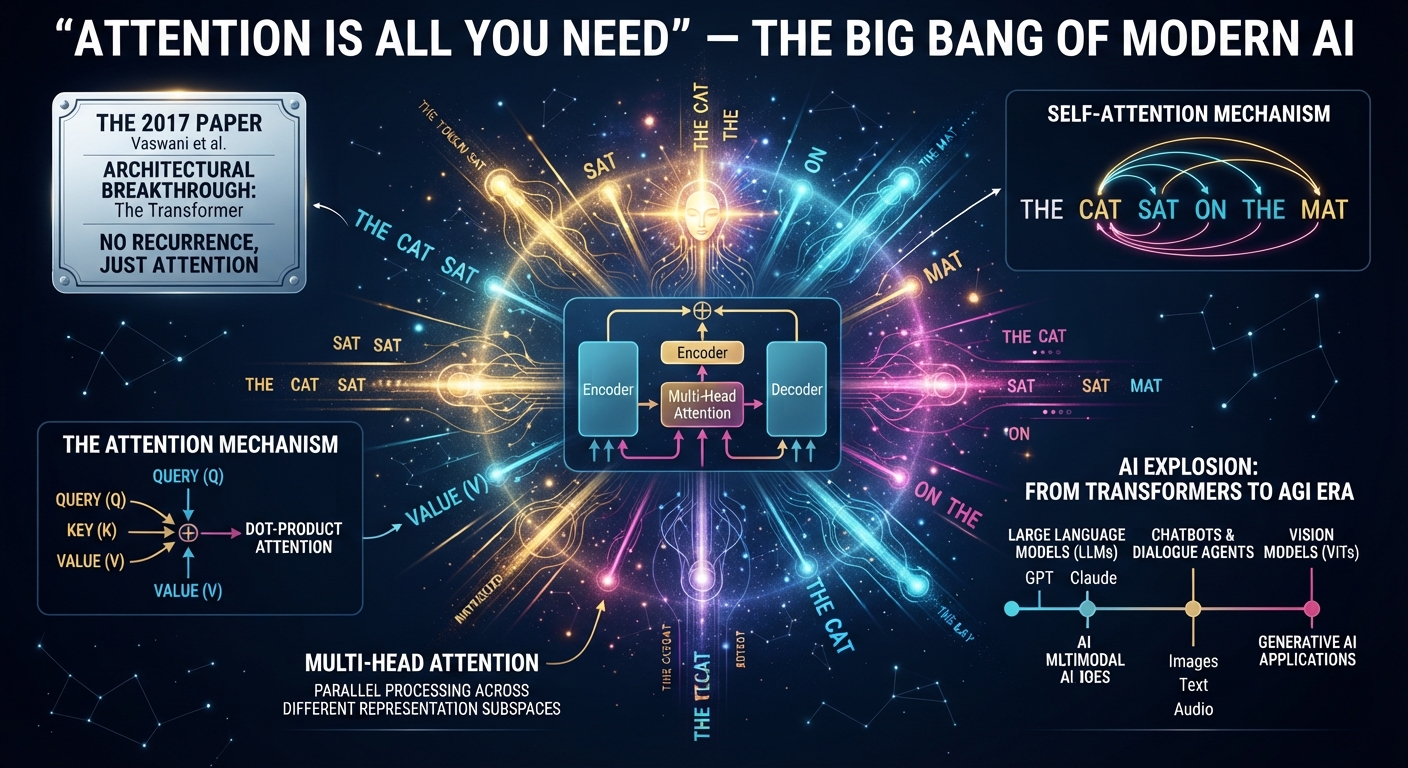
The paper “Attention Is All You Need,” published in 2017 by researchers at Google. The paper was authored by eight scientists and engineers: Ashish Vaswani, Noam Shazeer, Niki Parmar, Jakob Uszkoreit, Llion Jones, Aidan N. Gomez, Łukasz Kaiser, and Illia Polosukhin.
To explain the content of “Attention Is All You Need” in detail, we have to look at it as a blueprint for a new kind of machine. The paper’s central thesis is that recurrence (processing data in order) is unnecessary and that a mechanism called Attention can handle all the heavy lifting.
Here is the detailed breakdown of the paper’s content, structured by its architectural components.
1. The Core Motivation: Killing the Sequence
Before this paper, the industry standard for translation was the Encoder-Decoder RNN. The Encoder would read the source sentence one word at a time, updating a “hidden state” (a memory vector). The Decoder would then take that final vector and unfold it into the target language.
The Problem:
- The Bottleneck: All information from a 50-word sentence had to be squeezed into one single vector.
- Sequential Nature: You couldn’t calculate word 10 until word 9 was finished. This made training on GPUs incredibly inefficient.
2. The Model Architecture (The “Big Picture”)
The authors proposed the Transformer, which still uses an Encoder-Decoder structure but replaces the RNNs with “stacks” of identical layers.
A. The Encoder (The “Understanding” Side)
The Encoder’s job is to create a high-dimensional representation of the input text. It consists of a stack of identical layers. Each layer has two sub-layers:
- Multi-Head Self-Attention: This allows the encoder to look at other words in the input sentence to better understand the current word.
- Position-wise Feed-Forward Network (FFN): a simple neural network applied to each position independently to further process the representation.
B. The Decoder (The “Generating” Side)
The Decoder generates the output (e.g., the translation). It also has layers, but each layer has three sub-layers:
- Masked Multi-Head Self-Attention: Similar to the encoder, but it is “masked.” This means while predicting word 3, the model is forbidden from “peeking” at word 4.
- Encoder-Decoder Attention (Cross-Attention): This is the bridge. The Decoder uses this layer to “reach back” and look at the final representations produced by the Encoder.
- Position-wise FFN: Same as in the encoder.
3. The Mathematical Engine: Scaled Dot-Product Attention
The “secret sauce” of the paper is the formula for Attention. The authors treat every word as if it were in a database:
- Query: “What am I looking for?”
- Key: “What information do I contain?”
- Value: “Here is the actual content.”
The Process:
- The model calculates the dot product of the Query (current word) and the Key (all other words).
- This result is divided by (the scaling factor) to prevent the numbers from getting too large, which would “kill” the gradients during training.
- A Softmax function is applied, turning these scores into probabilities (e.g., Word A is 70% relevant, Word B is 20%, Word C is 10%).
- The model multiplies these probabilities by the Value vector to get the final weighted representation.
Multi-Head Attention: Instead of doing this once, the authors do it 8 times in parallel (8 heads). This allows the model to simultaneously attend to different types of relationships (e.g., one head tracks grammar, another tracks the subject of the sentence, another tracks the tense).
4. The “Assistant” Components
Since the model sees the whole sentence at once, it has no idea which word comes first and which comes last. To fix this, the authors introduced:
- Positional Encoding: They add a unique mathematical signal (using sine and cosine functions of different frequencies) to the input embeddings. This gives the model a “coordinate system” so it knows the relative position of tokens.
- Residual Connections & Layer Norm: Around every sub-layer, there is a “shortcut” (Residual Connection) that allows the original input to bypass the layer. This is followed by “Layer Normalization,” which keeps the numerical values stable across the deep network.
5. The Output Stage
At the very top of the Decoder, the model produces a vector. This vector is passed through a Linear layer (a final projection) and then a Softmax layer, which converts the vector into a probability distribution over the entire vocabulary. The word with the highest probability is chosen as the next word in the sequence.
Summary Table: RNN vs. Transformer
| Feature | RNN / LSTM | Transformer |
|---|---|---|
| Processing | Sequential (One by one) | Parallel (All at once) |
| Memory | Hidden State (Fixed size) | Attention (Dynamic lookup) |
| Long-range Deps | Struggles (Vanishing gradient) | Excellent (Direct connection) |
| Training Speed | Slow | Very Fast (GPU optimized) |
| Position Sense | Inherent (by order) | Explicit (Positional Encoding) |
Consequences and Impact
The publication of this paper is widely considered the “big bang” moment for modern AI. Its consequences include:
- The Death of RNNs for NLP: Recurrent architectures were almost entirely replaced by Transformers for natural language tasks due to their superior speed and accuracy.
- The Emergence of GPT and BERT: The “T” in GPT stands for Transformer. This architecture enabled the creation of BERT (which revolutionized search) and the GPT series (which enabled generative AI).
- Scaling Laws: The architecture proved that increasing the number of parameters and the amount of data leads to predictable improvements in performance, leading to the current “arms race” in model size (LLMs).
- Multimodality: While designed for text, the Transformer architecture has been adapted for images (Vision Transformers/ViT), audio, and video, creating a unified framework for almost all current AI research.
The information provided was sourced from the following references:
Primary Research Paper
- arXiv: Attention Is All You Need
- NeurIPS (PDF): Attention Is All You Need – Official Proceedings
Reference Summary
- Wikipedia: Attention Is All You Need
