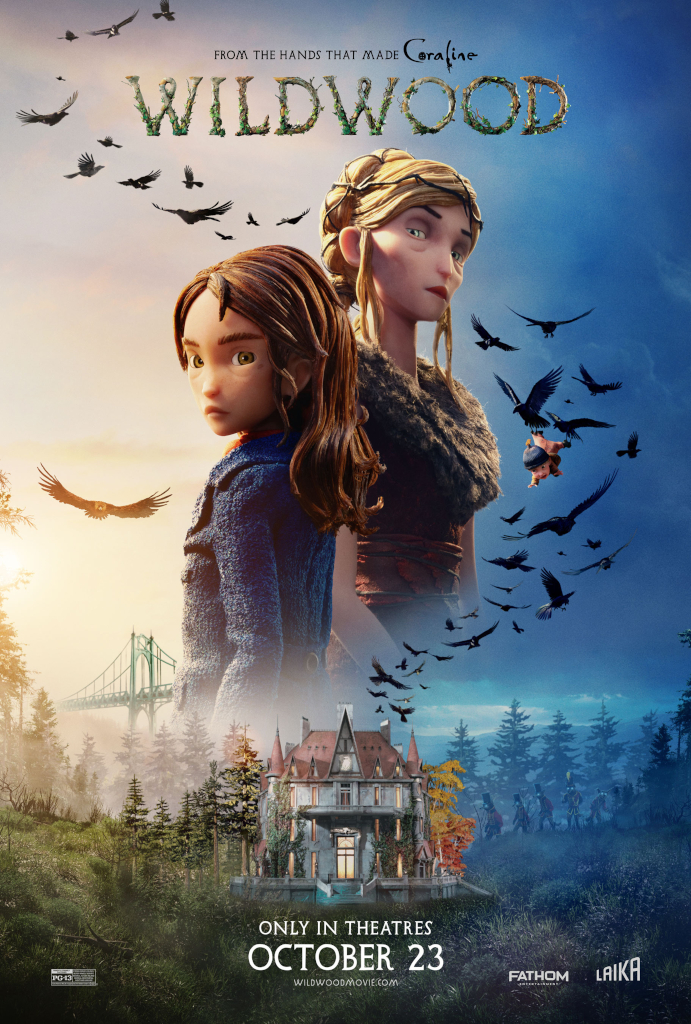
Wildwood is a dark fantasy stop-motion animated film produced by Laika Studios, directed by Travis knight, released in late 2026. It is based on the book series written by Colin Meloy and illustrated by Carson Ellis.
Plot
The story begins in Portland, where Prue McKeel, a cynical and headstrong teenager who tries to act more mature than she is, takes her baby brother Mac to a playground against her parents’ explicit warnings. In a moment of negligence, Mac is kidnapped by a murder of crows and carried into the Wildwood, a forbidden, sentient, and dangerous magical forest.
Prue, driven by intense guilt and love for her brother, ventures into the woods to rescue him. She is accompanied by Curtis Mehlberg, an awkward, fantasy-loving classmate. Inside, they discover a world of political intrigue, bizarre creatures, and a brutal war. As Prue navigates this “Impassible Wilderness,” she discovers a dark family secret: she and Mac were not conceived naturally. Her parents had made a mystical deal with a powerful being named Alexandra to have children; the price of that deal was that the second child (Mac) would belong to Alexandra.
The climax centers on a confrontation with the tyrannical Dowager Governess (Alexandra), whose grief over her own lost son has turned her into a monster. The battle concludes in a burst of “nightmarish violence” involving The Ivy, a blood-drinking botanical entity that Prue discovers she can control due to the magic in her blood.
Character Guide: Intentions & Motivations
Prue McKeel (The Protagonist)
- Intention: To rescue Mac from the Wildwood and return him safely to their parents.
- Motivations:
- Familial Love: A fierce, protective bond with her baby brother.
- Guilt: She blames herself for the kidnapping because she disobeyed her parents and lost sight of Mac.
- Self-Discovery: Over the course of the film, she moves from a “deadpan snarker” who thinks she has life figured out to someone who accepts the complexities of magic and morality.
Alexandra / The Dowager Governess (The Antagonist)
- Intention: To reclaim Mac as payment for the magical deal she struck with Prue’s parents and to maintain her tyrannical rule over the forest.
- Motivations:
- Grief and Loss: Having lost her own son, Alexei (who was consumed by the Ivy), she is driven by a distorted desire to replace him.
- Power: Her descent into madness is coupled with a need for absolute control over the inhabitants of the Wildwood.
Curtis Mehlberg (The Sidekick)
- Intention: To support Prue in her quest and survive the perils of the forest.
- Motivations:
- Loyalty: Despite his fear and awkwardness, he refuses to let Prue face the danger alone.
- Wonder: Unlike Prue, Curtis is a geek for fantasy and TTRPGs; for him, the Wildwood is the realization of the stories he has always loved.
The Ivy (The Sentient Entity)
- Intention: To feed on blood and keep the forest’s boundaries secure.
- Motivations:
- Instinct: Primarily driven by survival and hunger.
- Affinity for Prue: Interestingly, the Ivy develops a “soft spot” for Prue, aiding her not because it is commanded, but because it genuinely wants to protect her.
Key Narrative Beats
- The Catalyst: Prue’s disobedience → Mac’s kidnapping → Prue’s entry into the Wildwood.
- The Discovery: Prue and Curtis encounter the forest’s factions and realize the world is much more violent and complex than a fairy tale.
- The Twist: Prue learns she is a “magical creation,” which explains why the forest allows her entry and why she can manipulate the plants.
- The Climax: A desperate fight at the Plinth where Prue is forced to use the Ivy to kill Alexandra in self-defense, and Curtis is forced to kill the henchman Maksim to save Prue.
- The Resolution: The Ivy returns to dormancy, Mac is saved, and Prue returns home forever changed by the trauma and the truth of her origin.
How It Was Made
True to Laika’s philosophy and reputation, Wildwood was created using stop-motion animation.
- Handmade Artistry: The production is emphasized as a “handmade” achievement, contrasting the tangible art of physical puppetry and set building with the rise of AI-generated imagery.
- Production Cycle: Reports suggest an incredibly long and meticulous production process (with some sources citing a timeline spanning many years) to achieve the level of detail required for the epic fantasy scope.
- Laika Pipeline: While specific new technologies for this film weren’t detailed in the sources, it follows the studio’s established hybrid pipeline: combining traditional hand-sculpted puppets with high-precision 3D printing for facial expressions and seamless CG integration for environmental extensions.
Comparison with “Labyrinth”
Critics and audiences have frequently compared Wildwood to the 1986 cult classic Labyrinth, primarily due to the following:
- The Core Premise: Both films center on a protective older sister who must navigate a strange, dangerous, and surreal world to retrieve a baby brother who has been taken.
- The Setting: Both feature “labyrinthine” environments—expansive, confusing, and immersive worlds populated by a vast gallery of eccentric and grotesque creatures.
- The Divergence in Tone: This is where the films differ most. While Labyrinth is a whimsical, musical fantasy with moments of eerie tension, Wildwood is described as “utterly dark” and significantly more violent, leaning into the “dark fantasy” genre more heavily than its predecessor.
- Medium: While both rely on physical art (puppets/sets), Labyrinth was achieved through practical animatronics and live-action puppetry (led by Jim Henson), whereas Wildwood uses the frame-by-frame patience of stop-motion animation.
About Laika Studios
Laika Studios is an independent American animation studio based in Hillsboro, Oregon, renowned for pushing the technical boundaries of stop-motion animation.
Foundation and Origins
Laika did not start from scratch but evolved from Will Vinton Studios. In the late 1990s, Will Vinton’s studio sought investors for feature-length films. Phil Knight (co-founder of Nike) made an initial investment in 1998. By 2002, Knight acquired the financially struggling studio to pursue a vision of high-end feature productions. In 2003, director Henry Selick joined the team, and in July 2005, the studio was officially rebranded as Laika (named after the Soviet space dog).
Funding and Backing
The studio is privately owned and backed by Phil Knight and his son, Travis Knight (who serves as President and CEO). Because of this private funding, Laika operates with a degree of creative freedom and financial patience rarely seen in the industry, often spending several years and significant budgets on a single film without the immediate pressure of studio mandates.
Major Works
Laika is best known for its meticulously crafted stop-motion feature films:
- Coraline (2009)
- ParaNorman (2012)
- The Boxtrolls (2014)
- Kubo and the Two Strings (2016)
- Missing Link (2019)
- Wildwood (2026)
The studio is famous for blending traditional stop-motion with modern technology, such as using 3D printing for thousands of unique facial expressions for their characters.
Reception
Laika is critically acclaimed for its artistry and technical innovation:
- Awards: They have earned multiple Academy Award nominations for Best Animated Feature.
- Recognition: Kubo and the Two Strings is particularly noted for winning the BAFTA for Best Animated Feature and being one of the few animated films to receive an Oscar nomination for Best Visual Effects.
- Reputation: They are viewed as the gold standard for modern stop-motion, respected for their “handmade” aesthetic combined with cutting-edge precision.
