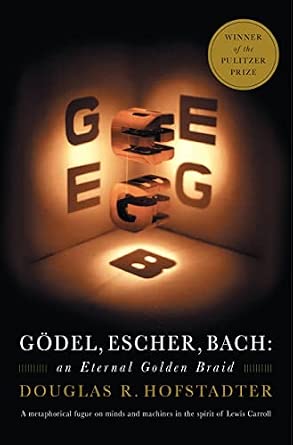
I will break this down by the book’s structural logic, its theoretical core, and a pragmatic critique of its conclusions.
1. The Thesis: The Emergence of Mind
The central objective of GEB is to explain how consciousness—the “I”—emerges from mindless components. Hofstadter’s hypothesis is that the mind is a Strange Loop: a hierarchical system that, through a series of levels, unexpectedly loops back to its origin.
He argues that meaning is not “added” to a system from the outside, but emerges when a system becomes complex enough to represent itself.
2. The Three Pillars (The Isomorphism)
Hofstadter uses Gödel, Escher, and Bach not as biographical subjects, but as isomorphic examples of the same phenomenon:
- Kurt Gödel (Logic): His Incompleteness Theorems proved that in any consistent formal system, there are statements that are true but unprovable within that system. This is the mathematical “loop”—a formula that talks about the formula itself.
- M.C. Escher (Visual Art): His drawings (like Drawing Hands or Waterfall) create visual paradoxes where the “up” eventually becomes “down.” This is the sensory manifestation of a Strange Loop.
- J.S. Bach (Music): His fugues and canons (specifically the Musical Offering) use recursive structures where a melody is played against itself in a way that shifts the key or timing, eventually returning home. This is the temporal manifestation of a loop.
The Analysis: By weaving these together, Hofstadter demonstrates that self-reference is a universal pattern across mathematics, art, and music.
3. The Operational Mechanism: Recursion and Isomorphism
The book focuses on two technical concepts to explain the mind:
- Isomorphism: When two different systems share the same structure. Hofstadter argues that we “perceive” meaning because our brains find isomorphisms between the symbols we see and the concepts we already know.
- Recursion: The process of a function calling itself. He posits that the “self” is a recursive process—the brain is a system that creates a model of the world, and then creates a model of itself within that world.
4. Pragmatic Critique
From a modern perspective, GEB has both timeless insights and dated assumptions:
The Strengths:
- Structural Genius: The book’s format (dialogues alternating with chapters) is a “Strange Loop” in itself. It forces the reader to engage in the very recursive thinking the book describes.
- Conceptual Framework: It provides a vocabulary for discussing emergent complexity that remains useful in software engineering and cognitive science.
The Weaknesses:
- Symbolic Bias: Hofstadter writes from the perspective of “Symbolic AI” (GOFAI). He views the mind as a system of formal rules and symbol manipulation. Modern AI (Connectionism/Neural Networks) suggests that intelligence emerges from weighted statistical patterns rather than explicit recursive rules.
- Speculative Leap: While the math of Gödel is concrete, the leap from “mathematical self-reference” to “human consciousness” is a philosophical hypothesis, not a proven biological fact.
Final Verdict
Gödel, Escher, Bach is an analysis of pattern recognition. Its primary value is not in providing a “solution” to the mystery of consciousness, but in proving that the architecture of the mind resembles a formal system that has become aware of its own rules.
For a pragmatic thinker, the book is a lesson in abstraction: it teaches you how to see the same underlying logic in three completely different fields.
