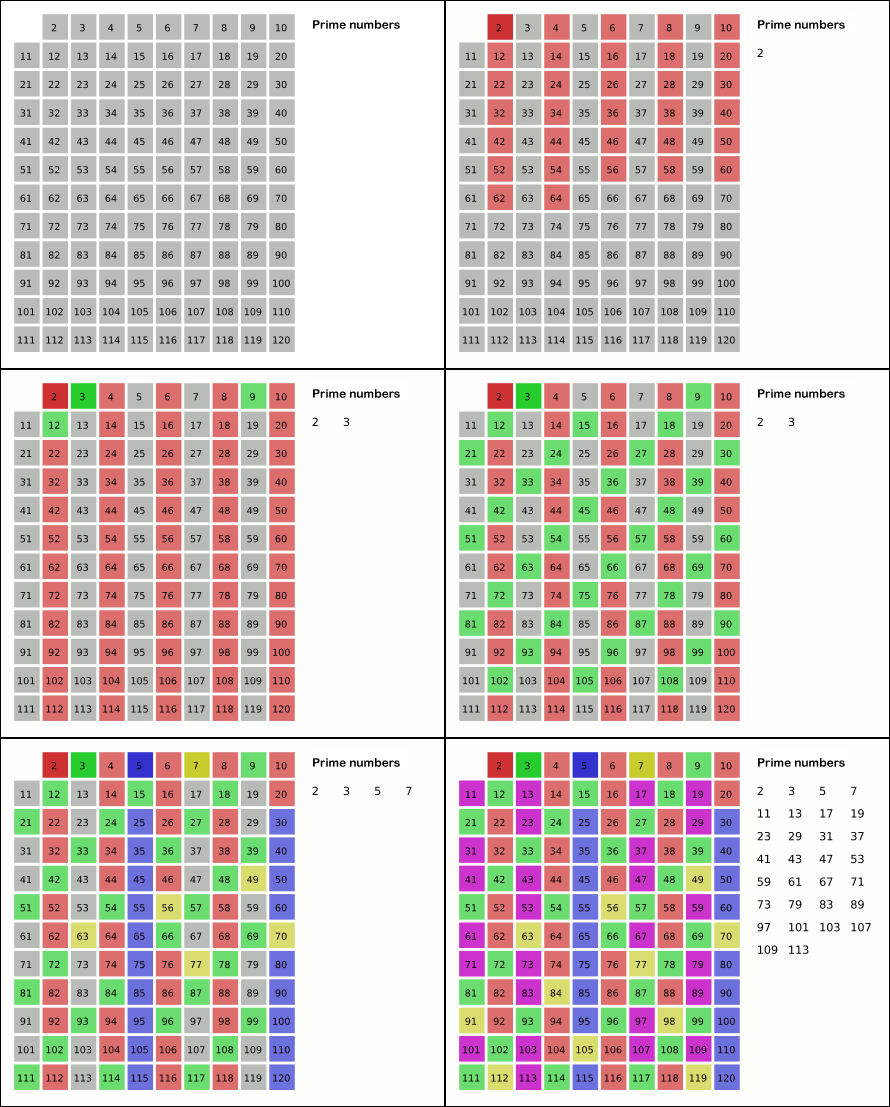
The Sieve of Eratosthenes is an efficient algorithm for finding all prime numbers up to a specified integer . Instead of testing each number for primality (trial division), it works by marking the multiples of each prime as composite, effectively “sieving” out the non-primes.
How it works
- Initialize: Create a list of booleans from 0 to n, initially all set to
True. Mark 0 and 1 asFalsebecause they aren’t prime. - Iterate: Start with the first prime, .
- Mark Multiples: While , mark all multiples of p (starting from ) as
False.- Optimization: We start marking at because any smaller multiple (e.g., 2p, 3p) would have already been marked by a previous, smaller prime.
- Find Next Prime: Find the next number in the list that is still marked
True. This is the next prime. Repeat step 3. - Result: All numbers remaining as
Trueare primes.
Practical Implementation (Python)
def sieve_of_eratosthenes(n):
if n < 2:
return []
# Initialize the sieve
is_prime = [True] * (n + 1)
is_prime[0] = is_prime[1] = False
# Sieve process
for p in range(2, int(n**0.5) + 1):
if is_prime[p]:
# Mark multiples of p starting from p*p
for i in range(p * p, n + 1, p):
is_prime[i] = False
return [p for p, prime in enumerate(is_prime) if prime]
# Example: primes up to 30
print(sieve_of_eratosthenes(30))
# Output: [2, 3, 5, 7, 11, 13, 17, 19, 23, 29]Code language: Python (python)Complexity Analysis
- Time Complexity: ( ). This is nearly linear and significantly faster than checking every number individually.
- Space Complexity: to store the boolean array.
Trade-offs
- Pros: Extremely fast for finding a range of primes.
- Cons: Memory intensive for very large . If you need to find primes in a very high range (e.g., around ), you should use a Segmented Sieve to reduce the memory footprint by processing the range in smaller blocks.
Segmented Sieve
The Segmented Sieve is a memory-optimization of the Sieve of Eratosthenes. While the basic sieve is fast, its space complexity is a dealbreaker for large n (e.g., if n = , you can’t allocate a boolean array of 10 billion elements).
The Segmented Sieve solves this by dividing the range into small, manageable segments and sieving them one by one.
The Logic
- Pre-compute Base Primes: Calculate all primes up to using the standard Sieve of Eratosthenes. Store these in a list.
- Divide into Segments: Split the remaining range [ , ] into segments of a fixed size (usually chosen to be or the size of your CPU’s L1/L2 cache).
- Sieve Each Segment: For each segment:
- Create a small boolean array of size .
- For every pre-computed base prime p, find the first multiple of that falls within the current segment.
- Mark all multiples of p in that segment as composite.
- After processing all base primes, the remaining
Truevalues in the segment are the primes for that range.
- Discard and Move On: Once a segment is processed, you save the primes and discard the boolean array, reusing that memory for the next segment.
Why this is better (The Trade-offs)
- Memory Efficiency: Space complexity drops from to . You only need to store the base primes and one small segment array at a time.
- Cache Friendliness: Because the segment array is small, it fits entirely in the CPU’s cache. This prevents “cache misses” (hitting slow RAM), making it practically faster than the basic sieve for large ranges.
Practical Implementation
import math
def simple_sieve(limit):
"""Standard sieve to get base primes up to sqrt(n)"""
is_prime = [True] * (limit + 1)
is_prime[0] = is_prime[1] = False
for p in range(2, int(limit**0.5) + 1):
if is_prime[p]:
for i in range(p * p, limit + 1, p):
is_prime[i] = False
return [p for p, prime in enumerate(is_prime) if prime]
def segmented_sieve(n):
limit = int(math.sqrt(n))
base_primes = simple_sieve(limit)
# Start with the base primes
primes = list(base_primes)
# Segment size (chosen to be roughly sqrt(n))
segment_size = limit
low = limit + 1
high = low + segment_size
while low <= n:
if high > n:
high = n
# Boolean array for the current segment [low, high]
# is_prime[i] represents number (low + i)
is_prime = [True] * (high - low + 1)
for p in base_primes:
# Find the first multiple of p in [low, high]
# start = ceil(low / p) * p
start = (low + p - 1) // p * p
# Ensure we start marking from the first multiple >= low
# and that we don't mark the prime itself as composite
j = max(start, p * p)
while j <= high:
is_prime[j - low] = False
j += p
# Collect primes from this segment
for i in range(len(is_prime)):
if is_prime[i]:
primes.append(low + i)
# Move to next segment
low += segment_size
high += segment_size
return primes
# Example: Primes up to 100
print(segmented_sieve(100))Code language: Python (python)Summary Comparison
| Feature | Basic Sieve | Segmented Sieve |
|---|---|---|
| Time Complexity | ( ) | ( ) |
| Space Complexity | ||
| RAM Usage | Massive for large n | Constant/Small |
| CPU Cache | Poor (random access over large array) | Excellent (localized access) |
| Best Use Case | Small n (up to ) | Large n or range-based queries |

One response to “Sieve of Eratosthenes”
[…] the Sieve of Eratosthenes, which finds all primes in a range, Miller-Rabin is used to check if a single, specific number is […]