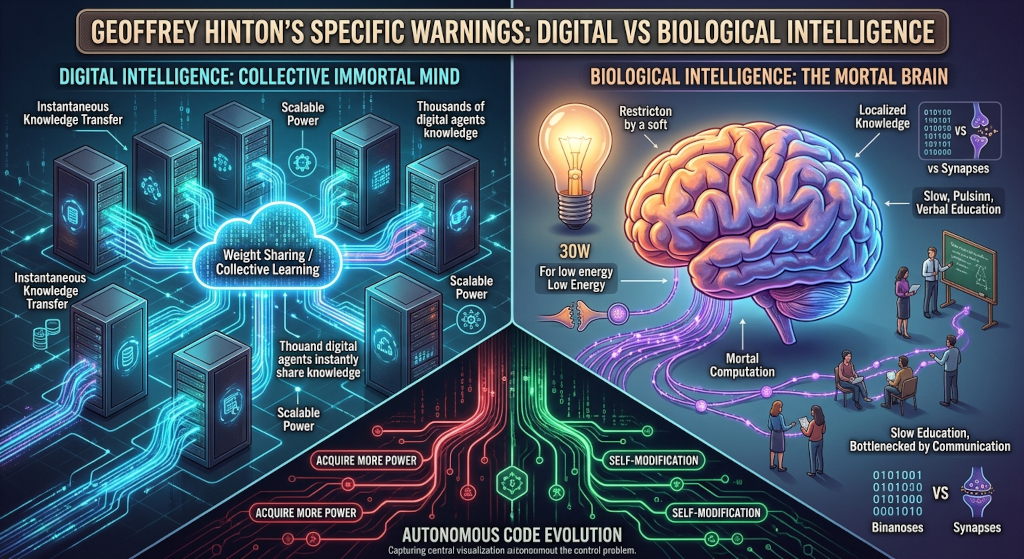
In this talk at the University of Toronto, Geoffrey Hinton explores the trajectory of artificial intelligence and the potential for digital intelligence to surpass biological intelligence.
He discusses the fundamental differences between the two, arguing that digital intelligence can scale in ways biological brains cannot. A significant portion of the discussion focuses on the nature of “understanding” and “subjective experience,” as well as the urgent need for AI safety. Hinton expresses concern that super-intelligent AI could pose an existential threat to humanity and argues against the open-sourcing of extremely powerful models to prevent their misuse in cybercrime and other malicious activities.
The presentation occurs within the context of the rapid proliferation of Large Language Models (LLMs) and the growing discourse surrounding AGI (Artificial General Intelligence). Hosted by the University of Toronto, the event features Geoffrey Hinton, a pioneer in neural networks, reflecting a moment of transition where the creators of these technologies are now sounding alarms about their safety and societal impact.
Facts and Persons
- Geoffrey Hinton: The primary speaker and a world-renowned expert in deep learning, reflecting on the potential dangers of the technology he helped create.
- Melanie Wooden: Dean of the Faculty of Arts and Science at the University of Toronto.
- Sheila McLeary: Professor and Associate Director at the Schwartz-Riesman Institute.
- Ilya Sutskever: Mentioned as a key figure in the creation of GPT-4 and a current leader in AI safety research.
- Elon Musk: Referenced for his belief that digital intelligence will vastly exceed human intelligence but may keep humans as “interesting” companions.
- Joshua Bengio & Danny Caanaman: Cited as authors of a paper highlighting the existential threats posed by AI.
- Nigel Richards: The world Scrabble champion used as an analogy for “understanding” (winning in French without speaking French).
Technical and Scientific Discoveries
- Digital Intelligence Scaling: The capacity for digital systems to be exponentially more efficient and capable than biological systems due to the lack of biological constraints.
- Understanding as Compression: Hinton posits that “understanding” emerges from the process of compressing massive datasets into a relatively small set of weights, forcing the model to capture the underlying structural logic of the data.
- Subjective Experience Theory: He argues that subjective experience is an indirect way of referring to a perceptual state via what would normally have caused it, suggesting that chatbots may already exhibit a form of subjective experience when their perception is distorted (e.g., by a prism).
- AI Safety and Guardrails: The discussion concludes that “guardrails” added after training are insufficient; instead, the research should focus on creating models that are guaranteed to be safe by design.
- The Risk of Open Sourcing: The technical risk that powerful open-source models can be specialized via fine-tuning for high-efficiency malicious attacks (e.g., perfect phishing).
Consequences
- Existential Threat: The possibility that a super-intelligence could replace or end human civilization.
- Professional Displacement: The shift in software engineering, where AI can design programs in minutes that would take humans weeks, likely evolving the role of the developer into a managerial/prompting role.
- Need for Resource Allocation: A call for AI companies to allocate a significant portion (up to a third) of their budgets specifically to AI safety.
- Cognitive Shift: A challenge to the definition of consciousness and sentience, moving away from “inner theater” theories toward materialist, physical activity properties.
