This video summarizes the development of fiber optic technology, moving from copper-based electrical signals to high-bandwidth light transmission. The core problem was the physical limit of copper wires (eddy currents) and the extreme signal loss in early glass fibers. Through the theoretical work of Charles Kao and the engineering breakthroughs at Corning, scientists achieved “low-loss” glass, which now serves as the global backbone for the internet.
Historic Context
- 1887: Early experiments with glass rods to measure forces.
- 1960s: Massive surge in telephone demand (US daily calls doubled 1960-1973), making copper infrastructure unsustainable.
- 1968: Invention of the laser provided the necessary high-power light source.
- 1966-1969: Charles Kao theorized and then proved that fused silica could have extremely low signal loss.
- 1970: The Corning team (Maurer, Schultz, Keck) produced the first practical low-loss fiber (approx. 17 dB/km).
- 1988: First transatlantic fiber optic cable installed.
- 2009: Charles Kao awarded the Nobel Prize in Physics.
Key Persons and Facts
- Charles Kao: The “father of fiber optics,” an electrical engineer who identified that impurities, not the glass itself, caused signal loss.
- Robert Maurer, Peter Schultz, and Donald Keck: The Corning research team that successfully engineered the first practical low-loss fiber.
- Shannon-Hartley Theorem: The mathematical foundation that describes the trade-off between bandwidth, noise, and signal power.
- Fused Silica: The ultra-pure form of silicon dioxide used to minimize attenuation.
Technical and Scientific Discoveries
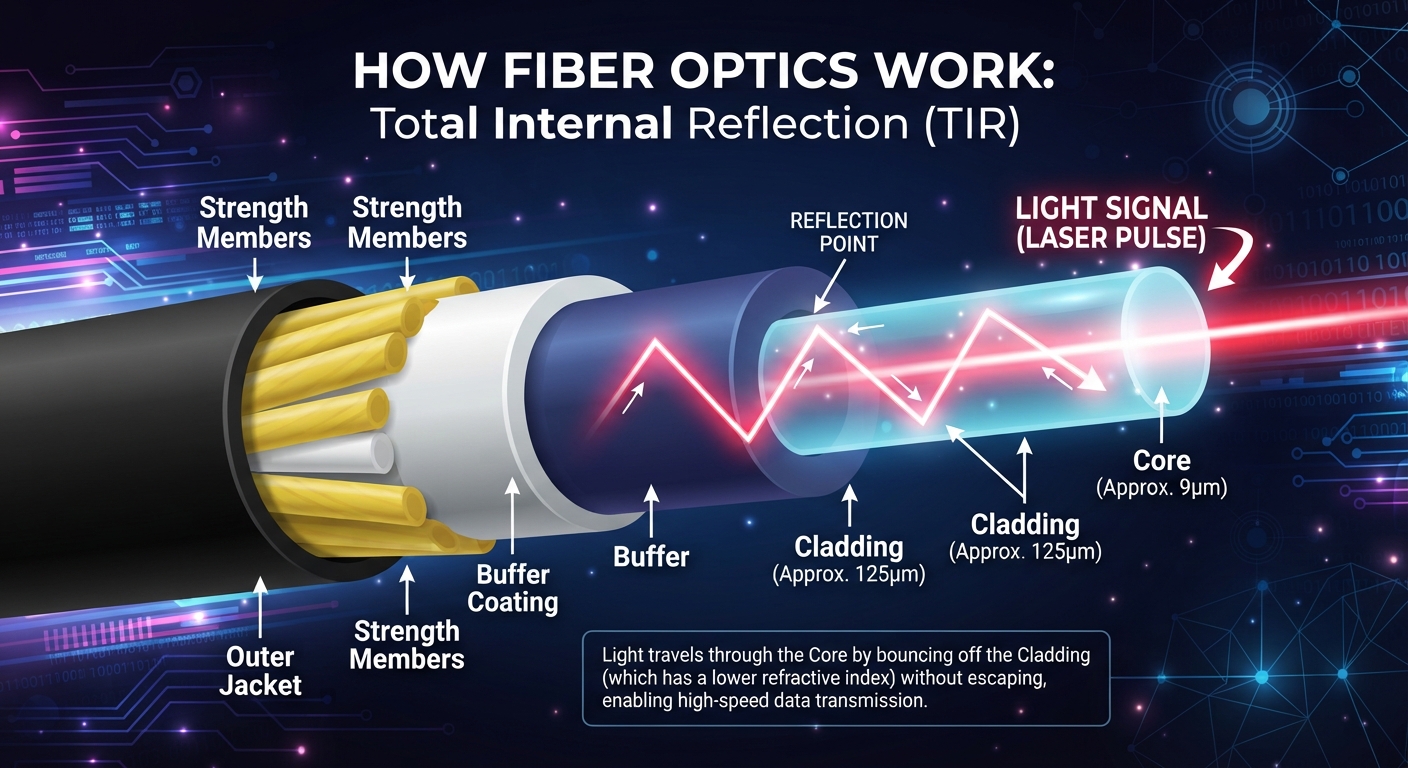
- Total Internal Reflection: The mechanism that keeps light trapped inside a fiber. It requires a high-refractive-index core surrounded by a lower-refractive-index cladding.
- Snell’s Law: Determines the critical angle at which light is totally reflected rather than refracted.
- Rayleigh Scattering: Loss caused by microscopic density fluctuations in the glass; minimized by slow cooling during production.
- Absorption: Signal loss caused by metal impurities (e.g., iron atoms) that absorb photons.
- Doping: The process of adding elements like Titanium or Germanium to the core to precisely increase its refractive index.
- Flame Hydrolysis: A chemical process used to create ultra-pure silica soot for preforms.
- The Preform Process: Creating a large-scale master rod of core/cladding glass, which is then heated and drawn into thin fibers.
Consequences
- Bandwidth Revolution: Enabled the transmission of millions of simultaneous conversations and vast amounts of data.
- Birth of the Modern Internet: The high capacity of fiber optics made the global transmission of images, video, and complex data viable.
- Infrastructure Shift: Replaced expensive and limited copper cabling with higher-performance, more durable glass fibers.
- Digital Transformation: Facilitated the move from analog signals to binary digital pulses (on/off laser flashes).
